Showing posts with label Jane Eyre. Show all posts

Unbound Series by Eve Marie Mont

Monday, April 29, 2013


I was very intrigued by the idea of the Unbound series -- a girl finds herself in the midst of a classic tale. However, this series surprised me by bringing a much more satisfying story to the second book.


In the first book, A Breath of Eyre, Emma, an aspiring writer, finds herself transported multiple times into the world of Jane Eyre while facing her own issues with her mother's death, a classic "mean girls" scenario at her boarding school, and a complicated boy situation. 

Sound like a lot? It is, but Eve Marie Mont almost pulls it off. I really enjoyed the critical analysis of Jane Eyre embedded in the text, and the constant drama of Emma's life kept me intrigued. However, the fact that she had to be in a coma to enter the literary world led to several Bella Swan-esque situations of constant injuries and rescues. A Breath of Eyre was colorful and interesting, but could have done with a bit of tight editing.

3 stars

Warnings: Language, thematic material


However, while I felt a little iffy about A Breath of Eyre, A Touch of Scarlet really impressed me. In this case Emma is back at school after a summer of romance, but her dreams have gone away with the warm weather (cheeeeeese) and she finds herself in a compromising situation that results in a cold freeze from her friends. Meanwhile, she is studying The Scarlet Letter in school and finds herself transported into the novel when she runs.

First of all, Emma's literary travels seem more believable to me in A Touch of Scarlet. She isn't getting struck by lightning and landing in comas. Instead, she is running and entering a trance-like state. It's all fantastical, but in a more believable way. Also, the drama in this book is addictive. There is a lot going on, and I was completely absorbed, dying to find out what happened next. Finally, while Emma did learn lessons in A Breath of Eyre, I found the lessons in A Touch of Scarlet to be much more resonant. 

All in all, the series so far is unique and enjoyable, blending classics, contemporary, historical fiction, and fantasy. I am excited to see what A Phantom Enchantment will bring.

4 stars

Warnings: Same as above
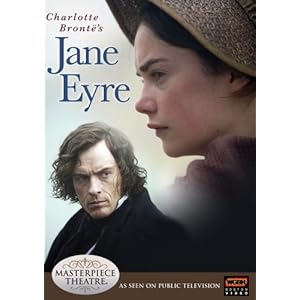
Book to Movie: Jane Eyre (2006 Mini-series)

Thursday, October 20, 2011

While I truly loved Focus Films' adaptation of Jane Eyre, I was sad about a few things that were left out and decided that I wanted to see a more comprehensive production (and, by the way, have you noticed there are approximately 387 productions of Jane Eyre? There is even a musical). So to my beloved Provo Library I went, and I was not disappointed.

Instead of going into in-depth analysis about the quality of the film and the cinematic elements (subjects I know nothing about, other than what pleases my eye and what doesn't), I am going to make for you a lovely little list of things I enjoyed about this movie. It is tied in my affections with the 2011 version, because they are both appealing for different reasons.

1. Lucy Pevensie plays the young Jane Eyre. (Okay, her real name is Georgie Henley). I hadn't seen her in anything but the Narnia films and I think she is adorable. It was nice to see her acting in a new type of role.

2. The gypsy scene is (somewhat) intact. It doesn't follow precisely with the book (AVERT THINE EYES IF YOU WANT TO AVOID SPOILERS) - Mr. Rochester isn't dressed up as the gypsy; he has simply employed her. (SPOILERS END) Although the scene wasn't perfectly faithful to the novel, I do think it is important enough to be included.

3. For frivolity's sake -- I simply can't decide which Mr. Rochester I like better. I was completely taken with the portrayal in the 2011 film by Michael Fassbender, but I think that Toby Stephens may have beaten him out in this film. His emotions are brought wildly to the surface, and we see a bit of the madness that threatens him due to the burden of his wife, although it isn't allowed to take hold. Compare and decide for yourselves, oh readers.
Toby Stephens
Michael Fassbender
4. The veil scene happened, albeit quickly and still not as freakily as I would have hoped.

5. The end scene between Jane and Mr. Rochester was more powerful, I thought, in the 2006 version than in the 2011 version. I was more emotionally moved - I felt that their emotions were stronger and more present. It was honestly one of the more touching scenes I think I've seen in a movie ever.

Granted, there are also aspects of the Focus Films production I preferred. I loved the portrayal of St. John Rivers (although deplored the exclusion of Rosamund) and his sisters. The landscapes were breathtaking. The music was beautiful. And Jane herself was played very well by Mia Wasikowska.

Both films have something to offer is my point I suppose. The 2006 production of Jane Eyre is more thorough and certain scenes have more power, but the new 2011 adaptation is certainly not a film to miss.

Why I Read... Classics (part 1)

Thursday, September 22, 2011

In my mind, there are two denominations of a classic - the typical, traditional classic and the "modern classic." While I don't entirely agree with the term "modern classic" (to me, the term classic indicates the passage of some amount of time and the ability of a work to stand up to that passage of time), it is a genre that I enjoy, so for lack of a better term, I will continue to use it to classify that group of books.

However, for today, I would like to focus on, um, unmodern classics. Which for the purpose of this post, is defined as an old book (before 20th century) that has literary and aesthetic meaning and merit. 

Classics have almost always been a part of my literary diet. Hand in hand with my love of historical fiction, I grew up enjoying "old-fashioned" things. Even more old-fashioned than the stories written about the era after the fact are the stories written right in the thick of things. In elementary school I devoured every volume of the Great Illustrated Classics series that I could get my little hands on. I have no idea if this series is still in print, and unfortunately most of those books that I owned disappeared in a garage sale years ago, but I am definitely hoping that I have access to them once my children are at an age when they are an appropriate reading level. Those books introduced me to the classics and gave me a familiarity with the stories that allowed me to enjoy them later when the language got harder. (I also have to put in a little plug for Wishbone, which gave me that familiarity even earlier than the Great Illustrated Classics). 

My love of the classics in their unabridged form was ongoing throughout high school, interspersed with fantasy and sci fi, but it was intensified my senior year in AP English. Each semester, we were required to choose a classic and do a huge project on it, involving about 20 small 2 page papers and projects. The last two weeks of the semester, we all presented on our projects, aiming to give a familiarity with the canon to everyone in preparation for our AP lit test. I was lucky enough to have two very excellent books suggested to me (The Count of Monte Cristo and East of Eden) and discovered several more in the process of the presentation. Up until the last year or two, my reading was almost exclusively classics from that point. 

Anyway, I'm pontificating overmuch in this introduction. I guess to sum up, if you are even still reading, the classics are a huge part of my life. I love them.

Why I Read Classics

* Timelessness. The reason these stories have lasted is because they tell a story that appeals to many people, or explore a theme that is important across large groups of humanity. These aren't for specialized audiences - these are stories that have touched thousands and millions of people.
* Rich writing. This isn't present in every classic - sometimes the writing is thick rather than rich (now I feel like I'm talking about Yoplait). However, in general classics have beautiful, well-crafted, and sensorily appealing sentences.
* Complexity. Once again, not always the case, but many of the classics I love have many things going on, unfolding slowly over time. Love it. 
* The prestige factor. Mostly kidding. But it does lend a certain sense of pride to have finished some of the more difficult tomes. 

Recommendations

* Jane Eyre by Charlotte Bronte and Wuthering Heights by Emily Bronte - I love the Brontes. Haven't gotten acquainted with Anne yet, but I think that will also be a good experience. These Victorian slightly creepy romances are excellent autumn or winter reads and tell love stories that aren't as simple as love-at-first-sight-then-happily-ever-after. 
* Anne of Green Gables and just about everything else (excepting Jane of Lantern Hill, which I did not like) by L.M. Montgomery. These classics tell simpler stories, but I've never been able to get enough of them. They describe good, simple lives with romance, family, and personal development.
* The Count of Monte Cristo by Alexandre Dumas. Despite the 80-odd pages of history on the Napoleonic wars, this book has a powerful narrative with many intertwining plot lines. If the huge volume intimidates you, read the abridged version. It's better than nothing!
* Middlemarch by George Eliot. This isn't an easy book, but I was swept up by it. Give it a chance and skim the sections on local politics. 

For further recommendations, visit...

Dead White Guys. If you like your classics with a serving of snark, this will be your new home. 
Rebecca Reads.  Thoughtful reviews with a lot of depth. She also runs the Classics Circuit, another great resource for learning about classics in concentrated areas. 
A Room of One's Own - Jillian is one of the most passionate readers I know through the blogiverse. She is dedicatedly becoming well-read, tackling many challenging texts but also many children's classics. 
A Literary Odyssey - Allie is working through a 250-book long list of classics. She works through many of the classics that absolutely intimidate me (namely: the Greeks). Her reviews are personable and informative. 


Quotables: On Marriage

Wednesday, August 24, 2011


(I originally meant to post this last week on my 1st anniversary, August 17th. I ended up running out of time to schedule posts, but couldn't put it on the back burner, so here it is for you a week later).

I have now been married ten years.
I know what it is to live entirely for and with what I love best on earth.
I hold myself supremely blest - blest beyond what language can express; because I am my husband's life as fully as he is mine.
No woman was ever nearer to her mate than I am: ever more absolutely bone of his bone and flesh of his flesh.
I know no weariness of my [husband's] society: he knows none of mine, any more than we each do of the pulsation of the heart that beats in our separate bosoms; consequently, we are ever together.
To be together is for us to be at once as free as in solitude, as gay as in company.
We talk, I believe, all day long: to talk to each other is but a more animated and an audible thinking.
All my confidence is bestowed on him, all his confidence is devoted to me;
we are perfectly suited in character -
perfect concord is the result.

Charlotte Bronte, Jane Eyre

Book to Movie: Jane Eyre (2011)

Saturday, June 25, 2011


I'm always a little worried when I go to a movie made from one of my favorite books, especially when it is a book I have finished recently. If I've put a bit of a time buffer, I am usually not quite so sensitive to the differences as long as they are not too noticeable. However, when they are too close together, I am forced to make comparisons.

Fortunately, with this film version of Jane Eyre, the comparisons were mainly favorable. The film was done by Focus Films, which also did the adaptation of Pride and Prejudice starring Keira Knightley. I know a lot of peopl
e did not enjoy that adaptation because "it left so many things out," but I thought it was exceptionally well done. I think one thing all readers forget when a beloved book comes to the screen is that what makes a good book does not always make a good movie. A director's challenge is to make adjustments so the translation will fit accessibly in a 2 hour time frame. Anyway, like the Focus version of P & P, the scenery and music were hauntingly beautiful. The atmosphere was spooky, giving a very Victorian feel to the film.

I also thought all the acting was excellent. Jane was plain but feisty, and it was delightful to see her as a character instead of just reading her thoughts. I also really enjoyed Jamie Bell as St. John Rivers - his intensity and arrogance were perfect for the character. And oh my goodness, Mr. Rochester... isn't he supposed to not be handsome? I am extremely partial to Mr. Rochester as a character anyway, and by the end of the movie I was obsessed.

There were two significant things left out of the film that made me sad, especially because I thought they were elements that could have transferred very well to film, although they would have made the movie longer, of course. These are spoilers for the film and book, so if you want it to be a surprise, don't read the rest of the paragraph. The gypsy scene, in which Mr. Rochester dresses up like a gypsy and questions all the females of his house, including Blanche Ingram and Jane, was missing. I thought this was the funniest part of the book and really shows Rochester's bizarre personality at its best, so I was very disappointed in missing that one. The other thing they left out was Bertha sneaking into Jane's room and ripping her veil in half. That had the potential to be so spooky, and according to my friend Erin it was a great scene in an earlier film adaptation. I was looking forward to that moment throughout the whole film, and was pretty disappointed when it didn't happen.

However, other than these two missing scenes that I was disappointed in not seeing, I thought Jane Eyre was very well done and a movie I would like to watch again. I also want to track down the other adaptation with the creepy veil scene, because I feel cheated of it in this adaptation. I'm going to close with a picture of Mr. Rochester. You're welcome.

Jane Eyre by Charlotte Bronte

Tuesday, April 26, 2011

Title: Jane Eyre
Author: Charlotte Bronte
Genre: Classic
Published: Originally in 1847 by Smith, Elder & Co.
Source: Personal copy

Most are familiar with the story of Jane Eyre, but for those who are not: A poor orphan girl despised by her immediate relations, Jane spends the early part of her life being tortured by her cousins and displeasing her aunt. Jane's aunt finally decides to send her away to boarding school, where Jane has the opportunity to become more independent. After eight years at Lowood, she decides to strike out on her own as a governess, and is hired at Thornfield. As she gets to know the owner of the mansion, Mr. Rochester, sympathy and friendship develop between them, but Thornfield Hall holds some shocking secrets.

This is my third read of Jane Eyre, and honestly each time I read it I enjoy it more. My first reading was in high school, where I remember liking the story and subsequently forgetting it. Because I forgot it, when I came across the book again in college, I decided to read it again. I enjoyed it even more, but still forgot most of the plot, so when I read it this time around, there were many aspects that seemed new to me. I'm not sure why this particular book doesn't stay in my memory very well, because I do really enjoy it. I am just happy that my book club chose the book for this month's selection so I could have the chance to revisit it yet again.

Jane Eyre is somewhat slow-paced and meditative. The story is told in the first person, something I personally haven't seen much in classic literature, although I have barely scratched the surface of classics and am by no means an authority on the subject. We really are admitted into her thoughts and ruminations on every subject, a process that can be lengthy, but is always interesting. Right now I am reading a book called AfterWord where several authors write imaginary conversations with deceased authors. I would have liked to talk with Charlotte Bronte and find out if she is similar in personality and temperament to Jane, because I don't know how else Jane's voice could seem so real. Jane is very developed - she has her quirks and idiosyncrasies, her likes and dislikes. Her voice is very distinct and full of personality. I loved the descriptions of Jane's fanciful paintings - I think those more than anything showed her personality. I wish I could see them. Aspiring artists - do you think maybe you could reproduce them and have an exhibit of "imagined paintings of Jane Eyre" or something like that? Because that would be awesome.

I also adored Mr. Rochester. He is not your typical Prince Charming - described as ugly, known to have committed some appalling acts (I won't reveal them for those who are not familiar with the story), yet passionate, tender, and delightfully devious. (I think the gypsy scene in the book is absolutely brilliant). I could gush about him, but instead I will refer you to my last blog hop post, where I waxed fan-girly on the subject.

As I participate in the Victorian Literature Challenge, I am starting to gain an appreciation of what Victorian lit really is. I've read a fair amount of it, but I've never studied or really identified it before. This book was fantastically spooky with harrowing descriptions of maniacal laughter and images of frightening scenes, such as bed drapes alight in flame. The genre is appealing to me more and more, and I can't wait to read more of it.

I think Jane Eyre is one of those must-read classics. The writing and characterization is fantastic, and the plot is mysterious and enticing, despite its slow pace.

4 stars

Book Blogger Hop: Characters with Character

Saturday, April 16, 2011

Book Blogger Hop

It's been quite a while since I participated in a blog hop, but I really like the prompt for this hop. It is:

Pick a character from the book you are reading or have just finished and tell us about him/her.

This is an easy choice for me. I am currently reading Jane Eyre by Charlotte Bronte, and am continually impressed by Mr. Rochester. I have read the book twice before, once in high school and once in my freshman year of college, but I feel like I am much better able to appreciate the characters this time around. I also think I have more perspective on his character since reading Wide Sargasso Sea by Jean Rhys, a prequel to Jane Eyre describing Mr. Rochester's courtship and early marriage to Bertha Antoinette Mason.

One thing I have noticed this time around is Mr. Rochester's quirky personality and way of speaking. His mannerisms and quirks ooze around his words, giving me a strong sense of his presence. He speaks in an elaborate, energetic, and lordly way. Two of my favorite excerpts, one kind of self-serving and arrogant, the other romantic and penetrating:

"Justly thought; rightly said, Miss Eyre; and at this moment,k I am paving hell with energy. [...] I am laying down good intentions, which I believe durable as flint."

"Because," he said, "I sometimes have a queer feeling with regard to you - especially when you are near me, as now: it is as if I had a string somewhere under my left ribs, tightly and inextricably knotted to a similar string situated in the corresponding quarter of your little frame. And if that boisterous Channel, and two hundred miles or so of land came broad between us, I am afraid that cord of communion will be snapt; and then I've a nervous notion I should take to bleeding inwardly."

He is passionate in his love for Jane, yet calculating in his means of attaining it, by *SPOILER* dressing up as a fortune teller and demanding the presence of all the women in the house to ascertain Jane's affection and Miss Ingram's mercenary character. *END SPOILER* He indulges in convoluted moral contemplations and then almost commits bigamy. He is complicated; dark and tempestuous, yet loving and tender. I appreciate him for not being the Prince Charming of so many different books, for having a dark past but the capability to enjoy a better future. I love that I can find new things every time I read this book.

Have you read about any interesting characters lately?

Wide Sargasso Sea

Wednesday, November 17, 2010

Wide Sargasso Sea is a spin-off. And we all know how I love spin-offs. That is to say, generally quite well. Better yet, this is a spin-off of Jane Eyre. Who didn't wonder about the mysterious woman in Mr. Rochester's attic and how she came to be there? Jean Rhys conveniently gives us a highly emotional answer.

Antoinette, the woman who becomes Bertha Mason (questions? Yeah, me too. I'll explain in a second) lives in Jamaica shortly after slavery has ended. Her parents were slaveholders, and also her father was perfidious and libidinous (and the father of many others, if you know what I mean), so Antoinette's now-widowed mother, herself, and her disabled brother are the objects of the former slaves' hatred. And because this is Jamaica, the hatred doesn't just results in gossip and dirty looks. It also includes black magic, poison, and violence. And it all occurs in a steaming, dark jungle.

So Antoinette is hated, but also very rich and very beautiful. And Mr. Rochester is in desperate need of money, and new to the area. So he doesn't know about Antoinette's dark past, of which slave-holding relatives are not the only secret. (I.e., hereditary insanity. Fast-forward to the attic).

When I describe this book, I find myself wanting to like it all over again. It has depth and complexity. It is original, and the world Rhys has created is very engrossing. The characters' motives are so convoluted, they themselves don't understand them. They do horrible things to each other without knowing why, and leave it up to us to analyze, How could you possibly do that? I think that is where the book lost its appeal for me. No matter how artistic or beautifully complex, I don't like to read about people destroying each others' lives, at least not without something to redeem our faith in human nature. Because as dark as real life can be, I think there is always something redeeming. But that is a rant for another time.

Anyway, to sum it all up, here are the things I liked:
* I was worried I would hate Mr. Rochester. I didn't. He definitely did terrible things in this story, but it is clear that he is not just a villain.
* I liked that Antoinette's madness was not simply explained by her parents' mental health history. There are many contributing factors, and Rhys leaves it to the reader to decide which factors truly caused Antoinette to leave reality.

Here's what I disliked:
* As aforementioned, the horribleness.
* The narrative was hard to follow, pretty much all the time. It was a little stream-of-conscious-y, and sometimes it was hard to pick up what the narrator left off. Sometimes the narrators randomly changed, without warning. Also, many points in the plot were only insinuated. While I understand that this was probably part of the complexity and darkness surrounding Antoinette's madness, I felt that some things would have been more clear if we had been permitted into the scene, instead of just trying to figure it out from the scattered thoughts of whomever was narrating.
* Mr. Rochester starts calling Antoinette Bertha. What? Ok, so names are a big theme in the novel, and calling Antoinette by Mr. Rochester's favorite lady name is a symbol of how he is trying to turn her into something he wants instead of accepting her for who she is. Still seemed too gimmicky and forced to me. Her name should have just been Bertha in the first place.*

I really wanted to love this book, but I did not. I am sure it is brilliant and everything, but it just didn't win my heart or my mind. Or my enjoyment. Or much else. Although it did win some of my money, because I keep forgetting to take it back to the library. 2.5/5.

*It has been a looong time since I read Jane Eyre, so if her name actually was Antoinette and Mr. Rochester actually did change it, please correct me!
Related Posts Plugin for WordPress, Blogger...