Showing posts with label literary blog hop. Show all posts

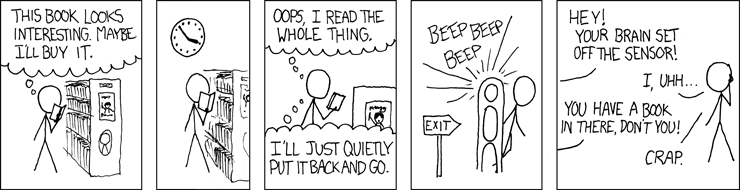
Literary Blog Hop: How do you read so much?

Thursday, March 08, 2012

Literary Blog Hop

I love the question for this month's Literary Blog Hop, hosted by the Blue Bookcase, so I am going to double-post the heck out of today. :)

How do you find time to read, what's your reading style and where do you think reading literature should rank in society's priorities? 

Question 1: How do you find time to read?

I tend to read whenever I am waiting. If I'm standing in a long line, if I'm waiting for my husband to put on his shoes or brush his teeth, if I have an appointment, I will read. I also have a long commute and I ride the bus, so I try to read at that time as well (although I frequently fall asleep). 

Question 2: What's your reading style?

As far as how I read, it is in silence, and often in small slices. I am a big fan of the Pomodoro Technique, where you set a timer for 25 minutes to be productive, then have 5 minutes to relax, then back to the 25 minutes of productivity. My 5 minutes are reading minutes. I don't usually read for hours at a time, because I just don't have those long stretches of time, except occasionally on Sundays and vacations. 

Question 3: Where do you think reading literature should rank in society's priorities?

So here's the thing. I think it is individual. I read quite a bit. I love reading, it is fulfilling for me, and it is an important part of my life. But I don't think it is like that for everyone, or that it should be. I don't expect people to want to spend as much time reading as I do. I will say I think teaching children to enjoy literature and spend time reading and learning is beneficial and should be a high priority, and I have a hard time understanding adults that never read, but in general I think it should be based on individual goals, not what society thinks should be a priority. 

Literary Blog Hop: Literary aliments

Sunday, October 09, 2011

Literary Blog Hop


This week's Literary Blog Hop, hosted by The Blue Bookcase, asks, 


 If you could invite any three literary figures from different eras to a Sunday Dinner who would they be?

Well, I'll tell you. 

First off, I would invite Ernest Hemingway. Because, let's face it, the man was interesting. He loved to tell stories. He was a show off and a man's man. I think he would be a highly entertaining dinner companion.

Secondly, I would have Jane Austen. This is not because I am so obsessed with her books (although I am...) or because I just want to have the chance to fangirl and swoon over her (although I would). She is the first literary figure I thought of after my first choice of Ernest Hemingway popped into my mind, and the simple reason is that I think that Hemingway's boorish ways would absolutely horrify Jane. Can you imagine how appalled she would be? I can picture her writing him up in a future novel, describing his manners and speeches in perfect detail. I'm sure she would toss more than one barbed comment his way, making for a highly entertaining dinner conversation.

Thirdly, I would invite Mira Bartok. Who, as I know, is completely different from the other literary figures I listed. I read Ms. Bartok's book, The Memory Palace, earlier this year and I was so astonished at how interesting and varied her life was. I would love to sit down with her and have a good chat about all of her adventures. Perhaps she would be a good balance for the fiery combination of Hemingway and Austen. 

Who would you invite? 

Literary Blog Hop: Why is this soooo hard?

Sunday, September 11, 2011

It has been ages since I've participated in the Literary Blog Hop, and although I'm a little late in the time frame for this one, I just couldn't resist the question. The ladies at The Blue Bookcase ask:

Must all literary writing be difficult? Can you think of examples of literary writing that were not difficult?

Obviously, this requires a bit of a definition of literary writing. The LBH itself defines literary as a text with aesthetic merit. I would elaborate on that to say perhaps that the text is also meant to do more than entertain. For example, the Sweet Valley Junior High books (which I insatiably devoured, I should add) were not written to illustrate something beautiful or describe part of the human condition that has great meaning. I'm sure the author tried to write them well (I honestly can't remember if she succeeded), but entertainment was her main focus. They came out at the end of every couple of months. They talked about drama and crushes. They were fun, but they were not literary. Does that make sense?

With that said, I don't think literary fiction has to be difficult. I am frequently irritated by people who think that a book must be inaccessible to be literary. I think many of our most inaccessible books are very literary - they are experiments in style, or part of the statement they make is in being different and difficult to digest. However, that is only one side of literariness (I didn't think that was a word and am now very pleased to find that Blogger isn't marking it as misspelled. Now I can use it in good conscience). Honestly, I think it is to the advantage of a literary work to not be too inaccessible - how can it touch people if nobody wants to read it? (Unless perhaps the author is an elitist and shudders at the thought of the uncultured masses enjoying his/her book).

The question is, do these "easy" yet literary works exist? One of the first authors that came to my mind is L.M. Montgomery, the author of the Anne of Green Gables books. These are certainly classics. I'm not sure if everyone would define them as literary because they are written for a young age, but even fifteen years after reading them for the first time I am enchanted by the language and the lovely simplicity of the lifestyle Montgomery creates. I think if they were truly only for entertainment value, the books wouldn't have held up this long.

I also thought of The Secret Garden by Frances Hodgson Burnett, which I have been slowly rereading for a book club. I first read this book when I was very young and had little appreciation for the harmony of a beautiful sentence or a strong truth in literature. However, as I've read the book a few short chapters at a time, I have been taken aback by the elegance of the writing and the humanity of the story. It is so simple a child can read and enjoy it, but it has truths about human nature and love that can evoke emotion in an adult.

So no, I don't think literature has to be hard. I don't discount the literature that is hard, because often the struggle yields a very worthwhile harvest. (Many have referenced their first exposure to Jane Austen and contrasted it to their enjoyment of her work today). But I will never turn up my nose at literature because it is too easy.

Literary Blog Hop: Emotions

Thursday, April 28, 2011

Literary Blog Hop

This week's literary blog hop, hosted at The Blue Bookcase, asks the question:

Discuss your thoughts on sentimentality in literature. When is emotion effective in literature and when is it superfluous? Use examples.

First of all, I want to differentiate between sentimentality and emotion, because for me, there are subtle differences. So I turn to my ever-useful Kindle dictionary for some definitions:

sentimentality: excessive tenderness, sadness, or nostalgia.

emotion: a natural instinctive state of mind deriving from one's circumstances, mood, or relationships with others.

To me, emotion is essential to a story. Why do we tell stories? To entertain and to connect with the human condition. Emotion is essential at least in some degree to make that connection. If we don't have love, anger, hate, sorrow, joy, what does any story matter? One of the first books that came to my mind when I tried to think of literary works that strongly invoke emotion is Of Human Bondage by W. Somerset Maugham. Philip is constantly beset with some sort of emotion
. Initially, he feels shame and sadness because of his club foot. He is rejected by many because of his handicap, which leads to a lifelong sensitivity about his deformity. Another even more prevalent emotion in the book is love and infatuation. Philip falls in love (or lust) with Mildred, a waitress. This emotion plagues him through much of the book as he struggles to forget about Mildred. He also discovers love in other manifestations as he seeks his calling in life.

In this example, both emotion and sentimentality are present. Philip waxes sentimental over Mildred, an insipid, unintelligent woman who nevertheless exercises a powerful influence over him. Another character, Miss Wilkinson, waxes sentimental over Philip and other men she has loved, declaring dramatically, "Men are always the same. You're heartless, all of you."

An example of a book that uses emotion but not sentimentality is The Old Man and the Sea by Ernest Hemingway. The old man, Santiago, experiences emotion throughout the book. He is driven by his loneliness and feeling of uselessness as an old man to fight to catch a huge fish. He is driven by his loneliness and love for his wife to turn her picture down so that he doesn't have to look at it and be reminded. The boy is driven by his love for the old man to help him in any way he can, even
though his parents no longer allow him to fish in the old man's boat due to his unluckiness. The human condition is there, ore else the story wouldn't mean much. Sentimentality, however, is not. The old man does not soliloquize over his loneliness or sob over his wife. The boy, while he does cry at one point in the book, does not act in a dramatic way. He simply feels and allows that emotion expression.

What I'm trying to express is that yes, I do think emotion is essential for a book, or at any rate a work of fiction. Why would we care about a book if it didn't stir something within us? I do not think sentimentality is a necessary ingredient, although I believe it is usually present and can add to the book, whether comedically or simply to manipulate our own emotions. (Ingrid's evaluation of Twilight in this respect was in my opinion right on the ball. It also makes me think of Lauren Oliver - not to say I don't enjoy her work, because I do, but she does twist our heartstrings not just to tell her story but to get a response, I think). I took this in a slightly different direction than the blog hop but I enjoyed the thoughts it generated.

Literary Blog Hop: Last Words

Thursday, March 17, 2011

Literary Blog Hop

Today's literary blog hop, hosted by The Blue Bookcase, asks the question:

What one literary work must you read before you die?

As pointed out by Christina, who answered the question on the hosting site, there are two ways to interpret the question. Which work do I think you should read before you die, and which work should I read before I die?

I think you should read Of Human Bondage by W. Somerset Maugham. This book spoke to me on a level I have rarely experienced with any novel. Philip's romantic struggles, indecision about life decisions, and overall growth as a person were moving and close to my heart.

As for myself, lately I have been thinking a lot about Shakespeare. I made my way through most of his comedies in high school (with limited understanding, I'm afraid) and I want to at some point in the future read everything attributed to him, for a few reasons. First of all, his characters and stories are amazing. Second of all, it is a family rumor that we are related to him. I don't know if this is true or not - I should probably try and figure it out at some point. Third of all, I would just feel very accomplished to have read the complete works of Shakespeare. There was actually a play at the Boise Shakespeare Festival that I went to in middle school called "The Compleat Wks. of Wm. Shakespear" that included references to every play. It was very irreverent and very funny. But I'd like to experience it in the uncondensed version.

What about you? What books do you think I should read before I die?

Haha.

Thursday, March 03, 2011

It is Literary Blog Hop time once again! Hosted by The Blue Bookcase, The Literary Blog Hop is an opportunity for literary book bloggers to answer literary questions about literature. It's all very literary.

Literary Blog Hop

This week's question is from Gilion at Rose City Reader. She poses the question:

Can literature be funny? What is your favorite humorous literary book?

The answer to this question for me is a resounding yes. However, in my mind there are two categories of humor. There is dumb humor, which can be quite hilarious but has no deeper meaning behind it except evoking a laugh.

Then there's this comic, which I think is just generally amusing...


Then there's intelligent humor - humor with a punch behind it. It's funny but it has a point to make. I think a literary character that exemplifies this humor is Mercutio of Shakespeare's Romeo and Juliet. He is constantly making puns and jokes throughout the play, even as he lies dying ("Ask for me tomorrow, and you shall find me a grave man") but his jokes often have a barb of truth to them. Yes, he makes us laugh, but he also makes us pay attention.

Another example that I've recently discovered is my dear Mr. Charles Dickens, who I hated all through middle school and high school and finally picked up last month. I would find myself laughing aloud at Oliver Twist in public places, and then being appalled that I was laughing. Mr. Dickens was poking fun at poor, pure, innocent little Oliver and making light of the villains who made his life difficult, but he phrased those situations in such wry, subtle words that they seemed ridiculous even while being heart-wrenching. My favorite character was the pompous and awful Mr. Bumble, and my favorite quote is this passage about his wife crying -
But tears were not the things to find their way to Mr. Bumble's soul; his heart was waterproof. Like washable beaver hats that improve with rain, his nerves were rendered stouter and more vigorous, by showers of tears, which, being tokens of weakness, and so far tacit admissions of his own power, pleased and exalted him. He eyed his good lady with looks of great satisfaction, and begged, in an encouraging manner, that she should cry her hardest: the exercise being looked upon, by the faculty, as strongly conducive to health. 'It opens the lungs, washes the countenance, exercises the eyes, and softens down the temper,' said Mr. Bumble. 'So cry away.'
What a jerk, right? But very witty.

I also enjoyed this very true evaluation of a good sense of humor in The Age of Innocence by Edith Wharton:

She had a sense of humor (chiefly proved by her laughing at HIS jokes).

Isn't that the truth? Anyway, my point is, literature can be funny, and I think it is often better for it. What about you? Any favorite funny literature?

Literary Blog Hop: Required Reading

Thursday, January 20, 2011

Literary Blog Hop

The Literary Blog Hop is hosted by The Blue Bookcase. This week's question comes from Ingrid:

Discuss a work of literary merit that you hated when you were made to read it in school or university. Why did you dislike it?

To be honest, I really enjoyed most things I read for school. Especially when I was younger, I would read almost anything in print (I learned how babies were made because I was reading my mom's parenting magazine) and so I usually didn't have a problem with my school assignments. However, I do remember really hating The Crucible by Arthur Miller when I read it in 11th grade English. Looking back on it now, I'm not sure why I didn't get along with it. I think generally, I just found it to be depressing. Also, I'm not a huge fan of reading plays (although I will always make an exception for Mr. Shakespeare). I looked up some quotes online, trying to find what bothered me so much about The Crucible, but I liked the quotes I found, so maybe the overall feeling of the story was just a little dark for me.

I also have never been a huge fan of
The Odyssey. I never hated it - I think the story is really interesting. However, I have never enjoyed muddling through Homer's prose. I don't know if I didn't have a good translation or if I'm just lazy. Also, I had to read The Odyssey for multiple classes, so by the 2nd and 3rd times I was so sick of it.

How about you? Any literary works you loathed in school? Do you think being required to read a book makes you more likely to dislike it?

PS: Does anyone else have trouble with the fonts on blogger? If I change the font, I can never get it to go back to normal!

Literary Blog Hop: Beginnings

Thursday, January 06, 2011

Literary Blog Hop

It's time again for the Literary Blog Hop hosted by The Blue Bookcase. This week's question comes from Debbie at Reader Buzz:

How did you find your way to reading literary fiction and nonfiction?

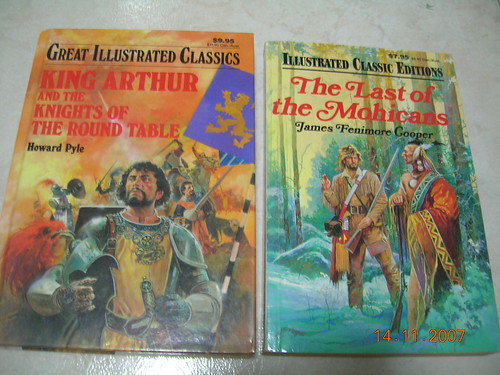
I find myself truly appreciating this question, because I've never thought about what caused me to start reading literary fiction and nonfiction. I have been a bookworm since I started to read - I didn't learn until the end of kindergarten but immediately started reading chapter books. I was a big fan of Nancy Drew and the Babysitter's Club in those days, but I do remember devouring the Great Illustrated Classics books as well. I think my real first brush with the classics came about as a result of the Accelerated Reader program. All the books in my elementary school library had difficulty levels and points assigned to them, and we were required to take quizzes on the books to attain specific point levels. I am a pretty competitive person, and when rumors of high level books (Little Women and Gone With the Wind are the ones I remember) I turned to those because the Great Illustrated Classics didn't count. (Although I do remember having my points revoked when I tried to take the Little Women quiz having just read the abridged version).

So Accelerated Reader probably gave me my first little introduction to classics. However, my grandma also encouraged me to read quality literature. She would buy me books at garage sales and give me books for my birthday. She also had a good friend who was a voracious reader, and that lady would recommend books that my grandma would pass on to me.

Despite my interest in the classics, I was a pretty devoted sci-fi/fantasy reader until high school. I still like the occasional sci-fi/fantasy novel, although after reading 20-30, they all started to sound the same to me. In my English classes in high school, I was again exposed to many classics I had never heard of. In one class, we were required to pick one book for each semester and do about 10 projects on it. I decided to read The Count of Monte Cristo by Alexandre Dumas and East of Eden by John Steinbeck. Getting fully involved in these books showed me how rewarding the classics could be. I fell in love with the complexity of the plots and characters. Character driven novels are much more rewarding for me than plot driven novels, and I found more of what I was looking for in the classics. For a few years, into college, I almost exclusively read classics (although I made an exception for Harry Potter and Twilight!)

I have only recently begun reading mainstream, modern literary fiction. I think my first discoveries of more recent books happened in France, where I fell in with a wonderful little bookstore that sold only English books and French books translated from English books. I attempted to talk about literature in French with the owner, and he recommended several books to me. And thus my journey into literary fiction commenced. Hooray!

Literary Blog Hop: Underappreciated

Thursday, December 23, 2010

Literary Blog Hop

I am so glad the LBH (hosted by The Blue Bookcase) is back this week! I love the opportunity to have some good discussion on the blog. This week's question is:

What literary title (fiction or nonfiction) that you love has been underappreciated? We all know about the latest Dan Brown, and James Patterson isn't hurting for publicity. What quiet masterpiece do you want more readers to know?

Honestly, there are probably quite a few books that I could list here, but there are two in particular that are popping into my head. The first is The Bean Trees, which I actually reviewed a few days ago. It is by Barbara Kingsolver, and while I know that she is a very popular writer, I'd never heard of this book until I picked it up for the Birth Year Challenge. It is one of my favorite books that I have read this year - the writing is beautiful, the plot is engaging, and by the end I felt like the characters were my best friends. I definitely think more people should be reading this book.

Another book that I think is underappreciated is my favorite, Kartography by Kamila Shamsie. (I have also blogged about this one before, in the very first literary blog hop!) I read this book for the first time in high school and it completely won me over. I think what I loved the most about it were the relationships. In high school I always wished that I had that "boy next door" best friend that I would eventually fall in love with and we would know everything about each other, blah blah blah (there were no boys in my neighborhood, just little kids and retired people). Anyway, this story displays the best and also the weirdest version of that relationship I've ever read about. And the other friendships surrounding the central pair were also so amazing - they were both typical of high school friendships and also different due to the strange dynamics of the political situation in Karachi. Anyway, I could go on about this book all day. Now that I look back on it after several rereads, I realize it is not a perfect book - but I am still in love with it. The only people I know that have read it are people I lent it to, so I think more people should try it out. Shamsie's other works are also fantastic - her most recent and publicized, Burnt Shadows, is the most well known but is my least favorite. Her writing is beautiful and engaging and her stories are unique. Anyway, enough ranting.

What are some of your unsung favorites? I have a feeling this hop is going to do disastrous things to the good ol' TBR.

Literary Blog Hop: Arrrgh

Thursday, December 09, 2010

No, it's not about pirates.

Literary Blog Hop

This week's literary blog hop, hosted by The Blue Bookcase, asks the question:

What is one of your literary pet peeves? Is there something that writers do that really sets your teeth on edge? Be specific, and give examples if you can

To be honest, I don't have a lot of literary pet peeves. There are stories that bother me, or thematic material that bothers me, but not usually literary devices that bother me, if that makes sense. Although if I see affect and effect misused, a vein in my forehead usually starts throbbing.

Probably the thing that has bothered me the most in the past is when a novel turns into a history lecture. You know, you're getting involved with the characters and the plot and loving every minute when you're suddenly thrust into an 80 page monologue about Napoleon. Which is nice, if you're wondering about Napoleon. But I'm usually not.

Don't get me wrong. I like history and I like context. I have noticed on others' posts on this topic that long descriptive passages are a common pet peeve of others. I am actually not this way - I love descriptions of settings and people and long detours into what they're thinking. But I don't like when the history goes on and on.

The two novels I've really experienced this with were Les Miserables by Victor Hugo and The Count of Monte Cristo by Alexandre Dumas. I really loved both of these books, so this pet peeve doesn't completely turn me off. I've even been thinking maybe I should reread those passages to increase my knowledge of history. BUT I don't think they belong right in the way of the narrative.

For some reason I can't get the blue highlighting out of the way from Christina's prompt. Oh well, consider it decorative.

A Weakness for Poetry

Thursday, December 02, 2010

Literary Blog Hop

I am weak, guys... I told myself, I cannot post on my blog today until I have done aaaaalll my homework. With finals week around the corner, I am swamped in "midterms" (whoever thought to call them midterms at the tail-end of the semester...) and final papers. But when I did my morning email-checking/blog-reading, I just couldn't resist this hop any longer. Because I love poetry.

(The literary blog hop is hosted by The Blue Bookcase, who are fabulous. This week's question is by Parrish Lantern - likewise fabulous.)

The question, as you can guess, is about poetry -

What is your favorite poem and why?

I don't know much about poetry, about the techniques and forms etc etc. But I love the flow of a poem, especially the way it concentrates emotions into tiny images that last in your brain because the words are more like a song than everyday prose. With that said, I can only handle poetry in small doses. I like short(ish) poems, and I can't read a volume of poetry at once. That is why I try to read just one poem a day - then I can savor it and remember it if I loved it.

I like many different poems for different reasons, but the poem that stands out in my mind the most is "The Love Song of J. Alfred Prufrock" by T.S. Eliot. My first exposure to the poem was before I ever read it, in the novel Salt and Saffron by my favorite author, Kamila Shamsie. The main character of the book meets a mysterious, estranged relative, and the first words this relative speaks are "Cigarettes are to me what coffee spoons were to Prufrock." (pg. 27) The character, and I, wondered who Prufrock was. I figured it was some cultured thing I would eventually learn in college. Yup. In Humanities 202 I was finally exposed to Prufrock - the sad, self-conscious, lovesick, balding man who spends his love song moaning about himself, not expounding on his beloved.

In the class discussion on this poem, most people, including the professor, expressed annoyance with Prufrock because he was self-centered, annoying, and whiny. However, I think if we get past that image of this bald, whining man, we get to a person who wants love desperately and doesn't know how to deserve it. I think we have all been that person at some point in our lives, whether we were balding, lonely old man or an angsty high school girl crushing on the boy who won't look her direction. It is hard to learn that the mermaids will not sing for you.

But Prufrock wants to sing now, so I'll let him take over:


Let us go then, you and I,
When the evening is spread out against the sky
Like a patient etherized upon a table;
Let us go, through certain half-deserted streets,
The muttering retreats
Of restless nights in one-night cheap hotels
And sawdust restaurants with oyster-shells:
Streets that follow like a tedious argument
Of insidious intent
To lead you to an overwhelming question. . .
Oh, do not ask, "What is it?"
Let us go and make our visit.

In the room the women come and go
Talking of Michelangelo.

The yellow fog that rubs its back upon the window-panes
The yellow smoke that rubs its muzzle on the window-panes
Licked its tongue into the corners of the evening
Lingered upon the pools that stand in drains,
Let fall upon its back the soot that falls from chimneys,
Slipped by the terrace, made a sudden leap, 20
And seeing that it was a soft October night
Curled once about the house, and fell asleep.

And indeed there will be time
For the yellow smoke that slides along the street,
Rubbing its back upon the window-panes;
There will be time, there will be time
To prepare a face to meet the faces that you meet;
There will be time to murder and create,
And time for all the works and days of hands
That lift and drop a question on your plate;
Time for you and time for me,
And time yet for a hundred indecisions
And for a hundred visions and revisions
Before the taking of a toast and tea.

In the room the women come and go
Talking of Michelangelo.

And indeed there will be time
To wonder, "Do I dare?" and, "Do I dare?"
Time to turn back and descend the stair,
With a bald spot in the middle of my hair—
[They will say: "How his hair is growing thin!"]
My morning coat, my collar mounting firmly to the chin,
My necktie rich and modest, but asserted by a simple pin—
[They will say: "But how his arms and legs are thin!"]
Do I dare
Disturb the universe?
In a minute there is time
For decisions and revisions which a minute will reverse.

For I have known them all already, known them all;
Have known the evenings, mornings, afternoons,
I have measured out my life with coffee spoons;
I know the voices dying with a dying fall
Beneath the music from a farther room.
So how should I presume?

And I have known the eyes already, known them all—
The eyes that fix you in a formulated phrase,
And when I am formulated, sprawling on a pin,
When I am pinned and wriggling on the wall,
Then how should I begin
To spit out all the butt-ends of my days and ways? 60
And how should I presume?

And I have known the arms already, known them all—
Arms that are braceleted and white and bare
[But in the lamplight, downed with light brown hair!]
Is it perfume from a dress
That makes me so digress?
Arms that lie along a table, or wrap about a shawl.
And should I then presume?
And how should I begin?
. . . . .

Shall I say, I have gone at dusk through narrow streets
And watched the smoke that rises from the pipes
Of lonely men in shirt-sleeves, leaning out of windows? . . .

I should have been a pair of ragged claws
Scuttling across the floors of silent seas.
. . . . .

And the afternoon, the evening, sleeps so peacefully!
Smoothed by long fingers,
Asleep . . . tired . . . or it malingers,
Stretched on the floor, here beside you and me.
Should I, after tea and cakes and ices,
Have the strength to force the moment to its crisis?
But though I have wept and fasted, wept and prayed,
Though I have seen my head (grown slightly bald) brought in upon a platter,
I am no prophet–and here's no great matter;
I have seen the moment of my greatness flicker,
And I have seen the eternal Footman hold my coat, and snicker,
And in short, I was afraid.

And would it have been worth it, after all,
After the cups, the marmalade, the tea,
Among the porcelain, among some talk of you and me,
Would it have been worth while,
To have bitten off the matter with a smile,
To have squeezed the universe into a ball
To roll it toward some overwhelming question,
To say: "I am Lazarus, come from the dead,
Come back to tell you all, I shall tell you all"
If one, settling a pillow by her head,
Should say, "That is not what I meant at all.
That is not it, at all."

And would it have been worth it, after all,
Would it have been worth while,
After the sunsets and the dooryards and the sprinkled streets,
After the novels, after the teacups, after the skirts that trail along the floor—
And this, and so much more?—
It is impossible to say just what I mean!
But as if a magic lantern threw the nerves in patterns on a screen:
Would it have been worth while
If one, settling a pillow or throwing off a shawl,
And turning toward the window, should say:
"That is not it at all,
That is not what I meant, at all."
. . . . .

No! I am not Prince Hamlet, nor was meant to be;
Am an attendant lord, one that will do
To swell a progress, start a scene or two
Advise the prince; no doubt, an easy tool,
Deferential, glad to be of use,
Politic, cautious, and meticulous;
Full of high sentence, but a bit obtuse;
At times, indeed, almost ridiculous—
Almost, at times, the Fool.

I grow old . . . I grow old . . .
I shall wear the bottoms of my trousers rolled.

Shall I part my hair behind? Do I dare to eat a peach?
I shall wear white flannel trousers, and walk upon the beach.
I have heard the mermaids singing, each to each.

I do not think they will sing to me.

I have seen them riding seaward on the waves
Combing the white hair of the waves blown back
When the wind blows the water white and black.

We have lingered in the chambers of the sea
By sea-girls wreathed with seaweed red and brown
Till human voices wake us, and we drown.

One more thing - I wonder who J. Alfred Prufrock really was. I wonder how T.S. Eliot really knew him. And (cue Dashboard Confessional lyrics right now) does he ever get the girl?


Literary Hop: Timeless

Thursday, November 25, 2010

Happy Thanksgiving everyone! Before I get to the Hop, I want to express thanks for a few things. First of all, I am thankful to have made it home! We were caught in a blizzard in southern Idaho that turned a 6 hour drive into 10, but we made it safely. I am very thankful to have made it home.

Second, I am grateful for you! Thank you for reading my blog. I read and appreciate every comment, and those of you who have blogs, I really enjoy perusing your blogs and finding new books to read. I am new to the world of book blogging and it has been great to have some readers so early in the game.

Third, I am thankful for The Blue Bookcase for hosting the Literary Blog Hop! I like thinking about these questions and reading the perspectives of others. And with that...

Literary Blog Hop

This week's question is...

What makes a contemporary novel a classic?
Discuss a book which you think fits the category of ‘modern classics’ and explain why.


Honestly, I don't think contemporary novels are classics (yet). They haven't had the opportunity to prove themselves. I guess I probably should define what "classic" is in my opinion. I think classics are well-written novels with universal themes that are relevant for most people. Classics also need to have more staying power than the New York Times Bestseller list. I've had a teacher require that we use books written before 1950 for a classics project. While I don't think the date is set in stone, I do think if a book sticks around for more than fifty years, it has some staying power and one would hope some beautiful writing as well.

While I don't think contemporary novels have reached the lofty goal of classic-hood, it is fun to guess which books will last and be read by my grandchildren in high school. I'll bet Twilight will have disappeared by then, and as much as I love The Hunger Games, I think that fad will probably be over as well. I think a novel I have recently read that does have a chance is The Road by Cormac McCarthy. The Road takes some common problems - are we running the world down, can "the center hold" - and transforms it into our worst nightmare. I think that will resonate with future generations as well as ours. It interweaves these external issues with an internal question that I think resonates with all humanity - What is morality and can it change with circumstance? Add the emotional ties between father and son, some good writing and originality, and simmer for twenty-five to fifty years. (It doesn't hurt that The Road has a nice, shiny Pulitzer to its credit, either). Voila! Classic.

What do you think? Do you have any ideas on some of our contemporary "classics" that will last through the ages?

Literary Hop: Nonfiction

Thursday, November 18, 2010

Literary Blog Hop

This week's literary blog hop poses the question

Is there such a thing as literary non-fiction? If so, how do you define it? Examples?

I have been excited to answer this question since I read it this morning. I love nonfiction. And I would say that much of it is literary.

Consider this quote by Ramon y Cajal, a pioneer in neuroscience (he diagrammed these beautiful dendritic processes from what he observed under his microscope)

"What mysterious forces precede the appearance of these processes... promote their growth and ramification... and finally establish those protoplasmic kisses... which seem to constitute the final ecstasy in an epic love story." (quoted from Kandel's Principles of Neural Science, pg. 1068). (This is in reference to neuronal processes finding their synapses)

In general I wouldn't consider a neuro textbook to be literary (try reading one of those things), but I love that quote and I think it demonstrates that literariness, in the sense defined on The Blue Bookcase (basically, demonstrating aesthetics and not simply entertainment or information) can appear in unexpected places.

But moving on from that, I have read many nonfiction books that are literary (and a few that are not... I am specifically remembering Charlotte Church's autobiography, Voice of an Angel). One of the first nonfiction books I read for pleasure was a collection of essays by Joan Didion that I found in my AP English teacher's bookshelf in high school (the same teacher of "abandon hope all ye who enter here"). I don't even remember the title of the book, and I can't find the cover on Amazon. However, I remember being moved by the poignancy of her writing and the people she described. Many of the essays described drug dens, poverty, hippies, things I hadn't encountered in my small, conservative, well-off town. She pulled me into that world with words that I would never have experienced otherwise, and it was all the more moving for me because it was true.

Currently I am reading a biography of John Adams. (It was due yesterday, so hopefully I will have it finished and reviewed in the next few days). Not all biographies are literary or enjoyable. I have very little patience for the ones that are so stuffed with facts and dates that everything begins to run together. However, this biography reads almost like a novel, not because the writer sensationalizes or invents but because John Adams' life is written with skill. McCullough, the writer, does not simply relay facts - he illustrates, brings to life, illuminates. He presents the facts in a way that makes me feel as if he were telling me conversationally about his grandfather. This is probably why McCullough has won the Pulitzer for another of his books, Truman.

There are several non-fiction books I am hoping to read soon. The number one on my list is The Emperor of All Maladies by Siddhartha Mukherjee. It is about cancer - its history, treatments, and people whose lives have been affected by it. I read a glowing review of it yesterday which made me even more excited to read it. Hopefully I will get my hands on it soon!

What about you? Do you like nonfiction? What do you like/dislike about it?

The literary blog hop is hosted by The Blue Bookcase. Thanks for a great prompt this week!

Hop hop hop hop hop

Friday, November 12, 2010


Do you ever have those days where you are just absolutely, inexplicably exhausted? I am having one of those days. Probably because I stayed up til midnight watching Slumdog Millionaire with my sister... I am an early to bed, early to rise kind of girl usually. Which is why I am wearing a sweatshirt and blogging instead of making use of my free hour to study for my upcoming exams.

But anyway... It's time for the 2nd literary blog hop. :)
This week's question is:

What is the most difficult literary work you've ever read? What made it so difficult?

This is a difficult question for me to answer. I am not sure if I have just not read very many hard books, or if I am just prone to liking everything so I don't consider it "difficult," because to me "difficult" has a more negative connotation.

I would definitely say Les Miserables was one of the more difficult books I read for a few reasons. (1), it's length. (2), my age when I read it (I can't remember for sure but I think I was in middle school). And (3), the interminable chapters about Napoleon. I really feel as if I should go back and read the unabridged version again so that I can learn more about Napoleon, but part of me wonders if I would just do the exact same thing and shamelessly skim again.

But with that said, I loved the book. I would read it again, and probably will someday.

The most difficult book I never read is Tale of Two Cities. I do not even remember all the times I have tried to start that book, but I will relay just a few for you.

Encounter 1: I heard of it in a short story I read in American Girl magazine when I was 9 or 10 (did any of you read this magazine? It has such good childhood memories!). The book was described as "a bit difficult, but a lovely story" so I immediately assumed I should read it. I read about one page and then gave up.

Encounter 2: Remembering that I gave up when I was younger, in middle school I decided to try again. I checked it out from the library, along with several other books. When I was in middle school, my friends and I always met in the back corner of the library to hang out, so I was always noticing new books to read. I remember reading the first line and thinking, "This sounds really great. I should definitely try to read it again." But the other books (i.e. Tamora Pierce) were easier and I returned the book unread.

Encounter 3: I found a worn out copy in one of my family's sheds. (Note about my dad: He is a crazy outdoorsman and he has a new hobby every few months. This has led to many sheds full of many hobbies. Examples include making bows and killing bears with them, motorcycles, wood carving, etc. This variety of hobbies has also led my dad to be fairly well read. He reads books and then gives them away, or I find them in canoes or toolboxes, etc.). Anyway, I found this book in a tent or something and thought, I should definitely read this. If my dad read it, I can talk to him about it. But he gave it away or threw it away shortly thereafter, and I never got a hold of it.

Encounter 4: I thought for sure I would read it this time. I was going to France, so I decided I needed some things to read on the plane trip and in the parks (bien sur!!). I went to the classics bargain books section of the university bookstore and picked out The Scarlet Pimpernel and The Hunchback of Notre Dame. Then Tale of Two Cities caught my eye and I thought, Why not? I'll try it again. I got through three pages.

Why is it I can't get through this book? Has anyone else had trouble with it? I was talking to my very intelligent friend Sam about it and he said, "Are you kidding me? That's the easy one!" Thanks, Samuel. I really hope someday to read this book. Maybe I'll be old enough for it in 20 years.

Literary Blog Hop

Friday, November 05, 2010


A new blog hop is being hosted this week by The Blue Bookcase that I think is right up my alley. This blog hop is for "literary" blogs, or in other words, blogs that focus on the aesthetic quality of a work as well as the narrative quality. While I do review the odd fantasy novel here and there, in general my enjoyment of a book is directly related to its aesthetic value, so I would say The Story Girl would qualify.

This week's prompt is:
Please highlight one of your favorite books and why you would consider it "literary."

My favorite book of all time is Kartography by Kamila Shamsie. The book has two stories in counterpoint - one, the story of two engaged couples who begin the civil war of 1971 engaged to one person and finish it engaged to the other, and two, the friendship of their children, Raheen and Karim, and the way their relationship is tested by the still ongoing ramifications of that war and their parents' choices during that war.

This book isn't very well known. The only people I know who have read it did so at my recommendation. However, I think this is definitely an example of a literary novel. The beauty of the writing is indisputable. Here is an example of a passage I love:

'Jake came to stand beside me as I gently squeezed the ink cartridge and a rain drop turned blue.

'"You really have this ability to find beauty in weird places."

'There was a tone of reconciliation in his voice, but when he had said it was over between us my heart had lurched ever so slightly, and if we were to stay together now perhaps it would lurch even more next week, next month, or whenever that inevitable ending came.' (p. 108) (And no worries, this is not a spoiler. Jake is not a significant character).

Another reason I think Kartography is literary is because the story is focused on the relationships between the characters. They must learn to forgive, accept, and love despite their frailties, betrayals, and mistakes. I think this novel portrays the real way relationships work, with their flaws and complexity, rather than dropping the story at happily ever after.

I hope this qualifies as a literary blog. I have had a harder time finding literary blogs, as it seems that there are abundant paranormal romance blogs, so I look forward to finding great blogs to read through this hop.

Related Posts Plugin for WordPress, Blogger...