Showing posts with label john steinbeck. Show all posts

A Classics Challenge: November meme

Tuesday, November 27, 2012


Here is the question for November for November's Autumn's A Classics Challenge:
Of all the Classics you've read this year is there an author or movement that has become your new favorite? Which book did you enjoy the most? Or were baffled by? Who's the best character? The most exasperating? From reading other participants' posts which book do you plan to read and are most intrigued by?
To tell you the truth, I think the most enjoyable classic for me this year has been East of Eden by John Steinbeck. This is actually a reread for me, but going through it a second time (and having someone with whom I could discuss it, my husband, who also recently reread the book) made it an extremely rewarding experience. I've always loved John Steinbeck (Okay, maybe not always -- the first book I read by him was The Pearl, which I loathed, but that was when I was 15 and I don't think it counts), but I gained a new appreciation for his work this time around. I've also recently finished Journal of a Novel, which consists of letters John Steinbeck wrote to his editor while working on the novel, which further increased my appreciation.

I think one book I would really like to read from seeing others' posts this year is A Room With a View by E.M. Forster. I can't remember if it was this challenge specifically that has introduced me to it, but I've seen many posts about it this year and I am hoping to get to it soon. 

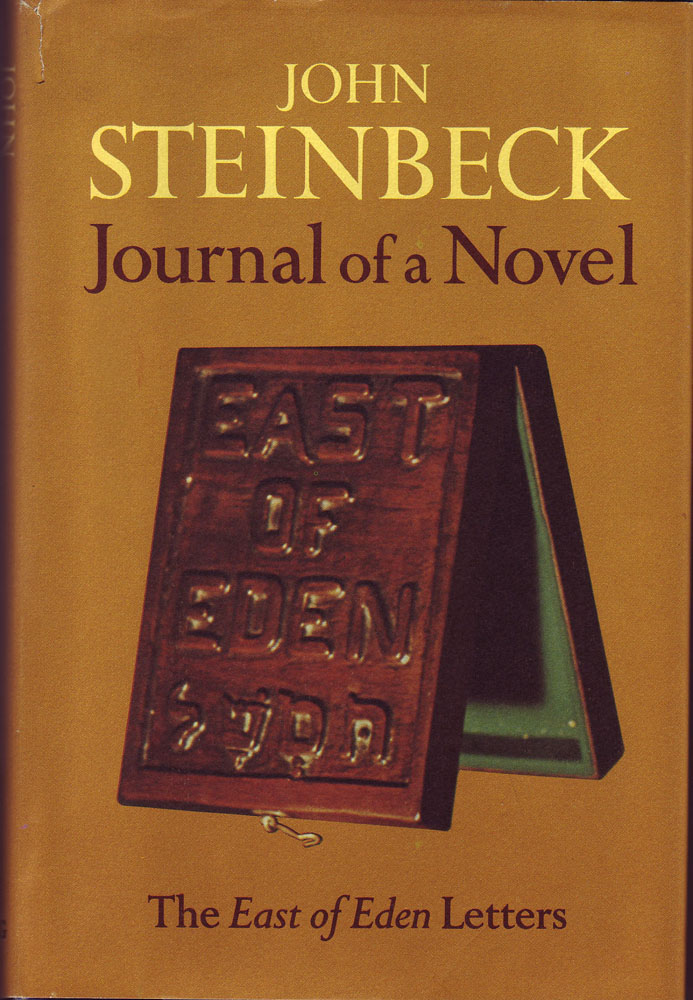
Journal of a Novel: The East of Eden Letters by John Steinbeck

Friday, November 16, 2012

Title: Journal of a Novel: The East of Eden Letters
Author: John Steinbeck
Genre: Nonfiction, memoir
Publisher: Penguin Books, 1990 (obviously written before that)
Source: Library
Read for: Fun

It is a well-known fact on this blog that I love John Steinbeck's East of Eden. When my friend Allison told me about this book, which consists of letters Steinbeck wrote on alternating pages with his manuscript for the novel, I knew I needed to get my hands on it. I wasn't sorry that I did -- Journal of a Novel gave me great insights into both East of Eden and John Steinbeck himself.

One of the first things I noticed was that, despite the fact that the letters Steinbeck wrote were just warm-ups for his daily novel writing, he still writes so well. His writing style has always been incredibly poignant and powerful for me, and that didn't change in the unpolished East of Eden letters.

I also loved having Steinbeck's thoughts about his own characters. For example, the Hamilton family, who are juxtaposed against the main characters the Trasks throughout the novel. I assumed the Hamiltons were at least partially inspired by people from Steinbeck's life, as he referenced his own mother a few times, but I assumed that they were mostly fictional. From Journal of a Novel, I learned that almost everything about them in the novel (aside from their interactions with fictional characters) was true. I also enjoyed reading Steinbeck's reasons for including the Hamiltons in the novel, as well as his reasons for many other of the decisions he made with the novel.

I think my favorite part, however, was getting to know Steinbeck better as an individual. I loved some of his little observations on life, his obsession with having the perfect pencil (and thus needing his electric pencil sharpener to always be in perfect working order), his desire to constantly be inventing and carving things. In many ways I felt that Steinbeck was a kindred spirit for me, such as his descriptions of the way things of the heart are unknowable to other people (something he explored quite a bit in The Winter of Our Discontent) and his complete and utter inability to relax (me too, Steinbeck! me too!). Having that added insight into his personality will, I think, help me to appreciate his work even more.

Anyone who has read East of Eden and wants to explore it further will benefit from Journal of a Novel. It will also bring great insight into (in my opinion) America's great author. Journal of a Novel was a fascinating journey into Steinbeck's mind and the background of East of Eden.

4 stars

Warnings: Mild language, spoilers for East of Eden (obvs)

Spiritual Sundays: Agency in Literature

Sunday, October 21, 2012


It has been a long time since I've written a "Spiritual Sundays" post, but lately some of the concepts I've been coming across in books I've been reading spurred the desire to write this post. 

My entire life, I've been taught the importance of the concept of "agency." My church's definition of agency is: 
Agency is the ability and privilege God gives us to choose and to act for ourselves. Agency is essential in the plan of salvation. Without agency, we would not be able to learn or progress or follow the Savior. With it, we are “free to choose liberty and eternal life, through the great Mediator of all men, or to choose captivity and death, according to the captivity and power of the devil” (2 Nephi 2:27).
So basically, agency is the principle that all people on earth have the right and the ability to make their own choices. Those choices come with consequences, whether positive or negative, but the choice is always present. I grew up being taught that agency was one of the most important gifts from God to humankind -- without it, our actions would be meaningless. (Boethius explores the idea of agency vs. fate/foreordination quite a bit in his Consolation of Philosophy, which I read in college, but I can't remember what his conclusions were... just thought I'd throw that fact in there while we were talking about agency). 

So what does this have to do with literature? Well, in the last few weeks I read two different passages in two different books that illustrated this principle, and I just wanted to bring them together because I thought it was really interesting and beautiful that a concept that I believe is an absolute truth was showing up multiple times in the books I was reading. 

The first passage is from The Giver. In this book, the protagonists live in a society where agency has been taken away. Everything is organized and set up so that people live perfectly happy, easy lives. However, there is a complete lack of emotion and meaning to these peoples' lives, and the protagonist, Jonah, realizes this:
‘But now that I can see colors, at least sometimes, I was just thinking: what if we could hold up things that were bright red, or bright yellow, and he could choose? Instead of the Sameness.’
            ‘He might make wrong choices.’
            ‘Oh.’ Jonas was silent for a minute. ‘Oh, I see what you mean. It wouldn’t matter for a newchild’s toy. But later it does matter, doesn’t it? We don’t dare to let people make choices of their own.’
            ‘Not safe?’ The Giver suggested.
            ‘Definitely not safe,’ Jonas said with certainty. ‘What if they were allowed to choose their own mate? And chose wrong?
            'Or what if,’ he went on, almost laughing at the absurdity, ‘they chose their own jobs?
            ‘Frightening, isn’t it?’ The Giver said.
            Jonas chuckled. ‘Very frightening. I can’t even imagine it. We really have to protect people from wrong choices.’
            ‘It’s safer.’
            ‘Yes,’ Jonas agreed. ‘Much safer.’
            But when the conversation turned to other things, Jonas was left, still, with a feeling of frustration that he didn’t understand.
I found this passage so interesting, because we actually believe that Satan wanted to implement a similar plan in opposition to that of God; instead of allowing people to make their own choices, he wanted to eliminate choice and give people a "fool-proof" life that was essentially devoid of meaning and purpose. 

The second passage I came across is from East of Eden by John Steinbeck, and illustrates the importance of the word timshel, a Hebrew word found in Genesis in the story of Cain and Abel. 
‘Ah!’ said Lee. ‘I’ve wanted to tell you this for a long time. I even anticipated your questions and I am well prepared. Any writing which has influenced the thinking and the lives of innumerable people is important. Now, there are many millions in their sects and churches who feel the order “Do thou,” and throw their weight into obedience. And there are millions more who feel predestination in “Thou shalt.” Nothing they may do can interfere with what will be. But “Thou mayest!” Why, that makes a man great, that gives him stature with the gods, for in his weakness and his filth and his murder of his brother he has still the great choice. He can choose his course and fight it through and win.’ Lee’s voice was a chant of triumph.
            Adam said, ‘Do you believe that, Lee?’
            ‘Yes, I do. Yes, I do. It is easy out of laziness, out of weakness, to throw oneself into the lap of deity, saying, ‘I couldn’t help it; the way was set.’ But think of the glory of the choice! That makes a man a man. A cat has no choice, a bee must make honey. There’s no godliness there. [...] I have a new love for that glittering instrument, the human soul. It is a lovely and unique thing in the universe. It is always attacked and never destroyed – because “Thou mayest.”'
I love that recognition of the fact that mankind is able to become elevated, to become truly good, because we are able to make choices, to decide if we are going to do good things or evil things.  If we didn't have the ability to make those decisions, our actions would be meaningless. I loved coming across that over and over in the last few weeks. I'm grateful for the opportunity it provided to consider the importance of agency and reflect in gratitude that it is part of my life. 

Literary Lyrics: "Timshel" by Mumford and Sons

Thursday, October 18, 2012

Having recently reread East of Eden, I've become re-enchanted with the whole concept of timshel, which is a Hebrew word used in Genesis in the Old Testament when God is chastising Cain for giving an unacceptable offering. The word means "Thou mayest" and in the book is used to illustrate that all people have a choice to overcome the influences and natural urges of their lives -- basically to triumph over sin.

Lately I've been listening to Mumford & Sons (I know I'm a little behind the times) and when I saw that they had a song called "Timshel" I had to see if it had any tie to East of Eden (because honestly, how could it not?). The references are fairly vague but if you've read the book you can see it -- the references to brothers is clearly a Cain/Abel/Aron/Cal/Adam/Charles reference (yes, lots of brotherly relationships in this book), the reference to a mother could be Cathy (as well as the reference to a cold, cold mind), and the book directly refers to the concept of timshel as man's ladder to the stars. So there you go. Way to write an intelligent song, Mumford & Sons. :)

Timshel

Cold is the water
It freezes your already cold mind
Already cold, cold mind
And death is at your doorstep
And it will steal your innocence
But it will not steal your substance

But you are not alone in this
And you are not alone in this
As brothers we will stand and we'll hold your hand
Hold your hand

And you are the mother
The mother of your baby child
The one to whom you gave life
And you have your choices
And these are what make man great
His ladder to the stars

But you are not alone in this
And you are not alone in this
As brothers we will stand and we'll hold your hand
Hold your hand

And I will tell the night
Whisper, "Lose your sight"
But I can't move the mountains for you

- Mumford and Sons

East of Eden by John Steinbeck

Monday, October 08, 2012

Title: East of Eden
Author: John Steinbeck
Genre: Classic
Originally published: 1952
Source: Personal copy
Read for: A Classics Challenge, Back to the Classics 2, The Classics Club, Banned Books Week, Chunkster challenge

John Steinbeck said of East of Eden, "Nearly everything I have is in it, and it is not full. Pain and excitement are in it, and feeling good or bad and evil thoughts and good thoughts -- the pleasure of design and some despair and the indescribable joy of creation."

What can be said to summarize East of Eden? In its simplest form, it is an allegory of the story of Cain and Abel -- but with a twist -- what if Cain had chosen to overcome his mistakes and his jealousy, had tried to rise above the fate he believed he had for himself and become a whole person?

There is so much more to the story than that, but I don't know how to summarize it without drawing everything in and writing pages and pages and pages about it. Honestly, I don't know how to write about East of Eden -- it is a book that means so much to me. I first read it my senior year of high school for a classics project, and I was absolutely drawn in (thank you to my awesome AP English teacher, Ms. Taylor, for recommending it in the first place). I loved the message, the depth of the story, and of course the writing. When we were talking about names for our son (who is due in 39 days, hooray!), my husband (who also had read and fallen in love with East of Eden) brought up Caleb, Cal for short, the name of the protagonist/anti-hero. It seemed to just fit, and we both decided to reread the book. We love the symbolism of the character, the journey he takes from an uncertain, jealous, struggling boy to a man who takes his destiny into his own hands and overcomes the forces of sin and circumstance pressing against him. I'm starting to ramble at this point, but perhaps this gives you a sense of my personal connection to East of Eden.

As for the book itself, it is so rich and vivid and multilayered. The cast of characters is vast but richly developed. I feel as if these characters are a part of my life. From Cal's inner struggle to the unbelievably evil acts of Cathy, from the philosophical journeyings of Lee and Samuel Hamilton to the muddled idealism of Adam and Aron, the characters fly off the pages.

While the characters give the book life, I think the greatest value of it is in the writing and the ideals behind it. The central idea of the book is the concept of timshel, a Hebrew word meaning "Thou mayest" that occurs in the Cain and Abel verses in Genesis. The main idea is that when God chastised Cain for his misplaced offering and killing his brother, he told him that "thou mayest" triumph over his sins. He had the choice to change his life and become more than he was in the current state. It is such a powerful idea, one that Lee, the philosopher-servant of the Trask family, calls man's "ladder to the stars."

In addition, John Steinbeck's writing is unbelievable, which is no more than what I expect of him. The other day my husband and I decided that in our opinion John Steinbeck is the greatest of all American authors. Granted, we are both scientists with no literary training, but we are also reasonably well-read, and that is our opinion. :)

Obviously I can't be coherent or unbiased about this book, and this review is nothing but a rambling on and on of how much I love it. But honestly, pick it up. While I can't promise that it will affect you as much as it affected me, I do think it is worth a read. It will inspire a lot of thought whether or not you agree with what it professes to be true.

5 stars

Warnings: Brief strong profanity, prostitution, some innuendo

Literary Lyrics: "Monster" by Meg and Dia

Thursday, August 16, 2012

So, I don't actually know this song, but I was at a loss for what to use for this month's Literary Lyrics. I found this list on Wikipedia that references songs about or referencing literature, and I saw that the song "Monster" by Meg and Dia was inspired by Cathy Ames in East of Eden -- also known as the most evil character ever created (in my opinion). I couldn't resist learning about this song. 

His little whispers.
Love Me. Love Me.
That's all I ask for.
Love Me. Love Me.
He battered his tiny fists to feel something.
Wondered what it's like to touch and feel something.
Monster.
How should I feel?
Creatures lie here.
Looking through the window...
That night he caged her.
Bruised and broke her.
He struggled closer.
Then he stole her.
Violet wrists and then her ankles.
Silent Pain.
Then he slowly saw their nightmares were his dreams.
Monster.
How should I feel?
Creatures lie here.
Looking through the windows.
I will.
Hear their voices.
I'm a glass child.
I am Hannah's regrets.
Monster.
How should I feel?
Turn the sheets down.
Murder ears with pillow lace.
There's bath tubs.
Full of glow flies.
Bathe in kerosene.
Their words tattoed in his veins, yeah.


Pretty bleak, but so is the character in the book. Not my usual musical choice, but it was interesting to learn something new. 

The Grapes of Wrath by John Steinbeck

Tuesday, August 23, 2011


Title: The Grapes of Wrath
Author: John Steinbeck
Genre: Classic, literary fiction
Published: 1940
Source: Library

The Grapes of Wrath explores the plight of migrant workers in California through the eyes of the Joad family. Uprooted from the land they farmed for generations in Oklahoma, they travel to California, only to find that the high numbers of migrant workers have made work scarce and prejudice rampant.

Steinbeck is my go-to man for beautiful writing about the human condition. While the story wheezed along like the rusty, overloaded truck the Joads forced to California by sheer will-power, the poignancy of the words and the vivid characterization kept my invested. Take this sentence, containing the title of the book (and aren't Steinbeck's titles fantastic? They all have some hidden meaning or allusion): "In the souls of the people the grapes of wrath are filling and growing heavy, growing heavy for the vintage." The perfection of those words just leaves a fullness in my soul. I can feel the anger, heavy in my chest, ready to be harvested. While at first the heavily accented dialogue between the characters bothered me, but I found myself falling into the cadences of their speech and enjoying the rhythms.

Steinbeck employs an interesting technique that I thought was very effective. He alternates chapters of narrative about the Joad family with generalized chapters describing the migrant workers as a whole. Frequently, I would silently beg Steinbeck not to let the horrible things happening in the "general" chapters befall the Joads. As their family is whittled away one by one I was desperate for some mercy, fully invested in their plight. The more general chapters gave a wider glimpse of the situation - because in truth, the novel is about a situation, not a family - while the chapters about the Joads made the story personal and important, something to pay attention to.

The Joad family were cleverly created to display both quirkiness and universality. They are all unique, nothing like the characters in Steinbeck's more allegorical works like The Pearl, but they still relate poignantly to human nature. There is Jim Casy, the man who is searching for truth, stumbling his way through religion and philosophy in an attempt to find something that satisfies his soul; Tom Joad, a man who is susceptible to his temper and his failings but wants to help his family survive; Ma, who shows more strength and resourcefulness than any man in the family; Rose of Sharon, whose glow at the dream of motherhood is dashed by the family's tragic circumstances, but who still manages to nourish and sustain life. They were what they were - simple people, displaced and desperate for survival - but they were more than that, because they were so human and desperate to overcome.

It is clear why this is considered a great work of literature. It is a maste
rpiece of style, prose, and message. While it can be rather heavy and ponderous, in the end it is a work of beauty that illustrates the triumph of human nature.

4 stars

Warnings: Language, innuendo, violence

PS: Check out The Classics Circuit for more about Steinbeck over the next few weeks!

The Three Musketeers by Alexandre Dumas: Readalong Post II

Thursday, March 31, 2011

Guys, this is going to be another lazy-lazy post. I'm not sure exactly why, but this week is leaving me totally drained. At least the semester is almost over!

I found myself enjoying the second half of the book much more than the first half. In the first half, the Three Musketeers and D'Artagnan seemed to just be messing around, spending all their money on foolish things and picking fights. The second half of the novel seemed much more serious to me. Suddenly, they had a goal (at times tenuously defined, it is true) - they wanted to protect Madame Bonacieux, the Duke of Buckingham (well, some of them wanted to do that...) and above all, D'Artagnan. They have a defined nemesis - while they are always more or less against the cardinal, Milady is their true enemy, and it is she against whom they are fighting. Once the Musketeers had a purpose, I saw a point in their escapades. They still did stupid things, but at least they were doing something other than trying to earn money, buying horses, losing the horses through gambling, etc. (How many times did that happen?)

In this more purposeful section, I noticed a strong disparity between the Musketeers - almost as if they were cut in half and divided into two groups. On one side of the spectrum we have Aramis and Porthos. These men are comical and (more) foolish. Porthos is obsessed with women, money, and fashion. He is a bumbling, dramatic man (but does have his good points). Aramis is more serious, but also foolish because he holds so fiercely to his ideal of becoming a priest, and yet cannot stay away from women. One the other side of the divide, we have Athos and D'Artagnan - also made fools by women, it is true, but able to calculate, to plan their next advances. I really enjoyed the character of Athos, with his quiet intensity and his ability to attend to his silent servant with hand-gestures. And while D'Artagnan is young and overly passionate in this story, it's obvious that he is intelligent and brave enough to plan his own destiny.

As I glanced through that last paragraph, I realized that in different ways, the main weakness of all the Musketeers (I just automatically consider D'Artagnan as a Musketeer) involves women. Porthos needs money, and he can only get money by seducing women. Aramis believes he is called to a holy life, but keeps messing around and putting off his ordination - because of women. Athos drinks all the time because a woman ruined his life, and D'Artagnan is in agony because of the two women he falls in love with in the story. So it makes sense that the arch-nemesis of the Musketeers is a woman, Milady Clarik.

I have always said that Kathy in East of Eden by John Steinbeck was the most evil character I have ever read, but Milady could give her a run for her money. Armed with beauty, a sweet voice, and a razor sharp desire for revenge, Milady ensnares men with her charms and then leaves them to die. Even though it was horrible, I was fascinated by how carefully plotted Milady's attacks were and the way she was able to be so sure of the effect of her charms. At the same time, I was bothered that Dumas chose to portray women as the downfall of men. I really think this was a major theme of the novel. I even think Dumas quoted some proverb about women being the downfall of men... but I'm too lazy to look it up now!

To sum up... this book was a decent read, but longer than it was enjoyable. Things got better toward the end. There are multiple sequels to this novel that are waiting for me on my Kindle. I think I need a little break, but I'll be curious to see if the musketeers ever grow up. I don't think Porthos will.

The Winter of Our Discontent

Saturday, November 27, 2010


I read this novel for book club. We're trying something new this month - instead of all reading the same book, we are all reading a book by Steinbeck. I chose The Winter of Our Discontent because I had heard the phrase and was curious to know where it came from. Turns out it's actually Shakespeare (forgive me - I'm a science major!) from the play Richard III. I'll have to read that baby sometime.

The premise: Ethan Allen Hawley lives in a New England fishing village. His family once had money, but in recent generations that money has run short and Ethan is now living as a grocery clerk, a role that bothers his family, his neighbors, and himself. He undergoes a transformation as he tries to elevate himself from his situation. I know it can be annoying to hear "the less you know about this book before you read it, the better" but I think it is really true in this case. The plot develops with tension and isolated events build on each other until you're dying to know what happens next - something that doesn't happen to me often with books. I don't want to deprive anyone else of that experience!

Before beginning the novel, Steinbeck leaves this little note: "Readers seeking to identify the fictional people and places here described would do better to inspect their own communities and search their own hearts, for this book is about a large part of America today." And it's true, on multiple levels. The main level, I think, is America's attitude about money. The novel depicts businessmen making less than perfectly honest deals, ripping each other off. It also depicts the desperate drive to acquire more - I love when the narrator explains to his wife, "Oh prince's daughter, there is no such thing as just enough money. Only two measures: No Money and Not Enough Money."

However, on a deeper level it reflects the aloneness we feel in our own minds, the thoughts we all have and wonder if other people have. "No man really knows about other human beings. The best he can do is suppose they are like himself," Ethan muses. Later, wondering what his wife really feels about their situation in life, he cries desperately in his mind, "Does anyone ever know even the outer fringe of another? What are you like in there? Mary - do you hear? Who are you in there?" This was my favorite part of this book - the experience of being in Ethan's head, of experiencing the twisting of his ideas and the development of the changes in him. His thoughts wander and flit around but somehow they are still easy to follow. And they are written by Steinbeck, so they are beautiful. Here's the mind-candy beautiful passage of the day:

The light-rimmed boundary of the east was July, for June had gone away in the night. July is brass where June is gold, and lead where June is silver. July leaves are heavy and fat and crowding. Birdsong of July is a flatulent refrain without passion, for the nests are empty now and dumpy fledglings teeter clumsily. No, July is not a month of promise or of fulfillment. Fruit is growing but unsweet and uncolored, corn is a limp green bundle with a young and yellow tassel. The squashes still wear umbilical crowns of dry blossom.

My other favorite thing about this book was the relationship between Ethan and his wife. So often literature exposes the dissatisfaction in marriage. While Ethan and Mary are dissatisfied with their lives, it isn't because they don't want to be married to each other. Even though they don't understand each other, they love each other deeply and sweetly. And while Ethan professes to not understand Mary, he makes poignant observations about her that suggest he understands more than he thinks - "My Mary knows she will live forever, that she will step from the living into another life as easily as she slips from sleep to wakefulness. She knows this with her whole body, so completely that she does not think of it any more than she thinks to breathe. Thus she has time to sleep, time to rest, time to cease to exist for a little." He picks her flowers, he calls her pet names, he wants more than anything to erase her shame, despite her love for him, that he is a store clerk. The relationship is refreshing and a fundamental theme in the novel.

Steinbeck won the Nobel for this in 1961, and he deserved it. This, his last novel, is beautiful, poignant, and even thrilling. I have so many pages bent over with the quotes that I love (sorry to all of you wincing because you keep your books pristine). I could go on all day with this review. But I will just leave you with this: READ THIS BOOK. You will not regret it!

Overall...
Accessibility/Readability: The beginning is weird, and when I read a sample of it, I was almost turned off from this book, ready to go pick up Grapes of Wrath. But after the first ten pages or so, you get used to Ethan's way of talking. There are also a few random shifts in the p.o.v., but they aren't hard to understand - they just might throw you off for a moment.
Aesthetics/literary merit: 5. Definitely.
Plot: 5. It is exciting, and made me eager to know what came next more than any other book I've read in the last several months.
Characters: 5. They are well developed, and you grow to love them. I feel like I know Ethan.
Personal Response: 5. Obvs.
Overall: 5

Related Posts Plugin for WordPress, Blogger...