Title: The Bronze Horseman
Author: Paullina Simons
Series: Tatiana and Alexander #1
Genre: Historical fiction
Publisher: HarperTorch, 2002
Source: Library
Read for: New Adult Challenge, Chunkster Challenge
Tatiana meets Alexander the day Hitler invades Russia, and both events shape their lives in an unimaginable way. Alexander is a soldier in the Red Army with a hidden past; Tatiana is the lowest member of her family, constantly sacrificing to help everyone but herself. As the war progresses, they fall in love, but the obstacles to their happiness seem unsurmountable.
The Bronze Horseman was unlike any book I have read before. The Russian culture, which is very familiar with me, combined with the absolute misery and hardship endured by the characters, topped by their fierce and at times torturous love, made The Bronze Horseman a difficult but deep and rewarding read.
The most powerful part of the story was, for me, the depth of Tatiana and Alexander's love, a roller-coaster that resulted in emotions that were negative and positive but always strong. Tatiana and Alexander find themselves in many sticky situations with their relationship that seem unescapable. Both Tatiana's family and Alexander's closest "friend" (if friend he can be called) pose strong opposition to their happiness, and in trying to circumvent these difficulties, the two star-crossed lovers tend to make matters even more complicated than before. I had a few shake-the-book-and-yell-at-it moments. However, at the same time, there are many scenes of unbelievable sacrifice and love. I'll try and be vague to avoid a spoiler -- this event does occur later in the story but doesn't reveal any outcomes, so I'll share it. The most powerful scene to me is one in which Alexander has been severely wounded and has lost immense amounts of blood. To save his life, Tatiana attaches herself to him by an IV and drains her arterial blood -- aka the blood that has yet to bring oxygen to her tissues -- straight into his body. That is an image I won't soon forget.
Another element that made The Bronze Horseman a gripping read for me was the absolute poverty and suffering encountered by the characters. I have read many books that discuss tragic situations, but The Bronze Horseman's level of detail left me feeling as if my own body was slowly starving, as if my own limbs were turning blue with cold. When Germany invaded Russia in World War II, they laid a siege on Leningrad and there was virtually no food, no heat, no way of sustaining life. The book describes people falling dead in the streets as they walked to get the small amount of food rationed to them. Not only was I feeling more strongly and more connectedly with a tragedy of history than ever before, it was all new to me; I knew nothing of Russia's suffering in World War II.
In fact, I knew next to nothing about Russia at all. And while I still know very little, it was interesting to be exposed to the culture in The Bronze Horseman. It was fascinating to hear first-hand how a Communist family lived. I also loved and was simultaneously confused by the complex hierarchy of nicknames, the use of which seem to confer certain meanings on different situations. Tatiana had at least four, two of which got her in trouble more than once.
I was a little jarred at times by the writing in The Bronze Horseman. Paullina Simons uses italics frequently, as well as short, blunt little sentences that sound somehow immature. However, at the same time, her imagery was able to inspire powerful emotions and visceral reactions to the tragedies and joys described. I wouldn't say necessarily that I didn't like the writing, but at times it distracted me from the story.
The Bronze Horseman is not a comfortable book to read, but it is still one that I cannot erase from my mind. I am looking forward to the remaining two books in the trilogy.
4 stars
Warnings: There are some graphic sexual scenes that are pretty much clustered together. I just skipped several pages until they were over, but be warned that they were uncomfortable to me to the point of not reading them. There are also instances of soldier profanity and extreme thematic elements (starvation, bodies in the street, war violence).
Showing posts with label world war II. Show all posts
The Orchid House by Lucinda Riley
Thursday, April 19, 2012
Title: The Orchid House
Author: Lucinda Riley
Genre: Historical fiction
Publisher: Atria Books, 2012
Source: NetGalley
Read for: Review
The Orchid House begins with Julia, a concert pianist who has suffered an unimaginable tragedy. In trying to deal with the struggles of her past, she uncovers tragedy of her ancestors and the deep secrets they covered during the second world war. Her travels take her from her home in England to her former home in France to Thailand, and she manages to find romance on the way.
I requested The Orchid House from NetGalley because it sounded just like something out of Downton Abbey, and the mansion was called Wharton House, which reminds me of Edith Wharton, although she is in no way connected to this story. While this book delivered for me in terms of drama and plot, I found it somewhat lacking in depth and strong writing.
I wouldn't say the writing was bad. There were no glaring errors or flaws. There was just a certain superficiality to it. I know that not every book needs to be a work of literary genius, but I would have liked more aesthetics in the writing, especially with the picturesque settings described, from the country garden loveliness of England to the exotic, colorful Thailand.
The story was also very focused on the plot. While the characters must have undergone some serious changes in their thinking and their views on life through the drastic changes that affected them, we only perceive this through the external events of the characters' lives. The only insight we have into their inner selves are shallow mentions of emotion.
However, with that said, the story was entertaining, with many unsuspected twists and turns. While the emotions are not very well explained, there are definitely some deep changes in the lives of the characters. There is definitely tragedy and twisted love and deep sorrow. There is also quite a bit of melodrama, which at times seemed unrealistic to me, but was for the most part entertaining.
Don't get me wrong -- I enjoyed the dramas of The Orchid House. However, I wish that the story had more richness and depth.
3.5 stars
Warnings: Scene of sensuality, some off the page stuff, some language, some violence
Author: Lucinda Riley
Genre: Historical fiction
Publisher: Atria Books, 2012
Source: NetGalley
Read for: Review
The Orchid House begins with Julia, a concert pianist who has suffered an unimaginable tragedy. In trying to deal with the struggles of her past, she uncovers tragedy of her ancestors and the deep secrets they covered during the second world war. Her travels take her from her home in England to her former home in France to Thailand, and she manages to find romance on the way.
I requested The Orchid House from NetGalley because it sounded just like something out of Downton Abbey, and the mansion was called Wharton House, which reminds me of Edith Wharton, although she is in no way connected to this story. While this book delivered for me in terms of drama and plot, I found it somewhat lacking in depth and strong writing.
I wouldn't say the writing was bad. There were no glaring errors or flaws. There was just a certain superficiality to it. I know that not every book needs to be a work of literary genius, but I would have liked more aesthetics in the writing, especially with the picturesque settings described, from the country garden loveliness of England to the exotic, colorful Thailand.
The story was also very focused on the plot. While the characters must have undergone some serious changes in their thinking and their views on life through the drastic changes that affected them, we only perceive this through the external events of the characters' lives. The only insight we have into their inner selves are shallow mentions of emotion.
However, with that said, the story was entertaining, with many unsuspected twists and turns. While the emotions are not very well explained, there are definitely some deep changes in the lives of the characters. There is definitely tragedy and twisted love and deep sorrow. There is also quite a bit of melodrama, which at times seemed unrealistic to me, but was for the most part entertaining.
Don't get me wrong -- I enjoyed the dramas of The Orchid House. However, I wish that the story had more richness and depth.
3.5 stars
Warnings: Scene of sensuality, some off the page stuff, some language, some violence
Sarah's Key by Tatiana de Rosnay
Monday, April 09, 2012
Title: Sarah's Key
Author: Tatiana de Rosnay
Genre: Historical fiction
Publisher: St. Martin's Press, 2007
Source: Borrowed from my sister
Read for: Fun
Sarah thinks that she is safe when she sees that it is just a French policeman speaking to her mother. However, in a few moments her entire world is turned upside down as she, her mother, and father are taken to a stadium to be held until later transit to concentration camps. At the last moment, Sarah locks her brother Michel in a small hidden closet in their apartment, hoping to keep him safe from the police. However, as the days in the camp become interminable, Sarah realizes her horrible mistake. Fast forwarding several decades, Julia Jarmond, an American journalist living in Paris, is assigned to cover the tragic events that befell Sarah and thousands of other French Jews. Julia is unprepared for the deep impact Sarah's story will have upon her life.
I have a confession -- I saw the movie first. Over Christmas break, my father-in-law rented it and told me he thought I would like it because it had a lot of French in it. I did like it, and I will write about my thoughts in a future post. For now, I will just say that I looked forward to the book because I felt that much of the story was introspective and would be better told in a book where there was more access to the thoughts of the characters.
In some ways, this was true. Julia's story is told in the first person, and I enjoyed getting to the inside of what, in the movie, was reflected only by long silences and facial expressions. Julia's connection to Sarah's story is palpable and powerful, not always directly related but translated into meaning by her own individual experiences. Sarah's story is a catalyst for many of the issues in Julia's life, and the meaning Julia derives from Sarah's story helps her to move on from negative situations to a more fulfilling, if not easier, life. I also enjoyed the deeper insights into Julia's relationship with her daughter, Zoe, her husband, Bertrand, and her in-laws, which represent Julia's experience in France in general. Again, in the movie, I saw it all through silences and meaningful looks -- in the book, I was happy to have a deeper connection to what Julia was experiencing.
Sarah remains an enigma, but this is part of her personality. The book follows Sarah in a third person perspective until the pinnacle of her story -- the moment that left me squirming and hoping against all hope that it would be avoided. Then, her life is left for Julia to discover through old documents and tenuously connected contacts. While there was slightly increased insight into her character, for the most part she was just as mysterious as she was in the movie -- a sad, tortured girl growing into a sad woman, dealing with the consequences of a horrible event.
So thus far, I liked the characterization and the events surrounding the characters. However, I took issue with the writing. It is complicated for me to explain, because it was evocative. The images and emotions were powerfully rendered. However, the structure was distracting and irksome. Tatiana de Rosnay frequently uses fragments in her writing that left me feeling as if I was reading something unfinished and unedited. I think she probably meant her structure to give an effect, but it was not effective for me and detracted from my reading experience.
Overall, Sarah's Key is a touching and unforgettable story. However, the writing distracted from the power of the story for me.
3.75 stars
Warnings: Violence and disturbing scenes, language, off-the-page sensuality
Author: Tatiana de Rosnay
Genre: Historical fiction
Publisher: St. Martin's Press, 2007
Source: Borrowed from my sister
Read for: Fun
Sarah thinks that she is safe when she sees that it is just a French policeman speaking to her mother. However, in a few moments her entire world is turned upside down as she, her mother, and father are taken to a stadium to be held until later transit to concentration camps. At the last moment, Sarah locks her brother Michel in a small hidden closet in their apartment, hoping to keep him safe from the police. However, as the days in the camp become interminable, Sarah realizes her horrible mistake. Fast forwarding several decades, Julia Jarmond, an American journalist living in Paris, is assigned to cover the tragic events that befell Sarah and thousands of other French Jews. Julia is unprepared for the deep impact Sarah's story will have upon her life.
I have a confession -- I saw the movie first. Over Christmas break, my father-in-law rented it and told me he thought I would like it because it had a lot of French in it. I did like it, and I will write about my thoughts in a future post. For now, I will just say that I looked forward to the book because I felt that much of the story was introspective and would be better told in a book where there was more access to the thoughts of the characters.
In some ways, this was true. Julia's story is told in the first person, and I enjoyed getting to the inside of what, in the movie, was reflected only by long silences and facial expressions. Julia's connection to Sarah's story is palpable and powerful, not always directly related but translated into meaning by her own individual experiences. Sarah's story is a catalyst for many of the issues in Julia's life, and the meaning Julia derives from Sarah's story helps her to move on from negative situations to a more fulfilling, if not easier, life. I also enjoyed the deeper insights into Julia's relationship with her daughter, Zoe, her husband, Bertrand, and her in-laws, which represent Julia's experience in France in general. Again, in the movie, I saw it all through silences and meaningful looks -- in the book, I was happy to have a deeper connection to what Julia was experiencing.
Sarah remains an enigma, but this is part of her personality. The book follows Sarah in a third person perspective until the pinnacle of her story -- the moment that left me squirming and hoping against all hope that it would be avoided. Then, her life is left for Julia to discover through old documents and tenuously connected contacts. While there was slightly increased insight into her character, for the most part she was just as mysterious as she was in the movie -- a sad, tortured girl growing into a sad woman, dealing with the consequences of a horrible event.
So thus far, I liked the characterization and the events surrounding the characters. However, I took issue with the writing. It is complicated for me to explain, because it was evocative. The images and emotions were powerfully rendered. However, the structure was distracting and irksome. Tatiana de Rosnay frequently uses fragments in her writing that left me feeling as if I was reading something unfinished and unedited. I think she probably meant her structure to give an effect, but it was not effective for me and detracted from my reading experience.
Overall, Sarah's Key is a touching and unforgettable story. However, the writing distracted from the power of the story for me.
3.75 stars
Warnings: Violence and disturbing scenes, language, off-the-page sensuality
In the Garden of Beasts by Erik Larson
Wednesday, March 28, 2012
Title: In the Garden of Beasts
Author: Erik Larson
Genre: Nonfiction, history
Publisher: Crown, 2011
Source: Received from publisher
Read for: Indie Lit Awards
The Garden of Beasts is the Tiergarten, the home of the misfit American ambassador to Germany during Hitler's rise to power, William E. Dodd. In the Garden of Beasts gives the tale of Hitler's rise to power told through the perspective of Dodd, a man desiring simplicity and frugality wrapped up in a world of intrigue and luxury, and his daughter, Martha, a glamorous socialite who became romantically entangled with many of the key players in pre-World War II Germany.
In the Garden of Beasts was an interesting experience for me. Politics and diplomacy are not areas that interest me; when I read history, I either want the epic great deeds of the age or small, intimate slivers of individuals' lives. In the Garden of Beasts, with its vast cast of characters and complicated political workings, was intimidating to me. However, the book was well written and, for the most part, enjoyable.
Larson juxtaposes the complexity of the political situation in Germany with the intimate personal details of William and Martha Dodds' lives. I knew very little about Hitler's rise to power prior to reading this book -- basically, that he worked with the leader at the time and slowly gained more influence until eventually taking over. I didn't know anything about the other main players in the story. I didn't realize that the Gestapo and the SS were secret entities (shameful). I also didn't realize how complex a role the Soviet Union played in the whole debacle (more on this in my forthcoming review of Berlin 1961). In some ways, these details were overwhelming to me, because I could not remember who was who and who was in charge of what and why that was important. To be honest, Hitler only rarely enters the story; most of the time the book deals with the smaller figures around him that buoy him up to power, and the aftermath of some of the insane actions of the time -- beatings of American tourists not giving the Heil despite a law excusing them from it, brutality against Jews, Hitler's paranoid turning against trusted advisors, mass shootings. Despite my confusion with some of the people with whom I am unfamiliar, the overall effect is powerful.
I also was very interested in Dodd and Martha. Both unique and at times difficult personalities, viewing the story through the lens of their experiences made everything more meaningful and personal. Dodd occasionally blunders, not understanding why he is expected to live such a lavish lifestyle when all he wants to do is finish his history of the Old South. Martha tries to seduce every man in sight, forming relationships with many powerful men, including a Soviet spy who tries to get her to work for them and the head of the Gestapo. She also receives steady correspondence from Carl Sandburg. Not too shabby. At times, the Dodds sympathize with the Germans, agreeing with them about "the Jewish problem" -- something that seems shocking, but must be taken with the fact that the scope of Hitler's evil actions was not near to being yet understood. As the Dodds' time in Germany passes, they become increasingly more disillusioned with Germany, but the process is a lengthy one.
In the Garden of Beasts is interesting, well-written, and well-organized. At times, it grew weighty with detail, and at times I felt left out of the loop because I had never heard of Goring (and so many others whose names I am unable to recall) and wasn't sure if I had forgotten the part where his original role was explained or if it was assumed to be common knowledge. This book is well done, but must be approached with the knowledge that there is a steep learning curve, and prior information may be necessary.
3.75 stars
Warnings: Some swearing, violence, tales of Martha's conquests (off the page)
Author: Erik Larson
Genre: Nonfiction, history
Publisher: Crown, 2011
Source: Received from publisher
Read for: Indie Lit Awards
The Garden of Beasts is the Tiergarten, the home of the misfit American ambassador to Germany during Hitler's rise to power, William E. Dodd. In the Garden of Beasts gives the tale of Hitler's rise to power told through the perspective of Dodd, a man desiring simplicity and frugality wrapped up in a world of intrigue and luxury, and his daughter, Martha, a glamorous socialite who became romantically entangled with many of the key players in pre-World War II Germany.
In the Garden of Beasts was an interesting experience for me. Politics and diplomacy are not areas that interest me; when I read history, I either want the epic great deeds of the age or small, intimate slivers of individuals' lives. In the Garden of Beasts, with its vast cast of characters and complicated political workings, was intimidating to me. However, the book was well written and, for the most part, enjoyable.
Larson juxtaposes the complexity of the political situation in Germany with the intimate personal details of William and Martha Dodds' lives. I knew very little about Hitler's rise to power prior to reading this book -- basically, that he worked with the leader at the time and slowly gained more influence until eventually taking over. I didn't know anything about the other main players in the story. I didn't realize that the Gestapo and the SS were secret entities (shameful). I also didn't realize how complex a role the Soviet Union played in the whole debacle (more on this in my forthcoming review of Berlin 1961). In some ways, these details were overwhelming to me, because I could not remember who was who and who was in charge of what and why that was important. To be honest, Hitler only rarely enters the story; most of the time the book deals with the smaller figures around him that buoy him up to power, and the aftermath of some of the insane actions of the time -- beatings of American tourists not giving the Heil despite a law excusing them from it, brutality against Jews, Hitler's paranoid turning against trusted advisors, mass shootings. Despite my confusion with some of the people with whom I am unfamiliar, the overall effect is powerful.
I also was very interested in Dodd and Martha. Both unique and at times difficult personalities, viewing the story through the lens of their experiences made everything more meaningful and personal. Dodd occasionally blunders, not understanding why he is expected to live such a lavish lifestyle when all he wants to do is finish his history of the Old South. Martha tries to seduce every man in sight, forming relationships with many powerful men, including a Soviet spy who tries to get her to work for them and the head of the Gestapo. She also receives steady correspondence from Carl Sandburg. Not too shabby. At times, the Dodds sympathize with the Germans, agreeing with them about "the Jewish problem" -- something that seems shocking, but must be taken with the fact that the scope of Hitler's evil actions was not near to being yet understood. As the Dodds' time in Germany passes, they become increasingly more disillusioned with Germany, but the process is a lengthy one.
In the Garden of Beasts is interesting, well-written, and well-organized. At times, it grew weighty with detail, and at times I felt left out of the loop because I had never heard of Goring (and so many others whose names I am unable to recall) and wasn't sure if I had forgotten the part where his original role was explained or if it was assumed to be common knowledge. This book is well done, but must be approached with the knowledge that there is a steep learning curve, and prior information may be necessary.
3.75 stars
Warnings: Some swearing, violence, tales of Martha's conquests (off the page)
Lost in Shangri-La by Mitchell Zuckoff
Wednesday, March 21, 2012
Title: Lost in Shangri-La
Author: Mitchell Zuckoff
Genre: Non-fiction, history
Publisher: Harper, 2011
Source: Library
Read for: Indie Lit Awards
The nonfiction award winner for the Indie Lit Awards tells the tale of a hidden valley in New Guinea and the plane that crashes there at the end of World War II. The paltry group of survivors -- one women and two men -- are severely injured, grieving the loss of their comrades that perished on the plane, and fearful of the native inhabitants of the untouched valley, who are rumored to be warlike and cannibalistic. Lost in Shangri-La is the story of the survivors and the indigenous people interacting and the fascinating and perilous rescue mission to get them out of the difficult-to-reach valley.
While this book was my second favorite of the five Indie Lit Award shortlist books, I think it was certainly deserving of the win. The story it told was unique and thrilling -- a hidden valley untouched by modern man, a dangerous plane crash with little hope of rescue, and the added unique element of a military woman being involved in an era when women in the military were not common. There were definitely moments in this book where I felt the tension, and the problems were clear and at times, seemingly unsurmountable. The events were relayed with excellent detail that brought me into the event.
The reason for this excellent detail is Zuckoff's impeccable research. He covers his bases with interviews, letters, and photographs, even visiting Shangri-La to get the perspective of the people who remembered the plane crash and the way it overturned their previously secluded way of life. The human detail was fascinating and gave the book its real charm; while simply recounting the events would have been interesting, adding the perspectives of nearly every player made it thrilling.
Another aspect of the book that led to its selection as the nonfiction award winner was the fact that it was readable, yet intelligent. It provided information that was new -- I knew nothing about planes and gliders, for example -- but it wasn't overly dense. Part of it is the nature of the story -- a book about a rescue from a hidden valley is going to be lighter and more exciting to read than a complex political event (at least for an apolitical person like myself) -- but part of it is the skill with which Zuckoff presented his story.
Lost in Shangri-La is exciting, well-written and researched, and unique, telling a story with which few will be familiar. Any World War II buff will enjoy adding this story to the vast collection of works about World War II, and many who may not be greatly interested in history will still find something to appreciate in Lost in Shangri-La.
4 stars
Warnings: Graphic descriptions of plane crash, injury, and native warfare, language
Author: Mitchell Zuckoff
Genre: Non-fiction, history
Publisher: Harper, 2011
Source: Library
Read for: Indie Lit Awards
The nonfiction award winner for the Indie Lit Awards tells the tale of a hidden valley in New Guinea and the plane that crashes there at the end of World War II. The paltry group of survivors -- one women and two men -- are severely injured, grieving the loss of their comrades that perished on the plane, and fearful of the native inhabitants of the untouched valley, who are rumored to be warlike and cannibalistic. Lost in Shangri-La is the story of the survivors and the indigenous people interacting and the fascinating and perilous rescue mission to get them out of the difficult-to-reach valley.
While this book was my second favorite of the five Indie Lit Award shortlist books, I think it was certainly deserving of the win. The story it told was unique and thrilling -- a hidden valley untouched by modern man, a dangerous plane crash with little hope of rescue, and the added unique element of a military woman being involved in an era when women in the military were not common. There were definitely moments in this book where I felt the tension, and the problems were clear and at times, seemingly unsurmountable. The events were relayed with excellent detail that brought me into the event.
The reason for this excellent detail is Zuckoff's impeccable research. He covers his bases with interviews, letters, and photographs, even visiting Shangri-La to get the perspective of the people who remembered the plane crash and the way it overturned their previously secluded way of life. The human detail was fascinating and gave the book its real charm; while simply recounting the events would have been interesting, adding the perspectives of nearly every player made it thrilling.
Another aspect of the book that led to its selection as the nonfiction award winner was the fact that it was readable, yet intelligent. It provided information that was new -- I knew nothing about planes and gliders, for example -- but it wasn't overly dense. Part of it is the nature of the story -- a book about a rescue from a hidden valley is going to be lighter and more exciting to read than a complex political event (at least for an apolitical person like myself) -- but part of it is the skill with which Zuckoff presented his story.
Lost in Shangri-La is exciting, well-written and researched, and unique, telling a story with which few will be familiar. Any World War II buff will enjoy adding this story to the vast collection of works about World War II, and many who may not be greatly interested in history will still find something to appreciate in Lost in Shangri-La.
4 stars
Warnings: Graphic descriptions of plane crash, injury, and native warfare, language
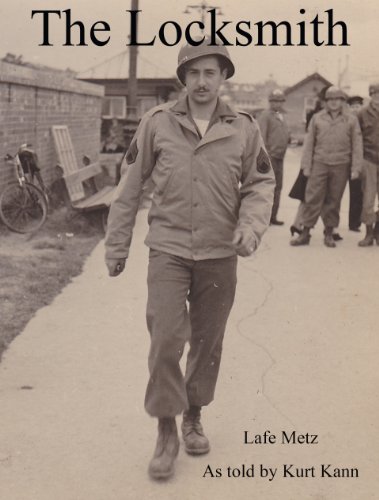
The Locksmith by Lafe Metz
Monday, September 12, 2011
Title: The Locksmith
Author: Lafe Metz (as told by Kurt Kann)
Genre: Biography/memoir
Publisher: LoudCloud Publishing, 2011
Source: Ebook provided by Author
Read for: Review
Kurt Kann's family is ravaged by the brutality of Kristallnacht - his father taken to Dachau, his mother beaten, his brother terrified. His family manages to escape to America, and after the bombing of Pearl Harbor, Kurt joins the military in order to get back at the Nazis and, he hopes, have a chance to settle his grievances against the Superintendent, his neighbor that told the Nazis about Kurt's family on Kristallnacht.
I always struggle a bit with reviewing a memoir. This is someone's story - often the greatest and most important events in their lives. Whether or not their story moves me personally does not detract from its power for them. With that said, I found Kann's story unique and interesting, but with an overall tone of vengeance that decreased my personal enjoyment of the story.
The book followed a narrative from Kristallnacht to the end of the war, with a few scattered chapters that would flash back to Kurt's past. While these flashbacks were occasionally disorienting, in general I enjoyed the way they tied the story together. Often Kurt would encounter something in the war or during his time living in America that reminded him of or could be represented by a scene from his past. The flashbacks added personality to Kurt's story.
Lafe Metz also did an excellent job of forming Kann's story into a clear and concise narrative. The language was simple but straightforward, only rarely meandering backwards into the past (and as I've mentioned, this was usually to the story's credit). I've found occasionally in memoirs a tendency to ruminate on aspects of the story that are not immediately important to the narrative, but this memoir was free of that fault.
The unique turn the story took was the best part of this memoir for me. I have never heard a story of a Jewish person escaping Nazi Germany and then returning as an American soldier. Kurt's experiences gave him a passion for victory that surpassed that of the other soldiers. While he lived the same military life as the men in his battalion, with the same distractions, horrors seen, and living conditions, he also lived with the knowledge that the men he was fighting were responsible for the suffering his family had encountered during the early days of World War II.
The most poignant and disturbing part of the book is when Kurt and his battalion liberate several Jews from captivity. I've read quite a few World War II books, many of them graphically describing the inhumanity of the concentration camps, but nothing prepared me for the nightmarish scene described in the book. Kurt Kann's story does not leave anything to the imagination - he uses harsh language to describe a harsh situation. It isn't pretty, but it is powerful, and a disturbing reminder of the terrible things mankind is capable of.
While the story was rendered well, the overall message of the story did seem a bit problematic. Kurt is obsessed with seeing vengeance done to the Nazis who hurt his family and his people, and in particular, the Superintendent that allowed his mother to be abused. I am sure his pain at these events is beyond anything I have experienced. However, a few deaths occur that are basically just out of Kurt's desire for revenge. They did horrible things, and I'm sure they deserved what happened to them. However, I was a bit uncomfortable with the fact that he resolved his experience with violence.
Overall, I think this is a unique and powerful story from the countless voices of World War II. I would recommend the book to anyone who loves reading about the military or World War II in general. This book also seemed like a story that would appeal to male audiences.
Warnings for the sensitive reader: Military language. A few stories of a boy's rowdy love adventures. Violence and disturbing themes.
Author: Lafe Metz (as told by Kurt Kann)
Genre: Biography/memoir
Publisher: LoudCloud Publishing, 2011
Source: Ebook provided by Author
Read for: Review
Kurt Kann's family is ravaged by the brutality of Kristallnacht - his father taken to Dachau, his mother beaten, his brother terrified. His family manages to escape to America, and after the bombing of Pearl Harbor, Kurt joins the military in order to get back at the Nazis and, he hopes, have a chance to settle his grievances against the Superintendent, his neighbor that told the Nazis about Kurt's family on Kristallnacht.
I always struggle a bit with reviewing a memoir. This is someone's story - often the greatest and most important events in their lives. Whether or not their story moves me personally does not detract from its power for them. With that said, I found Kann's story unique and interesting, but with an overall tone of vengeance that decreased my personal enjoyment of the story.
The book followed a narrative from Kristallnacht to the end of the war, with a few scattered chapters that would flash back to Kurt's past. While these flashbacks were occasionally disorienting, in general I enjoyed the way they tied the story together. Often Kurt would encounter something in the war or during his time living in America that reminded him of or could be represented by a scene from his past. The flashbacks added personality to Kurt's story.
Lafe Metz also did an excellent job of forming Kann's story into a clear and concise narrative. The language was simple but straightforward, only rarely meandering backwards into the past (and as I've mentioned, this was usually to the story's credit). I've found occasionally in memoirs a tendency to ruminate on aspects of the story that are not immediately important to the narrative, but this memoir was free of that fault.
The unique turn the story took was the best part of this memoir for me. I have never heard a story of a Jewish person escaping Nazi Germany and then returning as an American soldier. Kurt's experiences gave him a passion for victory that surpassed that of the other soldiers. While he lived the same military life as the men in his battalion, with the same distractions, horrors seen, and living conditions, he also lived with the knowledge that the men he was fighting were responsible for the suffering his family had encountered during the early days of World War II.
The most poignant and disturbing part of the book is when Kurt and his battalion liberate several Jews from captivity. I've read quite a few World War II books, many of them graphically describing the inhumanity of the concentration camps, but nothing prepared me for the nightmarish scene described in the book. Kurt Kann's story does not leave anything to the imagination - he uses harsh language to describe a harsh situation. It isn't pretty, but it is powerful, and a disturbing reminder of the terrible things mankind is capable of.
While the story was rendered well, the overall message of the story did seem a bit problematic. Kurt is obsessed with seeing vengeance done to the Nazis who hurt his family and his people, and in particular, the Superintendent that allowed his mother to be abused. I am sure his pain at these events is beyond anything I have experienced. However, a few deaths occur that are basically just out of Kurt's desire for revenge. They did horrible things, and I'm sure they deserved what happened to them. However, I was a bit uncomfortable with the fact that he resolved his experience with violence.
Overall, I think this is a unique and powerful story from the countless voices of World War II. I would recommend the book to anyone who loves reading about the military or World War II in general. This book also seemed like a story that would appeal to male audiences.
Warnings for the sensitive reader: Military language. A few stories of a boy's rowdy love adventures. Violence and disturbing themes.
The Book Thief
Sunday, September 26, 2010

This book surprised me.
I had heard of it from several people, but I didn't know anything about it except that it was narrated by Death. I wasn't sure what to think of that. And the first few pages, I wasn't sure how I liked "Death"'s voice. It seemed flippant, immature even. But after those first uncertain pages, I was hooked, much like Death was hooked, on the Book Thief's life. And once I got used to Death, I liked him - liked the stark, simple, and unforgivingly honest images he used to describe his observations and actions at the margins between life and death.
This story is ab
out a German girl in World War II. But it isn't quite that simple. Yes, you get the Hitler Youth uniforms and the harrowing descriptions of the treatment of the Jews. You get the bomb raids and the constant death and the militant, robotic youth. But you also get German children throwing bread to the Jews as they march. You get a glimpse of the privations the Germans went through, from coffee to their family members (all in the name of serving the Fuhrer, of course). And of course, you get book stealing. I'll let you read the book to find out how that comes into play.So back to my love-hate relationship with Death's voice. One thing I quickly grew to love about this book was the way Death inserts little anecdotes and facts into the text. Example: He is describing a situation with the main character, Liesel, and a boy she meets, and suddenly this little announcement is inserted into the text:
THE ONLY THING WORSE THAN
A BOY WHO HATES YOU
A boy who loves you.
A BOY WHO HATES YOU
A boy who loves you.
It is kind of trendy to have "abstractness" in books, I have been noticing - random things like those little anecdotal inserts, or weird drawings, or a strange point of view (like Death narrating the story). But in this book it wasn't tacky - it worked.
I loved the way Death gave the images in perfect detail but left you to feel the emotions of them. For example: "Her mouth jittered. Her cold arms were folded. Tears were frozen to the book thief's face" (pg. 8). Or (a happier image) "In the basement, when she wrote about her life, Liesel vowed that she would never drink champagne again, for it would never taste as good as it did on that warm afternoon in July" (357).
Death also gave longer, more developed images that I couldn't get out of my mind - a woman sleeping, bent over an accordion. A boy painting himself black and reenacting an Olympic race. A fistfighter defeating Hitler in an imagined fighting match, only to have Hitler call the audience back to fight him, yelling, "Can you see that this enemy has found its ways - its despicable ways - through our armor, and that clearly, I cannot stand up here alone and fight him? [...] Will you climb in here so that we can defeat this enemy together?" (254). That held my attention more than any translation of Hitler's words ever could. Wasn't that really what gave him his power - his words, his ability to convince people that not only was he smart, but he was morally correct? That imagined scene brought me closer to that than any history book ever could.
This book is raw. It is different. It will pull you in and not let you forget its characters. You may find yourself mentally arguing with Death sometimes. But I think you will end up enjoying his story, even if he bugs you at the beginning. 5 out of 5 stars. Buy this book. Highlight it, think about it, loan it to your friends, and read it again.
I loved the way Death gave the images in perfect detail but left you to feel the emotions of them. For example: "Her mouth jittered. Her cold arms were folded. Tears were frozen to the book thief's face" (pg. 8). Or (a happier image) "In the basement, when she wrote about her life, Liesel vowed that she would never drink champagne again, for it would never taste as good as it did on that warm afternoon in July" (357).
Death also gave longer, more developed images that I couldn't get out of my mind - a woman sleeping, bent over an accordion. A boy painting himself black and reenacting an Olympic race. A fistfighter defeating Hitler in an imagined fighting match, only to have Hitler call the audience back to fight him, yelling, "Can you see that this enemy has found its ways - its despicable ways - through our armor, and that clearly, I cannot stand up here alone and fight him? [...] Will you climb in here so that we can defeat this enemy together?" (254). That held my attention more than any translation of Hitler's words ever could. Wasn't that really what gave him his power - his words, his ability to convince people that not only was he smart, but he was morally correct? That imagined scene brought me closer to that than any history book ever could.
This book is raw. It is different. It will pull you in and not let you forget its characters. You may find yourself mentally arguing with Death sometimes. But I think you will end up enjoying his story, even if he bugs you at the beginning. 5 out of 5 stars. Buy this book. Highlight it, think about it, loan it to your friends, and read it again.
Subscribe to:
Posts (Atom)