Showing posts with label Middle East Challenge. Show all posts

Nefertiti by Michelle Moran

Monday, June 20, 2011

Title: Nefertiti
Author: Michelle Moran
Genre: Historical fiction
Publisher: Crown, 2007
Source: Borrowed from my sister-in-law

The untimely death of the pharaoh's oldest son leaves the kingdom wide open for Amunhotep, the ambitious and heretic second son. Nefertiti, the beautiful and intelligent niece of the Queen of Egypt, is a logical choice as his chief wife. However, as Amunhotep (later Akhenaten) pushes his new religious ideas on his reluctant subjects, the political climate of Egypt grows more and more unstable. Nefertiti's cat-eyed sister, Mutnodjmet, is thrown into the center of it all as she struggles to escape the tumult of royal life and establish a peaceful family life of her own.

This book sat on my nightstand for months, and I'm not sure why. I think it was one part my overwhelmed feeling with everything I had to read, one part my lack of interest in Egypt in general, and one part my reluctance to get into historical fiction. This is kind of laughable to me now, because since reading this book I have read practically nothing but historical fiction since.

To me, Nefertiti was mildly entertaining. The setting, however, was fantastic. In my mind I had a preconception that I wasn't interested in Egyptian history, but once I became swept up in the story I found the scenery and daily-life tidbits fascinating. Moran inserted little details of culture that made the events more believable. Her scenes were vivid - I could picture the city Nefertiti and Amunhotep were building and Mutnodjmet's herb garden.

I had mixed reactions to the characters. Mutnodjmet herself was an enjoyable character to read. She only wants to enjoy her life as a loved and fulfilled woman, but her family expects her to be willing to sacrifice everything for their social status, The Other Boleyn Girl -style. While she does have a few weak moments enjoying a triumph of beauty over Amunhotep's Second Wife, Kiya's, ladies in waiting. She has interests beyond the family's status, growing medicinal herbs and setting up a business to help women with various problems. She wants to have a family and enjoy a life married to a man that she loves. My one complaint with Mutny was that she was too perfect - she never made a mistake, never showed a dark side. She was consistently either devoted and dutiful or righteously indignant.

Nefertiti and Amunhotep, on the other hand, were selfishness personified. They ignored all political life and cut a pathway of destruction, debt, and death through Egypt. Their horrible deeds, which could have been entertainment for shock value, become predictable. You know that Amunhotep will do something stupid and selfish, and you know that Nefertiti will go along with him to keep power over him. Their story, presumably the central story, was occasionally tiresome because of the endless tirade of horrible acts.

However, the pace picks up in the last hundred pages as Nefertiti and Amunhotep's misdeeds escalate to a horrible climax. The story becomes like a train wreck (please realize I'm referring to the horrific events, not the writing). I knew just what would happen, but I had to keep reading. I was originally thinking that perhaps I wouldn't read the sequel, The Heretic Queen, but the last 100 pages convinced me to stay invested in Amunhotep and Nefertiti's tragic story. Be warned, however, that the first several hundred pages are a slow ebb and flow of Mutnodjmet trying to assert her right to happiness and Nefertiti and Amunhotep wreaking havoc.

This was an enjoyable read, perhaps not quite living up to my expectations or the time invested in the high page count, but nevertheless one that is staying with me still. I am still looking forward to reading Michelle Moran's other works, although I am hoping her next books hold my attention a little better.

3 stars
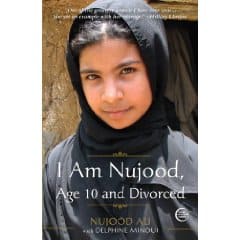
I Am Nujood, Age 10 and Divorced by Nujood Ali and Delphine Minoui

Wednesday, April 13, 2011

Title: I am Nujood, Age 10 and Divorced
Author: Nujood Ali and Delphine Minoui (Translated by Linda Coverdale)
Genre: Nonfiction, memoir
Publisher: Three Rivers Press, 2009
Source: Gift from my mom

This is the story of Nujood (and every time my husband saw me with the book, he would yell out, "I AM NUJOOD!"), a little girl married to an older man when she was 10 in order to pay some family debts. Although the man promised her father he wouldn't touch her until she reached puberty, Nujood was soon subjected to a life of physical and sexual abuse. Instead of silently giving in, she ran away to the courthouse and requested a divorce. Her story has given other young girls the inspiration and courage to request divorces of their own.

This was a quick little read - I finished it in two workout sessions. Nujood's voice is innocent and straightforward. She gives the facts about her life with simplicity and directness. After telling the story of her divorce, she explains a few other situations in her family that exhibit the desperation and inequality in Yemen. She also describes some of the uncertainty in her own life. While she managed to escape from her husband (you can't call that a spoiler when you take the title into account), she still lives with the family that essentially sold her to the husband in the first place. They still struggle to make enough money to live from day to day.

One thing that I thought was unique and refreshing about Nujood's viewpoint is that she doesn't resent her religion for the abuse she endured. She retains her faith in Islam - it is the system she has found fault with. Although she says she hopes in the future to be like the female lawyer who takes her case - "Like Shada, I will wear high heels, and I will not cover my face" - she also loves to study the Koran and never once blames her struggles on her religion. I think this is an important distinction to make - often it is the culture that results in the abuse of women and other activities we frown upon in western society, not the teachings of the religion itself. I am by no means an expert on Islam, so I can't really say more than that. But I appreciate Nujood's viewpoint and lack of resentment.

Overall, this is an interesting story and one that deserves to be heard. Often, we hear about situations in the Middle East through the media and politicians. Hearing it through the voice of a little girl who rose above her circumstances and fought for improvement was refreshing and at times moving. It is a simple story, but an empowering one.

Overall: 3.5

The Haj by Leon Uris

Saturday, January 15, 2011

My dad has been trying to get me to read this book for a couple of years now so that I could better understand the Arab situation. I have resisted in part because I only started really reading books for fun again last year, and in part because I am pretty apolitical. I don't like to generalize about groups of people so I was worried about this book.

The Haj is about a leader of a village in Palestine, Haj Ibrahim, and the formation of the Israeli state. It deals with the political forces combining both for and against Israel, the Palestinians' relationships with the Jews that come to their land, and the family of Haj Ibrahim, told from the perspective of Ishmael, Ibrahim's youngest son.

There were a few things I struggled with in this book. It was an offender in one of my main literary pet peeves - the offense of too-much-historical-detail. To be fair, this is an epic about the history of Palestine and Israel, and I knew that going into it. It was hard to keep track of some of the rulers, and the intentions of the different countries, but part of that was definitely because several of the countries kept changing their intentions. I knew absolutely nothing about Palestine or Israel going into this read, so part of my problem was probably my complete lack of context.

I also didn't like the one-sidedness. On my guard as I was for prejudice, at the beginning it seemed that Uris was pretty much an Arab hater. He describes in detail the inferior conditions of the village of Tabah. Haj Ibrahim's family is the only family to live in a house. Haj Ibrahim has two chairs, and one is only for revered visitors. The men are weak and run from battle. On the other hand, the Jews come up with new systems to make the desert inhabitable. They have high quality schools and courageous squads of specially trained soldiers. I don't know how much of this is true, and how much is not, but I would imagine at least the conditions are accurate.

As we get to know the characters, especially the members of the Haj's family, however, we do get a sympathetic side to the Palestinians. Other Middle Eastern nations are trying to crowd them out of their villages, with no intention to protect them or fulfill the promises they make. Ishmael wants to protect the women in his family and goes to great lengths to protect them. However, in the end, even the most likable characters fall into self destruction because, as spoken by Dr. Mudhil, one of Ishmael's mentors, "Hate is our overpowering legacy and we have regenerated ourselves by hatred from decade to decade, generation to generation, century to century. [...] We cannot stop ourselves." (522-23)

I don't think that all Muslims or all Middle Easterners are full of hatred as an overpowering legacy, although it seems there are definitely some out there (such as... those who attacked America on 9/11). Like I said, I am not very politically aware and the TV in my house gets turned on less than once a week, so I don't always know what is going on in the world. Note to self: become more aware of current events. However, I do know from my lovely Civ 1 class that while Christianity was still in the Dark Ages, the Muslims were translating the Greek philosophers and building palaces. So when did this transition take place? And why? Did something change? Anyway, kind of going off on a tangent, but I found myself wondering about this quite a bit.

This book was one of the most graphic and disturbing books I have ever read. The forms of torture employed by various governments was absolutely horrifying. There was also one ruler in particular who was so corrupt and disgusting, living in a world of drugs and orgies (please no spam... haha). I haven't figured out if he was a real character or not. I didn't enjoy the negative events, but it was interesting read about the corruption in these so-called leaders, making life-altering decisions for millions of people.

The character that I found most interesting was Nada, Ishmael's sister. She was essentially the embodiment of that ever-popular theme in Middle Eastern fiction - a marginalized woman desperate to make her own decisions and live her own life. She was a very likable character - smart, beautiful, braver than many of the men in her family, and full of life. She goes on a rant toward the end of the book that finally makes Ishmael, the bowed to man of the family, realize her position:

I remember once in Tabah I saw a little Jewish girl waiting for the bus on the highway with her parents. She carried a doll and she showed it to me. It was very pretty, but it could do nothing but open and shut its eyes and cry when it was hit on the back. I am that doll. [...] I have been molded into a lump that is not supposed to have feelings. My emotions have been controlled and enslaved from the time I was a little girl - shame... slap.. forbidden... slap... shame, shame, shame. Even my body is not my own. (479-480)
"I think I am going to be ashamed," Ishmael responds, finally understanding his sister for the first time. The characters are the redeeming point of the book. They are often strong and noble, although they are doomed to evil because they are Arabs (I hope you are catching my sarcasm).

This book was an interesting read, but it was hard to take completely seriously because the author seemed so biased. I do not doubt that many of the things he is saying are true, but because he seemed to be so one-sided it was difficult to take seriously. The book was very dark and negative, which is why it took me so long to read - I couldn't read straight up death and war during the Christmas season, so I interspersed the book with some seasonal books. I don't know that I'd recommend this book, although I didn't hate it. I'll probably try reading Leon Uris at least one more time, but this book was not for me.

Accessibility/readability: A bit confusing at times due to the many rulers and historical figures.
Aesthetics/literary merit: 2. I didn't think this book was very well-written. Nada's quote is a good example of what much of the rest of the book was like.
Plot: 3.5 It was interesting and told an important story. Although it did get bogged down with historical detail, they were necessary to the story.
Characters: 3. They were interesting and likable, but often one-sided.
Personal response: 2.5 It had its good qualities, but many things bothered me about this book.
Overall: 2.75

PS: Read this for the Middle East Challenge. Find more reviews here.

Mailbox Monday

Monday, December 27, 2010

I've never participated in this meme before, but I have had quite a few books enter my life in the past few weeks so I thought I would highlight them.

Of course, I got some wonderful books thanks to Christmas. I found I am Nujood, Age 10 and Divorced in my stocking, which will be great for the Middle East Challenge in which I am currently participating. My handsome husband bought me The Emperor of All Maladies: A Biography of Cancer by Siddhartha Mukherjee, one of my most anticipated reads this year.

This next batch came thanks to my mother's eccentric hairdresser. She also did my hair in high school, and really liked me because I was heavily involved in competitive classical piano. Her son is a cellist and I think her dearest hope is for him to become the next Yo Yo Ma (he is even half Asian!) Anyway, this lady, who I will just call K., has always had CDs she wants me to listen to, movies she wants me to watch, etc. The last time my mom went to her, she had several books that she had read and wanted to pass along to me. So nice of her! The books are...
  • The Blind Assassin by Margaret Atwood. I haven't read any Atwood yet, so I am excited to get started. Also, it is a beautiful hardback edition, and my husband and I are trying to build a library, so I'm excited to include it.
  • North to the Orient by Anne Morrow Lindbergh. This is about Charles Lindbergh and the author's trip to the Orient. Probably not a book I would choose for myself, but as I own it now, I will probably read it.
  • Mockingbird by Charles J. Shields. This is about Harper Lee, the author of To Kill a Mockingbird. I am looking forward to this one, especially because I am rereading To Kill a Mockingbird for the Back to the Classics Challenge.
  • The Man Who Knew Infinity: A Life of the Genius Ramanujan by Robert Kanigel. I don't really know anything about this book, but I might be able to use it in the South Asian Challenge.
I also acquired some gift cards to Amazon and Barnes and Noble, and have already bought a few books. They are:
  • Dash and Lily's Book of Dares by Rachel Cohn and David Levithan (Reviewed here)
  • In the Dark Streets Shineth by David McCullough (Reviewed here)
  • Major Pettigrew's Last Stand by Helen Simonsen (Can't wait for this one)
  • An Anthropologist on Mars by Oliver Sacks. Also looks like a winner - the title story is about an autistic person, one of my main areas of interest in neuroscience right now, so I'm hoping to get to that one soon.
I can't wait to use the rest of the money. Part of me wants to hoard it until some irresistible book comes out, and the other part of me wants to spend it all right now. My husband also received a Barnes and Noble card, and I am hoping his purchases benefit me as well. :)

Middle East Challenge

Monday, November 22, 2010

I have quietly picked a few challenges to join for this upcoming year of 2011. They are listed on my Challenges tab but I haven't written the introductory posts yet, because I didn't want to bombard my blog with all of them at once. However, I just finished my last test before Thanksgiving break, so I can catch up a little!

I became aware of this challenge thanks to the Zen Leaf, and I was instantly excited for a couple of reasons. First of all, I am going to participate in the 2011 South Asian Challenge hosted by S. Krishna's Books once the challenge begins in January. I have long been interested in the culture and especially the literature of India, so I was very excited to participate. However, my interest also includes the Middle East, which is not included in that challenge. Therefore, I was excited to find another challenge that would encourage me to read some of the Middle Eastern books on my TBR.

Secondly, (kind of a trivial, personal reason) I have in particular one book on my TBR that my dad has been trying to get me to read for years, The Haj by Leon Uris. I read about 200 pages of it (it's a chunker) and never picked it up again because I was reading it during a busy nightmare semester. As I will only have two classes next semester (hooray for graduating!) I thought maybe I would have more time to get through this one. Maybe I will eventually return it to him! Haha.

Anyway, enough about me... This challenge is hosted by Helen's Book Blog. It began August 1, 2010 and runs through July 31, 2011 (in honor of Ramadan). The books must be either by an author from one of the countries considered by Helen to be part of the Middle East (there are a few different ways of dividing it, and she explains the way she is using on her post) or take place in one of those countries. There are no levels - you can just decide how many books you would like to read!

I have tentatively selected four novels to read. First, The Haj by Leon Uris (of course). I've also heard good things about Reading Lolita in Tehran, and every time I go to the University library it jumps off the shelf at me, so I will be picking that one up as well. I think I'm going to have to read Lolita first, though, just so I feel like I can relate to the author! On the challenge's main page, I saw a link for a book called Habibi by Naomi Shihab Nye. I used to love her poems when I was younger, so I am looking forward to revisiting her work. I might have to read some of her poems again as well, because I can't remember them - just that I enjoyed them when I heard about them in school. Finally, I am Nujood, Age 10 and Divorced by Nujood Ali. Amazon suggested this book to me months ago, and I read a sample on my Kindle and was intrigued, but had forgotten about it after that. I am also intrigued by it because I watched a movie, Water, with my then-friend-now-husband about this time last year about child widows in India. It is certainly not the same, because the religions and regions are different, and Chuyia, the main character in Water, is a widow, not divorced, but she also was married at a very young age so I am interested to revisit this subject.

Looking forward to this challenge! I'll probably tackle The Haj first, and take it from there.


Related Posts Plugin for WordPress, Blogger...