

 Title: The Emperor of All Maladies
Author: Siddhartha Mukherjee, M.D.
Publisher: Scribner, 2010
Genre: Nonfiction
Source: Gift from The Husband
(I'm trying to be a little more organized, hence the abundance of information above)
The Emperor of All Maladies by Siddhartha Mukherjee is subtitled "A Biography of Cancer." The book attempts, then, to describe the cancer from its birth to its death, a multidimensional canvas that includes its history, its pathogenesis in the human body, and its range of treatment. Mukherjee adds to this broad scope of information his personal experiences with patients as a student doctor in an oncology fellowship. The result is a vast, information-filled tome of knowledge about this unruly, capricious disease.
Mukherjee's writing leaps around a bit, describing ancient tumors found on mummies, pathologies inscribed on ancient tablets (treatment: none, marked drearily on one), and then snapping into his beginning experiences as an oncologist. The main chronological thread is that of the discovery of ways to treat cancers, beginning with simple excision of a tumor and leading to the complicated and elegant array of gene therapies pharmaceutical companies are marketing today. While this main thread was followed throughout the novel, it was at times a little disorienting to jump from learning about a developing drug in the 40's to Dr. Mukherjee's current patient in the 21st century.
The book tended to focus on a few specific types of cancer, including Hodgkin's disease, breast cancer, and especially the leukemias. I understand his reason for this, as these particular cancers, possibly because of their uniqueness, led to specific cancer treatments. However, I would have liked to learn more about other cancers as well, such as skin cancer, colon and stomach cancer, and especially brain cancer. Mukherjee's main focus was on the development of treatment and government funding for research, while I personally would have been more interested in learning the biological details of the different diseases. However, through elucidating the development of different treatments, Dr. Mukherjee deftly pulls together the common causes of different cancers into a concise and uncomplicated genetic explanation.
Despite my occasional disappointment in the type of information presented, this book is a stunning accomplishment. Cancer is a diverse and elusive disease with behavior that still baffles some of the most intelligent people in the world. I loved Dr. Mukherjee's characterization of cancer as an alien opponent maneuvering its way through battles with the human body - its amazing adaptations to treatments and the way it harnesses the life-promoting ability of dividing cells is eerie and frightening. The range of information and research necessary to write a book like this is astounding, and despite the occasionally scattered narrative, I think Mukherjee did as good a job as anyone could in integrating the story elements.
Dr. Mukherjee's personal stories also give this intimidating and huge volume a personal touch. He describes the heaviness of his cancer fellowship, the way it changed his life and the lives of the doctors with whom he worked. He describes his feelings of defeat when he has to tell a cancer patient they really have no more options, and the delicate balance the doctor must tread in displaying hope for a treatment but not too much hope. I was especially touched by his story of driving to his leukemia patient, Carla's, home to bring her flowers when she was officially in remission. Dr. Mukherjee is not just a scholar, intent on discovering the root of a medical problem - he is a soldier struggling to protect the lives of those caught in the snare of a formidable enemy.
Dr. Mukherjee is also an excellent writer. His prose was never too thick with medical terms. He crafts his sentences well, clarifying complicated scientific processes with elegant metaphors. One such metaphor compares science as unveiling a picture one small piece at a time, until it resolves into a complete picture -
Science is often described as an iterative and cumulative process, a puzzle solved piece by piece, with each piece contributing a few hazy pixels of a much larger picture. But the arrival of a truly powerful new theory in science often feels far from iterative. Rather than explain one observation or phenomenon in a single, pixelated step, an entire field of observations suddenly seems to crystallize into a perfect whole. The effect is almost like watching a puzzle solve itself.
Overall, I think this book is a daunting read, but a worthy one. I think in our lifetimes cancer will affect all of us, whether from the disease in our own bodies or that of a loved one. While our understanding of the disease is far from complete, The Emperor of All Maladies gives us a small window of understanding. It is not a perfect portrait of this complicated enemy of ours, but may be one of the best we have so far.
Overall Rating: 4
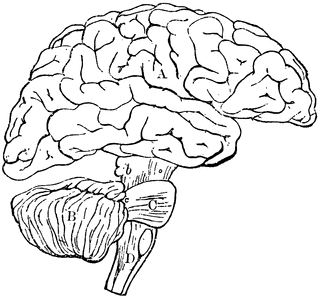
Neuroscience Notes: While the book didn't spend much time describing cancers of the brain, there were a few interesting anecdotes about certain cancers metastasizing to the cranial cavity, causing intense headaches, hallucinations, etc. For this reason, I am including it in my neuroscience list.
Read for the Chunkster Challenge and the South Asian Challenge.
