Showing posts with label nonfiction. Show all posts

Parenting Books Mini-Reviews

Wednesday, January 09, 2013

I'm back! Kind of. With my new baby (seven weeks old already! I can't believe it), I haven't been blogging at all... but I have been reading quite a bit. And a main portion of that reading diet, both before and after he was born, has been books about parenting. With my type A personality, I really wish that babies came with step-by-step manuals that told me exactly what to do to turn out a well-adjusted, happy individual. Unfortunately, instead I have been sifting through many, many books, some of which are helpful and many of which are not. I thought I'd give you all a brief run-down on the parenthood-related books I have read lately, what worked for me, and what didn't.

Heading Home With Your Newborn: From Birth to Reality by Lara A. Jana and Jennifer Shu

This is actually the only book that was 100% awesome advice. Heading Home With Your Newborn covers a variety of topics, from how to bathe a baby to breastfeeding tips to information about various illnesses. The authors are pediatricians who also have children, so they have a solid background and know exactly what they are talking about. They also are careful to differentiate between their opinions and what is supported by science and the American Academy of Pediatrics. I recommend this book to any first-time parent for a wide range of advice and information about newborns.


Breastfeeding Made Simple: Seven Natural Laws for Nursing Mothers by Nancy Mohrbacher and Kathleen Kendall Tackett

While I was reading this book, pregnant and blissfully thinking that I wouldn't have any trouble with breastfeeding, I thought it was excellent advice. Mohrbacher and Tackett go through the logistics behind milk production, latching, the benefits of breastmilk over formula, etc. However, when I experienced problems after the birth of my son, I found that a) the book didn't really address the problems I faced, instead assuming that all women are capable of breastfeeding if they simply "stick it out" and b) I felt incredibly guilty that I had to supplement with formula because of this attitude. So in short, this is a good overview for someone who doesn't have too many problems, but doesn't address problems well for those who do.

The Happiest Baby on the Block by Harvey Karp

This book presents five methods to soothe crying babies (once their basic needs, like dirty diapers and food, have been taken care of). To be honest, the book itself bothered me -- it was written in a somewhat childish, over-simplified way, and the ideas that Karp presents, such as the idea that prehistorically babies really were in the womb for a fourth trimester, are not backed up by science. However, the methods themselves are pretty effective and worked for my son most of the time. I've heard a DVD accompanies this book (I checked it out from the library) -- maybe that would be slightly less grating.


On Becoming Baby Wise by Gary Ezzo and Robert Bucknam

Countless people have told me this is THE book to get babies to sleep. When I read it while I was pregnant, I was skeptical -- it seemed too harsh to let babies "cry it out" and seemed too rigid. While there are still ideas that I don't agree with or follow in the Baby Wise method, I have, however, found many things it suggests to be effective now that I am actively parenting. I think that, like all parenting books, everything has to be taken with a grain of salt. No book is the true "user's manual" that will answer every question about babies. Like Happiest Baby on the Block, I also was at times irritated with the presentation of the ideas in Baby Wise. They present their ideas as if it is the only way to raise a well-adjusted child and that any parent would be foolish to do anything different. While I appreciate and use many of their ideas, I don't think it is the parenting gospel.

Your Amazing Newborn by Marshall H. Klaus and Phyllis K. Klaus

Your Amazing Newborn is an overview of newborns and their abilities. It was an interesting, brief read. It did leave me feeling a little cheated because it describes some of the amazing connections made between mother and baby when baby is placed on the mother's chest immediately after birth, and I had to wait almost an hour before meeting my baby for the first time after he was born. Still, that was a personal issue, and many things touched upon were interesting in this book.


Down Came the Rain by Brooke Shields

Postpartum stress, whether it is full-blown postpartum depression or a few days of baby blues, affects many women after childbirth, and I was no exception. I am feeling a lot better now, but with a very traumatic labor and difficulties in feeding my baby, as well as a hospitalization early in his life for RSV, adjusting to motherhood definitely took some time. I checked out Down Came the Rain out of curiosity -- I wanted to see what someone else was experiencing. While many of Brooke Shields feelings and experiences differed from mine, many also struck a chord with me and helped me to feel less alone with the stresses I was encountering. The book was also well written, something I don't usually expect from a celebrity memoir (although I haven't read many of those, so I don't have much to judge from). I think any new moms dealing with any measure of postpartum stress will find something to relate to in Shields' memoir. It was definitely a rewarding reading experience for me.

I am reading two more parenting books right now... you'd think I'd be an expert by now, right? What parenting books have you read and enjoyed? (And those of you who aren't parents, hope you haven't been too bored by this smorgasbord!)
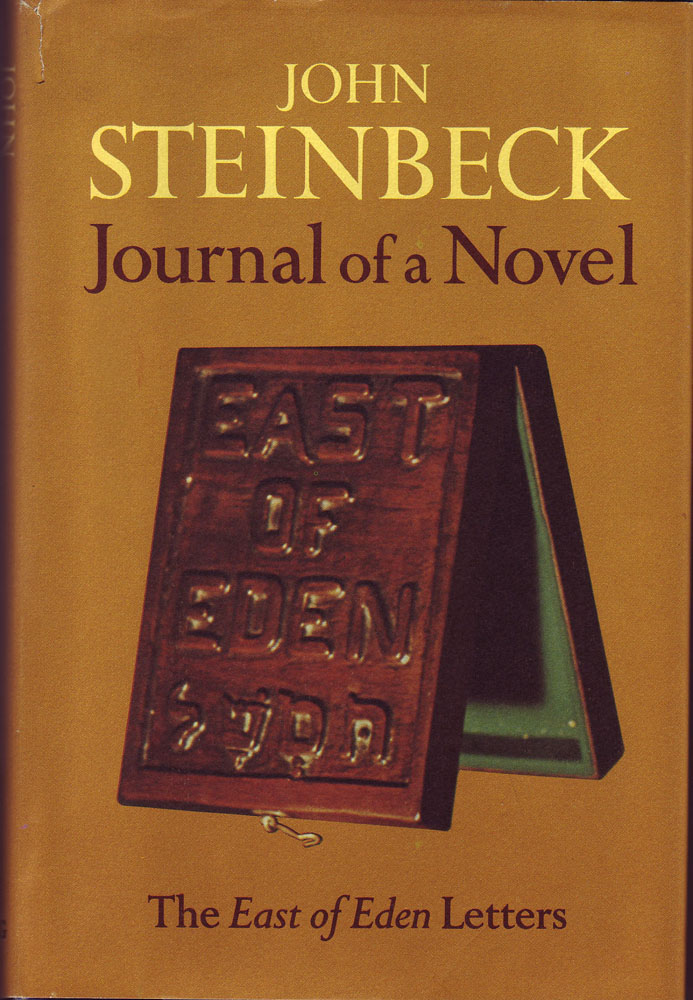
Journal of a Novel: The East of Eden Letters by John Steinbeck

Friday, November 16, 2012

Title: Journal of a Novel: The East of Eden Letters
Author: John Steinbeck
Genre: Nonfiction, memoir
Publisher: Penguin Books, 1990 (obviously written before that)
Source: Library
Read for: Fun

It is a well-known fact on this blog that I love John Steinbeck's East of Eden. When my friend Allison told me about this book, which consists of letters Steinbeck wrote on alternating pages with his manuscript for the novel, I knew I needed to get my hands on it. I wasn't sorry that I did -- Journal of a Novel gave me great insights into both East of Eden and John Steinbeck himself.

One of the first things I noticed was that, despite the fact that the letters Steinbeck wrote were just warm-ups for his daily novel writing, he still writes so well. His writing style has always been incredibly poignant and powerful for me, and that didn't change in the unpolished East of Eden letters.

I also loved having Steinbeck's thoughts about his own characters. For example, the Hamilton family, who are juxtaposed against the main characters the Trasks throughout the novel. I assumed the Hamiltons were at least partially inspired by people from Steinbeck's life, as he referenced his own mother a few times, but I assumed that they were mostly fictional. From Journal of a Novel, I learned that almost everything about them in the novel (aside from their interactions with fictional characters) was true. I also enjoyed reading Steinbeck's reasons for including the Hamiltons in the novel, as well as his reasons for many other of the decisions he made with the novel.

I think my favorite part, however, was getting to know Steinbeck better as an individual. I loved some of his little observations on life, his obsession with having the perfect pencil (and thus needing his electric pencil sharpener to always be in perfect working order), his desire to constantly be inventing and carving things. In many ways I felt that Steinbeck was a kindred spirit for me, such as his descriptions of the way things of the heart are unknowable to other people (something he explored quite a bit in The Winter of Our Discontent) and his complete and utter inability to relax (me too, Steinbeck! me too!). Having that added insight into his personality will, I think, help me to appreciate his work even more.

Anyone who has read East of Eden and wants to explore it further will benefit from Journal of a Novel. It will also bring great insight into (in my opinion) America's great author. Journal of a Novel was a fascinating journey into Steinbeck's mind and the background of East of Eden.

4 stars

Warnings: Mild language, spoilers for East of Eden (obvs)

January First by Michael Schofield

Wednesday, November 14, 2012

Title: January First
Author: Michael Schofield
Genre: Memoir
Publisher: Crown, 2012
Source: NetGalley
Read for: Review, Neuroscience list

January has been a high-strung child from birth, needing intensive stimulation all day in order to sleep at all. As she grows older and shows signs of extreme intelligence, her father believes -- and verifies with an IQ test -- that January is a genius. However, with the birth of a younger brother Jani begins displaying disturbing tendencies towards violence, and soon it becomes clear that it isn't just a phase -- Jani is suffering from severe mental illness.

I started January First when I finished my book on the bus and decided to knock out a review copy since I had my Kindle with me. I planned to read a few chapters on the bus and then finish it later. However, I could not put the book down and finished it within 24 hours. Jani's story is compelling, heartbreaking, and moving.

Michael Schofield chooses to relay his memoir in the present tense, which I think was very effective for this story. The immediacy of the present tense helped draw me in to his state of panic and confusion with Jani's bizarre and frightening behavior, as well as his frustrations with the institutions and doctors who are meant to be helping her but aren't always as willing or helpful as they could be.

I also felt that January First was written with stark honesty. I have read other reviews of the book complaining that Schofield's parenting was contributing to the problem, that he didn't pay enough attention to his other child, that his marriage was full of problems. There were certainly actions and attitudes Schofield had that I did not personally agree with, but he wasn't writing a parenting book -- he was writing the story of the effect his daughter's illness had on their lives. I appreciated that he included his mistakes with his successes. It also caused me to think about how I would handle a similar situation in my life -- it is easy to stand from a distance and judge Schofield's actions, but I can almost guarantee that none of the reviewers doing that have dealt with Schofield's unique situation. I appreciated his honesty and the direct look into the struggles of living with Janni and protecting their children.

While January First was an emotionally taxing book to read, it was also rewarding. While the Schofield family met with many challenges and setbacks, they also had moments of success. January First is not just about watching the train wreck of an awful disease -- it is also watching a family take an impossible situation and still manage to find solutions. January First is a fascinating memoir and story that will captivate readers.

4 stars

Warnings: Language, non-graphic violence

The Modern Girl's Guide to Motherhood by Jane Buckinham (with Jen Furmaniak)

Monday, October 01, 2012

Title: The Modern Girl's Guide to Motherhood
Author: Jane Buckingham (with Jen Furmaniak)
Genre: Parenting, nonfiction
Publisher: Reagan Books, 2006
Source: Borrowed from my sister-in-law
Read for: KNOWLEDGE

As my due date creeps ever closer, I have been reading quite a few books about motherhood. Because let's face it, while I may be able to take care of an infant in a sterilized hospital setting, I have no idea what I am supposed to do with one at home (especially because in my experience, the CNAs are in charge of feeding and diaper changing). With The Modern Girl's Guide to Motherhood, I got about what I expected -- some practical advice about dealing with various situations, but not much scientific evidence and a little bit of ambiguity.

The Modern Girl's Guide to Motherhood has nine chapters, focusing on nine subjects. It discusses things to buy, what to do before baby comes (covering everything from labor to ordering birth announcements), how life is the first few weeks after the hospital, information about food for newborns through toddlerhood, sleep habits and training, basics of caring for newborns, teaching babies and toddlers (things like manners, sharing, etc.), breaking bad habits, and how to play with babies, infants, and other parents (in setting up playdates). Sound like a lot of information? It is -- and at times it isn't helpful, because it seemed as if the author was trying to include a lot of different perspectives.

The information that was helpful was the information on good brands to buy, what types of baby gear the author found helpful, and the anecdotes. While I appreciate a well-researched parenting technique as much as the next panicked mom-to-be, I think what really helps me feel most comfort is the knowledge that normal people are doing this every day, and that they don't usually produce sociopaths or monsters. I also appreciate the fact that while Buckingham highlights many different philosophies, some of which she adheres to, she also describes some practical tips and situations that have simply worked for her. I think this information can be really helpful (with the caveat, of course, that every situation is different and what works for one person may or may not work for another). I enjoyed the ideas and may find myself turning back to the book at times when I am in a bind.

However, I also found that much of the information was strict opinion, or was presenting opposing parenting theories. I haven't yet figured out what I think the best approach to parenting is, having never done it, but it seems that every well-researched philosophy out there has an equally well-researched opposing philosophy. I suppose having them all presented in one book gives the reader a taste of where to look next. However, many of these philosophies were mingled with the opinion of the author, so it was hard to know what exactly I was reading.

Basically, while I found The Modern Girl's Guide to Motherhood interesting and gleaned a few gems, I have taken every bit of advice with a grain of salt (which is probably advisable with any parenting book, to be honest). The writing style is fresh and readable, and there are several helpful lists on every subject, from things to buy for the baby to when to introduce appropriate foods (although I didn't see scientific references for these, so it might be good to double check them with an American Academy of Pediatrics publication or something). I think The Modern Girl's Guide to Motherhood was a good overview for the information that is available, but I will definitely be consulting some more scientific resources.

3 stars

Warnings: Talk about body parts, some innuendo. It's a book about babies, so all the parts involved with that...

Truth and Beauty by Ann Patchett

Monday, September 17, 2012

Title: Truth and Beauty
Author: Ann Patchett
Genre: Nonfiction, memoir
Publisher: Harper, 2004
Source: Personal copy
Read for: Alex Awards Challenge, New Adult Challenge

Ann Patchett and Lucy Grealy met when they were working on their undergraduate degrees, but they became friends in their master's program, as they ended up rooming together in a cheap apartment due to their shared background. However, what started was an epic friendship, close as family, colored by their writing, their love lives, and Lucy's never-ending battle with her face, which was disfigured as a result of childhood cancer and made every day a struggle to eat, as well as coping with the reactions of other people. This is the story of that friendship, told from Ann's point of view.

I was already a fan of Ann Patchett's writing before I started Truth and Beauty, and it did not disappoint. Ann Patchett has a very readable and yet descriptive style. There is nothing straining about the style itself, although the subject matter is at times very heavy. Her writing is also addictive, meaning that I finished this book in less than 24 hours. Several of those hours transpired during a bout of pregnancy-induced insomnia, in which I probably could have gone back to sleep after an hour but stayed up for three reading.

The story itself is also compelling, for several reasons. First of all, for me at least, it is interesting to learn about the lives of successful writers and how they reached that point. As someone who occasionally toys with writing (although for the most part it all just goes onto this blog or into a personal journal), I was very interested in the day-to-day life details of these two successful writers. Second of all, much of the book takes place during Ann and Lucy's twenties. It has been bemoaned by many other book bloggers that there is a paucity of books taking place in college and about characters in their early to mid twenties, and I agree that it is a problem. Because I am in my mid-twenties now, I loved reading about other people and their experiences, despite the fact that they are different than mine. I think there is a common element of struggling to find one's identity and purpose no matter what the circumstances of one's life, and it is usually illuminating to see what others' experiences are. Finally, the relationship between Ann and Lucy itself is very unique and compelling.

I have to preface this by saying I found Lucy a dynamic and compelling character, one who had dealt with considerably more than most people. Diagnosed with cancer at a young age, she had lost most of her jawbone and teeth and was constantly undergoing reconstructive surgeries. She was unable to eat most food and was constantly stared at by others. In addition, her treatments had left her in a state of permanent debt. As someone who has worked with children who have cancer, it was interesting and heartbreaking to see the aftermath of the disease, when the individual is essentially cured by dealing with the side-effects of those cures for the rest of their life.

However, she was also a very difficult character to read about at times. She made very irresponsible decisions, frequently disregarded her friends' advice, continued to sink further and further into debt, and entered empty relationship after empty relationship with men, constantly seeking reassurance that she could be loved despite her facial abnormalities. Despite this, she was well-loved and popular, but no one cared for her the way Ann did. I loved the way Ann painted her clearly, showing her faults and weaknesses, while at the same time writing with unconditional love. She frequently refers to Lucy as her family, and it is clear that their relationship is one of family -- they helped each other through everything, even when it would have been easier to end the friendship and be around someone less needy or demanding. I think that is the true beauty of this book -- the ability to love someone imperfect, the ability to treat someone with patience and forgive them over and over again, the ability to see past someone's weaknesses to their truest, best self. There are so many heartbreaking images, so many acts of love, in Truth and Beauty.

While Truth and Beauty is not a story about romantic love, it is a love story -- a story about how to love in the purest, most unselfish form. Alternately frustrating, moving, and heartbreaking, this unique friendship spelled out in excellent writing is definitely worth reading.

4 stars

Warnings: Language, sensuality, graphic descriptions of surgery

Reading Lolita in Tehran by Azar Nafisi

Friday, September 14, 2012

Title: Reading Lolita in Tehran
Author: Azar Nafisi
Genre: Nonfiction, memoir
Publisher: Random House Trade Paperbacks, 2003
Source: Borrowed from my sister-in-law
Read for: Fun

Reading Lolita in Tehran is the memoir of Azar Nafisi, a college professor living in Iran who deals with the oppression of women and ideas through literature. Divided into four parts and focusing on four novels, Nafisi takes us through a private literature class held in her home after her expulsion from the university, her experiences teaching in universities in Tehran, and her experience of the war between Iran and Iraq.

First, a confession: I have not read Lolita. I tried once, and despite the beauty of the writing, I could not get past the subject material. With that said, I am familiar with the plot. Of the four novels especially highlighted in this novel, I had read two. There were also myriad other novels referenced, some of which I had read, but most of which I had not. While I'm sure my enjoyment of Reading Lolita in Tehran would have been greatly enhanced by having read all the novels mentioned, I still had a strong and positive experience with this book.

Azar Nafisi has a passionate relationship with literature, and I think that in and of itself drew me to this book. I think as readers, we enjoy reading about other readers; we like to see ourselves reflected in the books we choose. Nafisi paints her experiences through the lens of literature, which I think gives reading more meaning; she uses it as a means to interpret circumstances that seem senseless to her. Her interpretations are intelligent and beyond what I have studied -- I've only taken one literary theory class, and it was interesting to be exposed to literary theory once again. However, beyond her intelligent use of the books, a more emotional, passionate love for them is also clearly present.

The circumstances Nafisi illustrates through literature are also fascinating. While I'm interested in the Middle East, I had never read anything specifically about Iran. I never knew that there was a period of time where women experienced more freedom, before a religious revolution necessitated the scarf covering and other restrictions. The day-to-day regulations, as well as the horrors some of her students expressed, awed me. I can't imagine living my life in a constant aura of fear and uncertainty.

I enjoyed the two sections sandwiching the rest of the book about Nafisi's private class for women most in the book. I expected the entire book to be focused on these classes, and was a little disappointed when the narrative veered in a different direction, although I still greatly enjoyed the book.

The "icing on the cake" for me was Nafisi's beautiful writing. The copy wasn't my own, or else I would have dogeared and highlighted the life out of it. Instead, I had dozens of tiny slips of paper stuck into the pages I loved. Afterward, I copied out the quotes onto a Word document on my computer. Here are just two of my favorites:
My daughter, Negar, blushes every time I tell her that her particular brand of obstinacy, her passionate defense of what she considers to be justice, comes from her mother’s reading too many nineteenth-century novels when she was pregnant with her. […] Well, don’t they say that what a mother eats during her pregnancy, as well as her moods and emotions, all have an effect on the child?
 I'm curious what effect my reading will have on my child -- there has been a lot of fantasy reading going on during this pregnancy.
A novel is not an allegory, I said as the period was about to come to an end. It is the sensual experience of another world. If you don’t enter that world, hold your breath with the characters and become involved in their destiny, you won’t be able to empathize, and empathy is at the heart of the novel. This is how you read a novel: you inhale the experience. So start breathing. I just want you to remember this. That is all; class dismissed.
 I don't think I can say much beyond that. Reading Lolita in Tehran is a beautiful book, one that will expand your desire to read and appreciate literature, as well as an eye-opener to a different culture. Highly recommended.

4.5 stars

Warnings: Violence, discussion of sexuality

The Girlfriend's Guide to Pregnancy by Vicki Iovine

Wednesday, August 22, 2012

Title: The Girlfriend's Guide to Pregnancy
Author: Vicki Iovine
Genre: Nonfiction
Publisher: Pocket, 1995
Source: Borrowed from my sister-in-law
Read for: Fun

Vicki Iovine, the author of The Girlfriend's Guide to Pregnancy, doesn't have any medical qualifications or special education. She has simply experienced four pregnancies. This means that while her book is not full of authorized medical advice, it is full of plenty of practical information and commiseration, which can be more valuable in the long run.

I loved Iovine's snarky writing. She is sharp and amusing, self-deprecating and honest. At times she gets slightly cheesy, referring constantly to her Girlfriends with a capital G and saying that there are Girlfriend codes of conduct, etc. However, for the most part, the writing was awesome, readable, and comforting.

For the most part, the information in The Girlfriend's Guide to Pregnancy was not new for me. I took a maternity nursing class in my first trimester (not something I recommend, by the way -- you learn way too much about all of the issues that can arise and spend the rest of your pregnancy thinking that your child is not going to make it). I knew the basic biology of pregnancy and the expected symptoms and why they occur. However, The Girlfriend's Guide was full of commiseration and anecdotes and "I've-been-there-too" stories that, at times, I really needed. It's nice to know that you aren't the only one, especially when you've just had a sobbing meltdown in public and everyone is staring at me with fear.

So, in my case at least, The Girlfriend's Guide to Pregnancy was more a humorous read about an experience I am currently immersed in rather than a source of reliable information. However, it was hilarious and full of excellent commiseration and I would recommend it to any other pregnant woman.

4 stars

Warnings: Language, some sexual jokes (it's a book about pregnancy...), some vivid descriptions of bodily functions

Chopin's Funeral by Benita Eisler

Monday, July 23, 2012

Title: Chopin's Funeral
Author: Benita Eisler
Genre: Biography, nonfiction
Publisher: Vintage, 2004
Source: Library
Read for: Paris in July

A few of you may know that in a former life, I was a music major. I spent about four hours a day practicing the piano in high school. While I don't play nearly that much now, music is a huge part of my life. Frederic Chopin happens to be one of my favorite composers. I first read this book in high school, and the other day I found myself thinking of it and decided to read it again.

The book begins with Chopin's funeral -- the people who were there, the music that was played, the way his coffin looked, his final resting place in the Pere Lachaise cemetery. It then takes us back to his early life, his beginning fame as a performer and composer, and his troubled relationship with the infamous novelist George Sand. While Chopin had poor health throughout his brief adulthood, it was the ending of his romance with Sand that finally spiraled him down into decline and death.

Chopin and I at Pere Lachaise
This 240-page volume is sparse, even for Chopin's brief life. Eisler does not spend time on the minute details of Chopin's life, instead bringing to her narrative details that I found more interesting -- his relationships with women, family members, and friends; the types of pianos he had; the circumstances he was in when he wrote certain pieces of music. The book read like a novel instead of a listing of details (a trap I find many biographies fall into) and it was smooth and easy to read. Each event on which Benita Eisler focuses is relevant to the next, so that we see many of the events of Chopin's life in a cause and effect relationship. The details themselves of Chopin's life were also interesting -- he lead the life of a romantic artist in a romantic city, dying in the end of a romantic, Bohemian disease. Aside from his tumultuous relationship with Sand, he also had a woman back in Poland that he remembered with a bundle of faded letters bound up with a rose and labeled "My Sorrow."

Eisler's writing is fluid and evocative, adding to the romantic air of Chopin's life with her excellent descriptions of Paris and Chopin's music. There is nothing stiff in her portrayal of Chopin's life, and she writes with a sensitivity and care that indicates to me that she is also a lover of his music.

The one thing that I wish could have been added to this novel is a CD or interactive file of Chopin's music. Compositions are frequently referenced and I was not familiar with all of them. While at times I would search for them on the internet and listen, others I was not near a computer or headphones and wasn't able to connect with the music. I know interactive ebooks are a new "thing" and this book was written almost ten years ago, but this book would be a perfect candidate for a reimagining as an interactive ebook.

While some readers might not appreciate Eisler's minimalist, descriptive rendering of Chopin's life, for me as a reader and a musician it was deeply satisfying. Learning about the man behind the music made the musical legacy he leaves behind even more meaningful. Any lover of classical music and Chopin's music in particular will find Chopin's Funeral an evocative treat.

4 stars


Warnings: A few sordid affairs are alluded to.

Blink by Malcolm Gladwell

Wednesday, April 11, 2012

Title: Blink
Author: Malcolm Gladwell
Genre: Nonfiction
Publisher: Little, Brown and Company, 2005
Source: Library
Read for: Book club

Oh my goodness, guys, I read this one quite a long time ago. And with allergies tormenting my throat and a big busy week ahead of me, I'm not overly motivated to write this review. So why do it, you ask? Because it's something I can cross off my to-do list, and because I have been pushing this review back for ages. Sometimes you do what you can, you know?

Anyway, Blink is about snap-decision judgments. In general, we tend to think that stewing and marinating over issues is the way to make the best choice. However, the studies Malcolm Gladwell presents in Blink indicate otherwise -- that actually, often the best decision is the one that offers itself immediately.

There were two things that bothered me about Blink. One is fair and one is totally biased to me. But because I have to share everything, I'll start with the somewhat illogical one that just isn't Gladwell's fault, but made the book slightly less than enjoyable for me. So many of the studies he examined are things I've heard about ad nauseum over the last several years. I think that may be because Blink was such a hit when it first came out, but some of the studies just left me thinking, Okay, but doesn't everyone know that story?  I know that isn't really a fair assessment of the book, but reading about the marshmallow study again decreased my enjoyment of the book.

The second thing is more fair. Gladwell vacillates back and forth between the split-second judgment theory and the more elongated decision-making process. He makes his point in the end of which is better (is sharing the end of a nonfiction book considered spoiling? Well, if it is, be aware that one is coming: Gladwell's answer is that once you have expertise in an area, split-second judgments are the most accurate. Moving on). However, I moved from chapter to chapter, I felt a little jerked around. What are you trying to say, Malcolm? I wanted to cry. Which is better, and why won't you tell me? I felt like the thesis and organization could have been more direct without losing readers. The air of mystery lost me more than straightforwardness would have.

However, overall, it was an interesting read. As I said, I was familiar with many of the studies, but not the overall idea of the book. Worth a read if you are really into this sort of thing, but it didn't shatter my universe or anything.

3 stars

Warnings: Can't think of any. But I read this book like three months ago.

Berlin 1961

Thursday, April 05, 2012

Title: Berlin 1961
Author: Frederick Kempe
Genre: Nonfiction, history
Publisher: Putnam, 2011
Source: Publisher
Read for: Indie Lit Awards, Chunkster challenge

I've heard of the Cold War and the Berlin Wall, of course. However, I knew next to nothing about them -- essentially, that the Cold War was with Russia and we were competing to have bigger weapons, and that the Berlin Wall was a wall and it was hard for East Germans to escape (this courtesy of the awesome movie Night Crossing. For serious, watch it). Berlin 1961 delineates the dangerous, intense events leading to the construction of this wall and the face-off between Russian and United States forces at Checkpoint Charlie on the wall at the end of 1961.

Honestly, I was not expecting to like this book. While I find history to be interesting, too many details are a turn-off to me. Also, I tend to like events and personal stories, not complex political intrigues. Politics make me nauseated, in a word.

However, I thought Berlin 1961 was fantastic.

I'm not sure what it was, exactly, that drew me in. And of course, it wasn't an easy book for me to read -- it took me almost a month to get through it. In all honesty, it might be the fact that I am obsessed with the movie Night Crossing and was excited to learn more about why that division existed. But I absolutely loved it.

Kempe's writing is excellent, and I think that was key to my enjoyment of the novel. As I mentioned before, I struggle with excessive detail and politics, and Berlin 1961 abounded with both. Kempe's ability to turn a phrase made the 500+ pages fluid and interesting, leading me from one idea, one conversation, one diplomatic encounter to the next.

I also appreciated Kempe's attention to the personalities of the event. I felt that I become well-acquainted with Khruschev, a man I had not even heard of. His idiosyncrasies, his calculated outbursts at meetings, and his personal agenda came together to paint a picture of who this man was in history. I also felt better acquainted with Kennedy, and in particular his vulnerabilities at the beginning of his presidency. Lesser characters were also well realized, making me feel not like a was reading a dry story of political giants but instead an intimate rendering of a complex event and the way it was shaped by individual personalities.

The topic also became interesting to me -- I knew so little about that time period and the Cold War that it was interesting to learn about why events progressed as they did. My one complaint is that Kempe assumes that we have some knowledge already. I had no idea why Berlin was divided, or for that matter why Germany was divided (and I still am not completely sure -- Berlin was so far from the rest of West Germany. How did that work, exactly? Or am I understanding incorrectly?). While I picked information up as I read, the background was never completely clear to me. A brief summary of events leading up to 1961 would have been indispensable to me.

Overall, this book was a pleasantly fascinating surprise. I had the opportunity to learn about an event in history that I previously was almost completely ignorant of, and enjoyed Kempe's excellent writing.

4 stars

Warnings: Language, maybe some descriptions of Kennedy's affairs, but nothing explicit

Social Animal by David Brooks

Tuesday, April 03, 2012

Title: Social Animal
Author: David Brooks
Genre: Nonfiction, sociology
Publisher: Random House, 2011
Source: Library
Read for: Indie Lit Awards

In The Social Animal, David Brooks creates two unique characters that navigate the waters of life successfully. Applying real studies to his fictional characters, Brooks explores the reasons for success, love, and sociality humans.

Guys, this was my favorite of the five nonfiction books that I read for the Indie Lit Awards. When explaining it to a friend, she said, "So basically it is a nonfiction book that is actually fictional?" Okay, yes, it sounds that way. But it has been done before. Jean-Jacques Rousseau created a similar situation with his treatise on education, Emile, creating a character with experiences that showed the application of his theories.

And it definitely works for Brooks in The Social Animal. We are introduced to our two central characters, Harold and Erica, following them through their early lives -- a life of privilege and attention for Harold, a life of struggle, racial tension and poverty for Erica -- through to their relationship and careers and leaving them at the end of their lives. The story is absolutely peppered with little tidbits and factoids exposing interesting details about different studies. Some of these studies are well known, such as the ubiquitous marshmallow study, in which children that are able to wait fifteen minutes to eat a marshmallow in order to receive a second are more successful in life than those who eat their marshmallow immediately. Others are more incidental, such as when Erica meets Harold and evaluates him based on his height, because tall individuals generally make more money than their shorter colleagues.

While all this information could have been clogging and oppressive, Brooks' style is such that it comes off as informative and entertaining. He employs dry humor constantly, and invents personal details from Harold and Erica's life that makes them likable and personable instead of dry research subjects. I particularly loved when Harold became enthralled with the ancient Greeks and the moments of inspiration when he worked on his project on these heroes. I was thoroughly invested, and kept coming across fascinating little "Did you know" moments that I wish I could have stored better in my brain.

My one complaint with the book is that for all intents and purposes, Harold and Erica existed in 2011 throughout their entire lifespans. When they were born, their parents were described as living a lifestyle that is current with this time period, complete with Facebook. From what I read, the time period never ended, but if we are being realistic, drastic changes are occurring at least every five years in technology and life in general. I know that Brooks couldn't possibly forecast the future (and anyway, it drove me crazy in Physics of the Future) but it would have made more sense to me logically to start Harold and Erica in the 50's or whenever they would have been born. Then again, it was a literary device and didn't have to follow normal rules of chronology, and I can see why the story would possibly not have worked as well. It just irked me slightly.

However, all in all I found this book entertaining and informative. The Social Animal is one of the most unique and interesting nonfiction books that I have ever read.

4 stars

Warnings: Language, including F bombs, and clinical descriptions of sex

In the Garden of Beasts by Erik Larson

Wednesday, March 28, 2012

Title: In the Garden of Beasts
Author: Erik Larson
Genre: Nonfiction, history
Publisher: Crown, 2011
Source: Received from publisher
Read for: Indie Lit Awards

The Garden of Beasts is the Tiergarten, the home of the misfit American ambassador to Germany during Hitler's rise to power, William E. Dodd. In the Garden of Beasts gives the tale of Hitler's rise to power told through the perspective of Dodd, a man desiring simplicity and frugality wrapped up in a world of intrigue and luxury, and his daughter, Martha, a glamorous socialite who became romantically entangled with many of the key players in pre-World War II Germany.

In the Garden of Beasts was an interesting experience for me. Politics and diplomacy are not areas that interest me; when I read history, I either want the epic great deeds of the age or small, intimate slivers of individuals' lives. In the Garden of Beasts, with its vast cast of characters and complicated political workings, was intimidating to me. However, the book was well written and, for the most part, enjoyable.

Larson juxtaposes the complexity of the political situation in Germany with the intimate personal details of William and Martha Dodds' lives. I knew very little about Hitler's rise to power prior to reading this book -- basically, that he worked with the leader at the time and slowly gained more influence until eventually taking over. I didn't know anything about the other main players in the story. I didn't realize that the Gestapo and the SS were secret entities (shameful). I also didn't realize how complex a role the Soviet Union played in the whole debacle (more on this in my forthcoming review of Berlin 1961). In some ways, these details were overwhelming to me, because I could not remember who was who and who was in charge of what and why that was important. To be honest, Hitler only rarely enters the story; most of the time the book deals with the smaller figures around him that buoy him up to power, and the aftermath of some of the insane actions of the time -- beatings of American tourists not giving the Heil despite a law excusing them from it, brutality against Jews, Hitler's paranoid turning against trusted advisors, mass shootings. Despite my confusion with some of the people with whom I am unfamiliar, the overall effect is powerful.

I also was very interested in Dodd and Martha. Both unique and at times difficult personalities, viewing the story through the lens of their experiences made everything more meaningful and personal. Dodd occasionally blunders, not understanding why he is expected to live such a lavish lifestyle when all he wants to do is finish his history of the Old South. Martha tries to seduce every man in sight, forming relationships with many powerful men, including a Soviet spy who tries to get her to work for them and the head of the Gestapo. She also receives steady correspondence from Carl Sandburg. Not too shabby. At times, the Dodds sympathize with the Germans, agreeing with them about "the Jewish problem" -- something that seems shocking, but must be taken with the fact that the scope of Hitler's evil actions was not near to being yet understood. As the Dodds' time in Germany passes, they become increasingly more disillusioned with Germany, but the process is a lengthy one.

In the Garden of Beasts is interesting, well-written, and well-organized. At times, it grew weighty with detail, and at times I felt left out of the loop because I had never heard of Goring (and so many others whose names I am unable to recall) and wasn't sure if I had forgotten the part where his original role was explained or if it was assumed to be common knowledge. This book is well done, but must be approached with the knowledge that there is a steep learning curve, and prior information may be necessary.

3.75 stars

Warnings: Some swearing, violence, tales of Martha's conquests (off the page)

Physics of the Future by Michio Kaku

Monday, March 26, 2012

Title: Physics of the Future
Author: Michio Kaku
Genre: Nonfiction, science
Publisher: Doubleday, 2011
Source: Library
Read for: Indie Lit Awards

This is going to be a quick review because life is insane, but I am drastically behind in my reviews -- I have enough to make it to May without reading another book. So here goes. :)

Michio Kaku's book has an interesting premise: Take several different technologies, such as medicine, economics, robotics, computers, and nanotechnology, and evaluate what they will be like in 2030, 2050, and 2100.

Sounds cool, right? In many ways, it was. I was introduced to countless inventions and possibilites that had never crossed my mind, and the fact that when I was in elementary school, I still had never used the internet, had a cell phone, or heard of a blog show that drastic changes are certainly possible, considering that all of these things factor very significantly into my daily life. However, Kaku did not convince me that all of these inventions are in our future. He had an arrogant tone, saying that these inventions will definitely be a part of our future lives, while citing examples of others who had said the same thing about certain technologies we have yet to see. It seemed to me as if every time he was describing something especially revolutionary he would say, "You think that this won't happen -- but it will." I needed a little more evidence to back up those claims -- the "look how far we've come lately" argument isn't quite solid enough to convince me. Many of these claims were quite extremist -- for example, Kaku claimed that physicians would be completely outdated by the year 2100, and that nanobots would scour our bodies for rogue cells and microorganisms while a computer analyzed them and prescribed treatment according to an algorithm. While nanobots rooting out cancer sounds like an excellent idea to me, I don't think an algorithm will ever completely effective in prescribing and diagnosing. Each human body is so different, and each illness somewhat unique in its way -- I think there will always be a human behind the nanobot.

I also found Kaku's writing to be somewhat lacking. Of course, his primary goal was to convey information from his primary career, science. However, I think if someone endeavors to write a book, they owe it to their reader to write well -- writing not being their primary career is not an excuse. While Kaku's ideas were conveyed clearly enough, at times transitions or explanations were a bit awkward or simplistic, brimming with enthusiasm but not always content.

However, there were some interesting ideas. As mentioned before, I love the idea of nanobots living in our bodies and destroying rogue cells that could lead to cancer. I also found Kaku's ideas on information being inserted in a chip or some other internal device for constant access to be refreshing -- I usually feel pretty fatalistic about biotechnological enhancement, but he painted the picture much more brightly than I had perceived it.

Physics of the Future will appeal to technology and science buffs and futurists, but Kaku's claims must be taken with a grain of salt. He is eager to state that his ideas are the certain truth, which gave the entire book an air of incredulity. It is an interesting but flawed book.

3 stars

Warnings: None I can think of

Lost in Shangri-La by Mitchell Zuckoff

Wednesday, March 21, 2012

Title: Lost in Shangri-La
Author: Mitchell Zuckoff
Genre: Non-fiction, history
Publisher: Harper, 2011
Source: Library
Read for: Indie Lit Awards

The nonfiction award winner for the Indie Lit Awards tells the tale of a hidden valley in New Guinea and the plane that crashes there at the end of World War II. The paltry group of survivors -- one women and two men -- are severely injured, grieving the loss of their comrades that perished on the plane, and fearful of the native inhabitants of the untouched valley, who are rumored to be warlike and cannibalistic. Lost in Shangri-La is the story of the survivors and the indigenous people interacting and the fascinating and perilous rescue mission to get them out of the difficult-to-reach valley.

While this book was my second favorite of the five Indie Lit Award shortlist books, I think it was certainly deserving of the win. The story it told was unique and thrilling -- a hidden valley untouched by modern man, a dangerous plane crash with little hope of rescue, and the added unique element of a military woman being involved in an era when women in the military were not common. There were definitely moments in this book where I felt the tension, and the problems were clear and at times, seemingly unsurmountable. The events were relayed with excellent detail that brought me into the event.

The reason for this excellent detail is Zuckoff's impeccable research. He covers his bases with interviews, letters, and photographs, even visiting Shangri-La to get the perspective of the people who remembered the plane crash and the way it overturned their previously secluded way of life. The human detail was fascinating and gave the book its real charm; while simply recounting the events would have been interesting, adding the perspectives of nearly every player made it thrilling.

Another aspect of the book that led to its selection as the nonfiction award winner was the fact that it was readable, yet intelligent. It provided information that was new -- I knew nothing about planes and gliders, for example -- but it wasn't overly dense. Part of it is the nature of the story -- a book about a rescue from a hidden valley is going to be lighter and more exciting to read than a complex political event (at least for an apolitical person like myself) -- but part of it is the skill with which Zuckoff presented his story.

Lost in Shangri-La is exciting, well-written and researched, and unique, telling a story with which few will be familiar. Any World War II buff will enjoy adding this story to the vast collection of works about World War II, and many who may not be greatly interested in history will still find something to appreciate in Lost in Shangri-La.

4 stars

Warnings: Graphic descriptions of plane crash, injury, and native warfare, language

Indie Lit Awards Winners Announced!

Monday, March 19, 2012


Many of you already know that I was a voting member on the Nonfiction Panel for this year's Indie Lit Awards. The winners have been announced, and I will finally have the opportunity to share the reviews of the books I have been reading over the last several months. The winner of the nonfiction indie lit award is:

Lost in Shangri-La by Mitchell Zuckoff

The runner up is:

Berlin 1961 by Frederick Kempe

I learned so much from reading this books, as well as the other three that were on the nonfiction short-list. That is why I love nonfiction -- it gives me the opportunity to dive into subjects that I haven't had a chance to learn about before (a valuable experience for someone who changed her college major seven times). 

The winners in the other categories are:

Biography/Memoir

Winner: Little Princes by Conor Grennan
Runner-Up: Battle Hymn of the Tiger Mother by Amy Chua

GLBTQ

Winner: Nina Here Nor There: My Journey Beyond Gender by Nick Krieger
Runner-Up: Huntress by Malinda Lo

Fiction

Winner: Silver Sparrow by Tayari Jones
Runner-Up: Dance Lessons by Aine Greaney

Mystery

Winner: A Trick of the Light by Louise Penny
Runner-Up: Fun and Games by Duane Swierczynski

Poetry

Winner: Catalina by Laurie Soriano
Runner-Up: What Looks Like an Elephant by Edward Nudelman

Speculative Fiction

Winner: Ready Player One by Ernest Cline
Runner-Up: A Monster Calls by Patrick Ness
Related Posts Plugin for WordPress, Blogger...