Showing posts with label Charles Dickens. Show all posts

Classics Club Meme: June 2013

Saturday, June 22, 2013


This month's Classics Club question is: 
What is your favourite opening sentence from a classic novel (and why)?
There are two that stick out to me. One of them is somewhat stereotypical -- the beginning of A Tale of Two Cities by Charles Dickens.
It was the best of times, it was the worst of times, it was the age of wisdom, it was the age of foolishness, it was the epoch of belief, it was the epoch of incredulity, it was the season of Light, it was the season of Darkness, it was the spring of hope, it was the winter of despair, we had everything before us, we had nothing before us, we were all going direct to Heaven, we were all going direct the other way -- in short, the period was so far like the present period, that some of its noisiest authorities insisted on its being received, for good or for evil, in the superlative degree of comparison only.
There is magic in those lines for several reasons, in my opinion. I think that first of all they are simply memorable because of the rhythm of the sentence. I also think they perfectly capture the French Revolution -- there is so much hope and yet so much despair, just as the lines describe.

The other beginning that I love is from Margaret Mitchell's Gone With the Wind.
Scarlett O'Hara was not beautiful, but men seldom realized it when caught by her charm as the Tarleton twins were.
I've found that most people either love or hate Gone With the Wind. I am firmly in the love camp, despite the unlikable character and overly tragic ending. Part of that may be because it was the first huge book I'd ever read, but I think more than that, it is because despite Scarlett's negative qualities, she is a survivor, and she grows. I'd never want to have her close in my life, but I respect her and see her redeeming qualities all the same. I love the way this sentence illustrates that Scarlett is more than just beautiful -- she is cunning, sharp, and persistent.

Which opening lines of classics do you enjoy? 
 

Happy birthday, Mr. Dickens!

Tuesday, February 07, 2012

Dear Mr. Dickens,

I haven't much time this evening due to the fact that my professors seem firmly possessed of the belief that I have no need to eat, sleep, or in any other way attend to my needs; they are of the belief that I live solely to study, study study. They are also unaware of my three hour daily commute. For this reason, I haven't the time to say much to you, but I couldn't let this momentous birthday pass without a few words.

I have stronger feelings about you than any other author, I must say. This hasn't always been a positive thing, but as I've been more willing to try your work, I've enjoyed it more. I've read four of your works. A Christmas Carol is a classic. I enjoyed it, but it didn't truly introduce me to your style, because really I was just wrapped up in the story because it is such a part of modern society. I tried to read A Tale of Two Cities many times and couldn't bear it, so I tried Oliver Twist (a second try, I'll admit) and fell in love with your whimsical and yet powerful writing and characters. Then I gave A Tale of Two Cities another chance, and once I powered through the first two chapters, I realized what I had been missing. Granted, it still took me a couple of months to read the book, but by the end, I was swept away. And I have just recently read A Cricket on the Hearth, which was quite charming.

I think we can say that our relationship is finally becoming healthy. And I am so happy that you have more works for me to discover. Because I obsess about reading every book by every author, I hope to reach them all some day, although I don't know if that is truly possible. Pickwick Papers is next on my list, and I definitely plan to read Great Expectations, Bleak House, and David Copperfield in the future as well.

I suppose what I want to say is thank you -- for the excellent writing you produced during your 58 years of life, and the legacy you've left beyond it. You are a trying author, but a rewarding one, and I am looking forward to discovering more of your work.

As always,
The Story Girl

Short Story Spotlight: "The Cricket on the Hearth" by Charles Dickens

Saturday, January 28, 2012

Dear Mr. Dickens,

It has been quite some time since we last corresponded, and I am delighted to inform you that I had the pleasure of enjoying one of your Christmas-themed short stories, "The Cricket on the Hearth." I would argue with you that it isn't truly Christmas themed, as the story takes place in late January and doesn't mention Christmas-time but instead treats of weddings and anniversaries. However, I enjoyed the story so much that I was completely willing to overlook the fact that the cheer it imparted was not, in fact, Christmas cheer -- just a general sort of cheer about love and friendship and family.

I felt John Peerybingle's insecurities along with him as he wondered how his beautiful, young wife could possibly be in love with an older man like himself. I watched his mind reel as Tackleton planted nerve-wracking suspicions into his head, watched him fight the hope that swelled up in him when the good spirit of the cricket on the hearth tried to make him see the truth. I was just as shocked as Peerybingle when he thought his suspicions to be confirmed; I couldn't believe that his faith in his wife was misplaced. I was relieved and experienced real comfort when everything was restored as it should be. I think that is your real talent, Mr. Dickens -- while at times your characters seem like comical caricatures, they bring up powerful, universal emotions. And they leave me with a feeling of satisfaction. "The Cricket on the Hearth" is the perfect story for a winter's night, curled up in a sweater and Snuggie with hot cocoa. It is even cozier than tea.

So, Mr. Dickens, our relationship keeps improving. I think friendships are a little more interesting when everyone isn't always in perfect, boring agreement. I've even come to accept my arch-nemesis, A Tale of Two Cities -- all of the false starts were worth Sidney Carton. "The Cricket on the Hearth" removed another brick from the wall between us. I hope to continue to enjoy this relationship, sir.

I remain,
Your faithful correspondent.

Post script: In case you are unfamiliar with the Snuggie in your own particular time period, it is a delightsome invention that enables ultimate warmth with the free use of the hands. It is the perfect way to read a book, if only one does not concern oneself about one's own foolish appearance. I have enclosed a photograph.


Dear Mr. Dickens: A Tale of Two Cities (finished)

Wednesday, July 13, 2011

Dear Mr. Dickens,

I think that in reality, you thought I couldn't do it. You were silently laughing to yourself at my futile attempts to get through your acclaimed work, considering me to be too stupid, too naive to understand what my friend Sam called "his easiest novel," what I always heard described as "a lovely book," but what I could nevertheless not fathom.

However, I have defeated it. It took me months, and there were a few moments of tearing my hair, but I finished the book.

But don't feel too defeated, Mr. Dickens. In reality, this is a two-way victory. Because after I got through your soliloquies on the best and worst times, the unintelligible rantings of Jerry Cruncher, the overabundance of Jacques, and the over-explanation of some things, under-explanation of others, I found myself deeply connected and invested with your story.

Mr. Dickens, I even cried. On public transportation. I know that you don't have buses in your sphere of reality, but compare it to crying in a giant cab filled with over fifty people. I was that swept up.

I've told you the things I struggled with in a paragraph above, and if you are sufficiently humbled, I will build up your confidence once more and tell you the reasons it warmed my heart. It was a slow process, I'll admit. It took time for me to love your characters. However, they stole quietly into my heart. It was so moving to hear Lucie plead for Charles Darnay and to see the devotion she had for her father. She was a bit insipid as far as heroines go, but sweet in her way. And Darnay was obviously upstanding, although it seemed more in principle than in action. Yes, he gave up his position and was ostensibly a good person, but it was something I heard about rather than saw for myself.

But Sidney Carton - nice work, Mr. Dickens. I have never seen such an effective transformation of a character that was so believable. He is the best example I have ever seen of love overcoming all things. I don't want to say more - I don't want to ruin the story for anyone else who may happen to come across our correspondence in the future. But you took me from a bored reader just trying to overcome this beast of a book to a passionate player in the story, knowing exactly what will happen but spellbound anyway. I still wish you hadn't made it such a tough nut to crack, but this will forever be a book that I recommend now - with a grain of salt, mind you, but recommended all the time. It is a must read for everyone who wants to understand the human condition. Thank you.

The Story Girl

4 stars

Dear Mr. Dickens: A Tale of Two Cities

Monday, May 09, 2011


Esteemed Mr. Dickens,

You are by this point familiar with my previous struggle with your works. Fortunately, after electing to read Oliver Twist, we were able to repair our fractured relationship and enjoy each other's company. However, it was still not without consternation that I began your later work, A Tale of Two Cities. You may remember the number of (fruitless) attempts that I previously made to enjoy this particular tale. Although I picked up the volume at multiple stages of my life, I could never get past the second chapter. After my delightful experience with Oliver Twist, I vowed that I would give this novel, described by some of my friends as your best, a second chance. However, as the time to read it approached, I wondered if I should get in another novel before attempting A Tale of Two Cities, strengthening our fragile relationship.

When I noticed your name on the roster of this month's installment of The Classics Circuit, however, I thought that the pressure of a deadline would inspire me to finish. I dug out my Dover thrift edition (cheap binding and tiny print) and settled in with the book on my two hour bus ride. Once again, the first two chapters will difficult for me. Despite the famed quote at the beginning ("It was the best of times, it was the worst of times") the beginning of the book meandered and muddled for me. Don't get me wrong - it was eloquent - but I just had no idea what was happening. The air of mystery surrounding the stagecoach did not only cloak the passengers in darkness, but my own awareness of what was going on. However, as Mr. Lorry emerged from the night into the adventures of rescuing Dr. Manette, the plot also brightened for me. Once the characters began to take shape, your heavy words enhanced instead of obscured the scenes.

I am currently one hundred pages in. While the reading is thick, so far it has been rewarding. I am curious to know who imprisoned Dr. Manette, what exactly Charles Darnay is doing in France, and who will win the heart of Lucie Manette (okay, so it really isn't that much of a surprise, Mr. Dickens - I am pretty sure my assumptions will be correct. But I want to humor you in the challenge you are presenting with Sydney Carton). I positively delight in Miss Pross and her horror of the "hundreds of men" coming to call on Lucie. I am also enjoying your language once again. While it isn't as humorous as in Oliver Twist, it still presents shades of humor and sarcasm. To me, Oliver Twist seems like you are writing in caricature and A Tale of Two Cities seems like you are writing in earnest. It seems a little more real with a little more emotion. While I wasn't able to finish the book by my deadline, I have made considerably more progress than ever before (and the number of attempts I've made have been numerous, so this is a great milestone). I will send you my review once I finish the book.

As always,
The Story Girl

Haha.

Thursday, March 03, 2011

It is Literary Blog Hop time once again! Hosted by The Blue Bookcase, The Literary Blog Hop is an opportunity for literary book bloggers to answer literary questions about literature. It's all very literary.

Literary Blog Hop

This week's question is from Gilion at Rose City Reader. She poses the question:

Can literature be funny? What is your favorite humorous literary book?

The answer to this question for me is a resounding yes. However, in my mind there are two categories of humor. There is dumb humor, which can be quite hilarious but has no deeper meaning behind it except evoking a laugh.

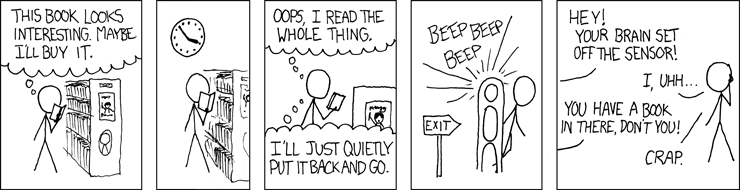
Then there's this comic, which I think is just generally amusing...


Then there's intelligent humor - humor with a punch behind it. It's funny but it has a point to make. I think a literary character that exemplifies this humor is Mercutio of Shakespeare's Romeo and Juliet. He is constantly making puns and jokes throughout the play, even as he lies dying ("Ask for me tomorrow, and you shall find me a grave man") but his jokes often have a barb of truth to them. Yes, he makes us laugh, but he also makes us pay attention.

Another example that I've recently discovered is my dear Mr. Charles Dickens, who I hated all through middle school and high school and finally picked up last month. I would find myself laughing aloud at Oliver Twist in public places, and then being appalled that I was laughing. Mr. Dickens was poking fun at poor, pure, innocent little Oliver and making light of the villains who made his life difficult, but he phrased those situations in such wry, subtle words that they seemed ridiculous even while being heart-wrenching. My favorite character was the pompous and awful Mr. Bumble, and my favorite quote is this passage about his wife crying -
But tears were not the things to find their way to Mr. Bumble's soul; his heart was waterproof. Like washable beaver hats that improve with rain, his nerves were rendered stouter and more vigorous, by showers of tears, which, being tokens of weakness, and so far tacit admissions of his own power, pleased and exalted him. He eyed his good lady with looks of great satisfaction, and begged, in an encouraging manner, that she should cry her hardest: the exercise being looked upon, by the faculty, as strongly conducive to health. 'It opens the lungs, washes the countenance, exercises the eyes, and softens down the temper,' said Mr. Bumble. 'So cry away.'
What a jerk, right? But very witty.

I also enjoyed this very true evaluation of a good sense of humor in The Age of Innocence by Edith Wharton:

She had a sense of humor (chiefly proved by her laughing at HIS jokes).

Isn't that the truth? Anyway, my point is, literature can be funny, and I think it is often better for it. What about you? Any favorite funny literature?

Oliver Twist Read-along: Post 3

Monday, February 28, 2011

Dear Mr. Dickens,

Our time together has come, for now at least, to an end. Before I tell you my thoughts on the last part of your novel, I wanted to tell you that your great granddaughter, Ms. Monica Dickens, has come to my attention recently. I have seen many positive reviews of her Persephone novel, Mariana, and hope to pick it up soon. I am intrigued to find if her style is anything like yours. I also wanted to mention to you that I will be attempting A Tale of Two Cities yet again within the year. I don't anticipate that it will prove to be any easier for me, but I hope that because our relationship has improved I will be more likely to stick it out. Finally, I wanted to let you know that I have enclosed a brief review of Oliver Twist in case anyone eavesdropping on this correspondence would like to know my thoughts sans spoilers.

I found the last third of your book to be much more exciting than any other volume. I did read a simplified version of Oliver Twist in childhood and therefore had some anticipation of what was to come. However, the events still struck me just as drastically. I think the scene that moved me most profoundly was the stark contrast between Rose Maylie and Nancy when they met in the dark. Rose is the picture of graciousness and feminine virtue, the pinnacle to which womanhood can hope to attain, while Nancy is the exemplar of degradation and degeneration, the depths to which womanhood can sink. However, both women are united in their desire to protect and nurture Oliver, and to love and be supported by a man - it is just that Rose has been in contact with a good man, while Nancy has been in contact with the worst of men. Her reasons for staying with Sikes are heartbreaking but I'm sure resonate with any woman who has stayed in an abusive relationship -
'When ladies as young, and good, and beautiful as you are,' replied the girl steadily, 'give away your hearts, love will carry you all lengths -- even such as you, who have home, friends, other admirers, everything, to fill them. When such as I, who have no certain roof but the coffinlid, and no friend in sickness or death but the hospital nurse, set our rotten hearts on any man, and let him fill the place that has been a blank through all our wretched lives, who can hope to cure us? Pity us, lady -- pity us for having only one feeling of teh woman left, and for having that turned, by a heavy judgment, from a comfort and a pride, into a new means of violence and suffering.'
Even more heartbreaking was the terrifying and gruesome murder of Nancy by the man she loves, and the way he can no longer shake the image of her pleading eyes from his mind. The fact that imagining her eyes is worse than actually seeing them is a testament to how low he is. Much of the tragedy and sorrow of Oliver's little world is alleviated by sarcasm and light speaking, but in these final scenes with Sikes you show us the real colors of that world. Well, the real colors dyed with a Victorian compound that elicits frightening, dramatic images of ghostly eyes stalking the murderer through the countryside.

I have heard that your intent in writing this novel was to exhibit the plight of the poverty-stricken and crime-ridden inhabitants of London. I think in this, you were able to remain accurate. However, in your countless fortuitous connections between Monks, Oliver Twist, the Maylies, and Mr. Brownlow, I think you may have overstepped reality just slightly. That Oliver should have found both families he was connected with in such a large country as England seems completely preposterous. However, I enjoyed discovering the connections and was happy on poor Oliver's behalf that they were found. Although of course you couldn't resist killing Dick. That was a bit unkind of you, although I guess no ending can be too happy if it is to be true to life.
Amid your thrillingly blood-chilling murder and ghost scenes, you did manage to impart a few more sarcastic insights into your more comical characters. I would just like to mention a few quotes I particularly enjoyed -
On Mr. Bumble:

But tears were not the things to find their way to Mr. Bumble's soul; his heart was waterproof. Like washable beaver hats that improve with rain, his nerves were rendered stouter and more vigorous, by showers of tears, which, being tokens of weakness, and so far tacit admissions of his own power, pleased and exalted him.

On Mr. Grimwig:
'I had serious thoughts of eating my head to-night,' said Mr. Grimwig, 'for I began to think I should get nothing else. I'll take the liberty, if you'll allow me, of saluting the bride that is to be.' Mr Grimwig lost no time in carrying this notice into effect upon the blushing girl.
And I was rather thrilled with Charley Bates' end as well. He was a character of particular annoyance for me (did you have to make him laugh every moment?) but I was glad he decided to live an honest life in the end.

Overall, kind sir, I believe you have executed a masterpiece. My time with you has been far more enjoyable than I could ever have expected, and I must thank Allie for prodding me toward the visit.

I remain, until I next dare to attempt one of your revered works,

The Story Girl.

Post script: As promised, the brief review. I'm going to be extremely lazy and just break it down into my five areas with a bit of extra detail.

Accessibility/readability: The writing can be a bit thick at times, but was in general pretty readable as long as you are willing to wade through some wordy passages.
Plot: 4. I really enjoyed Oliver's story. It did get a bit slow in the middle, but by the end I was hanging on every word.
Characters: 4. Some of the characters were extremely irritating, but in a comical way (Charley Bates, Fagin, Mr. Grimwig). Mr. Bumble was an absolute delight to me because he was so ridiculous. I also loved the development and contrast between Nancy and Rose Maylie.
Literary merit/Aesthetics: 5. I loved the writing in this book. I loved the sarcasm. I loved the contrast of poignant and comical. Definitely a masterpiece.
Personal Response: 4. It's not a "favorite," per se, but definitely an amazing work. I'm glad I read it and would recommend it to anyone who doesn't mind a heavy dose of description and sarcasm.
Overall: 4

Oliver Twist Read-Along: Book 2

Thursday, February 17, 2011


Dear Mr. Dickens,

Your continued tale of the misfortunes (and good fortunes) of the cherubic Oliver Twist continue to interest me, as well as the lives of the individuals that surround him. I must admit that I am familiar with the tale already, thanks to a series for children that strips the stories of the writing behind them and presents only the tales. While I was fascinated by the tale, I must admit that I thought your writing would decrease my enjoyment. As I told you in my last epistle, this was not the case, and I am thoroughly enjoying your story-telling.

I must say that one of my favorite characters to hate is Mr. Bumble. He is so ridiculous and yet so utterly perfect, a caricature who bumbles and blusters through life. His courtship of the Widow Corney was a sheer delight, as he sneaked in her cupboards to see how many silver spoons she possessed, and declared her an angel when she told him that the board gave her coals and candles. "Such parochial perfection!" he cries out in romantic bliss, and reminds Mrs. Corney that the master of her house is about to die. "What a opportunity for a jining of hearts and housekeepings!" In a real person his traits would be despicable and repulsive. In this case his traits are food for laughter.

Oliver's tragic misfortunes become his greatest blessings as he drags himself over the fields back to the very house he was attempting (forced by Sikes) to burglarize. I must say, Mr. Dickens, that at times you seem very heartless. Are you familiar with the film Stranger Than Fiction, in which the author narrates the life of a real man? Her plot necessitates his death, but when she discovers that she is putting a real person in danger, she rethinks her ending. (I know this is an anachronism, but as this letter is also an anachronism, I pray you won't take offense). Consider, Mr. Dickens, if this were the case with you and Mr. Twist. You would be guilty of subjecting him to all sorts of unjust tortures and torments, clearly undeserved by such a perfectly angelic child, who despite his years of hunger and want, cannot bring himself to steal. But perhaps this is your point - to show us all that circumstances are not dictated by karma but merely by chance. The rich have no more right to their good fortune than the poor - they are just lucky. Is this what you mean?

Anyway, at least you were kind enough to deliver Oliver to two sentimental women who protect him despite his seemingly obvious role in the burglary and care for them as his own. Under their protection, Oliver is schooled in reading, writing, and flower arranging. All is perfect until Rose, the younger of the two ladies, is stricken ill by a random and unknown illness. Oliver is plagued with worry, but the illness brings only good fortune, as the son of the elder lady, Mr. Henry Maylie, comes at once and becomes Oliver's rival in flower arranging.

However, Mr. Maylie brings sorrow to Rose in a truly Jane Austen-esque scene. Mr. Dickens, you wrote in a time when society and class standing were much more important than they are now. I cannot fully comprehend what it would be to reject a proposal of marriage because my parents had committed some crime and I couldn't bear to have my bad name reflecting upon my husband. Now, we are more of a mind to tell gossipers exactly where they can put their opinions. However, I believe your point was to show that Rose is a noble and self-sacrificing person, willing to give up her own hopes and dreams to keep from harming another. "Busy recollections of old hopes, cherished as a girl, long ago, crowded into the mind of Rose, while making this avowal; but they brought tears with them, as old hopes will when they come back withered; and they relived her." What surprises me most, Mr. Dickens, is Mrs. Maylie's determination to dissuade her son from marriage. Rose is her dearest companion, and I am surprised that she would caution her only son against making the match. I suppose she was really just trying to protect Rose or something disgustingly wise and noble like that. Maybe I am too young to understand.

The last thing I want to discuss with you is Fagin's completely disturbing appearance outside Oliver's window. I have to say I am intrigued both by his determination to find this stray orphan and his creepiness. Sure, Oliver saw his collection of jewels that he kept locked up, but is that really a reason to stalk him out to the country, at least a day's journey away, and creep in his window? I hope Fagin's devious motives are soon laid bare. I must say that I am enjoying the element of suspense and creepiness.

Overall, Mr. Dickens, while I feel in some ways this volume of Oliver's story is just a placeholder, my interest is certainly piqued to find out how it ends. I have a feeling many of the characters' lives will connect in ways unexpected. Until February 28, I remain,

The Story Girl

Oliver Twist Read-Along: Post 1 (Ch. 1-22)

Tuesday, February 08, 2011


Esteemed Mr. Dickens,

I owe you an apology. For years, I have avoided your acclaimed works, believing them to be stuffy, old-fashioned, and out of the interest of my modern intellect. After multiple attempts at reading A Tale of Two Cities, I gave you up forever. I could not understand your writing, did not take interest in your characters, and wondered if the language you wrote in and the language I spoke were, in fact, even related.

However, this day I stand chastised, humbled, and completely corrected. The first section of your tale, Oliver Twist, left me completely enraptured. I love your amusing and apt characterizations. The plight of Mr. Twist played upon my heart-strings, especially the moment when, freezing and appalled at the moral travesty he is being forced to commit, he cries out, "Let me run away and die in the fields. [...] Oh! pray have mercy on me, and do not make me steal." Indeed, Oliver's many trials, from the workhouses and orphan homes that nourish the body as little as humanly possible, to the undertaker's home, where Oliver is ruthlessly teased by the maid and charity-boy, to Fagin's lair, where he is trained to perform that action he so wholly abhors, stealing - Oliver's case is one for pity. However, he is also a character to admire, with surprising resilience and ability to survive in the face of adversity.

Your other characters also interest me, Mr. Dickens, although it does grate upon my nerves when their individual quirks are brought up again and again. How many times does Mr. Fagin call his friends "my dear"? Surely if it is as often as you have recorded, they tire of his voice and hide from his endearments. I also found Mr. Bates' fits of laughing quite bizarre and irritating. Clearly, he is an individual to find hilarity in inappropriate situations. However, must this point be brought up thrice every time we encounter him?

However, overall I found your depictions of both character and scene to be witty and amusing. I found myself laughing audibly in many scenes (and then feeling guilty for laughing at a book that describes so much misery and lack of justice). Your sarcasm is refreshing, and quite unexpected in what I thought would be a dry, scholarly tale full of archaic terms. It is dry indeed, but in the humorous way. One example of your delightful sarcasm (occurring during an interview in which Oliver is quite terrified) -
These two causes made him answer in a very low and hesitating voice; whereupon a gentleman in a white waistcoat said he was a fool. Which was a capital way of raising his spirits and putting him quite at his ease.
In short, Mr. Dickens, I am pleased that I have found reason in this volume to discontinue our avoidance of one another. I look forward to finishing this tale, and plan on perusing others, even the dreaded Tale of Two Cities (which I do not expect to enjoy nearly as much as your history of Oliver, but which I expect will be more tolerable than I remember).

I remain, until February 17,

The Story Girl.

For links to other participants in the Oliver Twist Read-Along, see A Literary Odyssey. :)

I think I have a problem.

Wednesday, February 02, 2011

I am officially addicted to read-alongs and challenges. But it's better than being addicted to hard drugs, right? At least my addiction improves my mind. :) I am participating in two read-alongs for the month of February, and I am also joining the Battle of the Prizes, a challenge that I thought sounded intriguing last year and have therefore decided to join in this year.

First of all, the Oliver Twist Read-along, hosted by Allie at A Literary Odyssey. Originally, I planned to read Great Expectations for my 19th century classic in the Back to the Classics Challenge, but I had been dreading the Dickens and so I decided a read-along would be a better way to jump in. Here is the schedule:
February 8 - Book 1 (22 chapters)
February 17 - Book 2 (14 chapters)
February 28 - Book 3 (15 chapters)
I will say that I have already gotten started with this one and am absolutely loving it. Maybe I was too immature to enjoy Dickens the first time I tried to read him.

Secondly, I am participating in the Age of Innocence Read-along hosted by Beth at Bookworm Meets Bookworm. I am also reading this one for the Back to the Classics challenge (20th century classic) and it will fit in nicely with the Battle of the Prizes challenge as well. The post for Book 1 is on February 16 and Book 2 is on March 2. The House of Mirth is one of my most loved books so I am excited to read another novel by Edith Wharton.

Finally, I am joining in Rose City Reader's American version of Battle of the Prizes. There are two Pulitzer Prize winners on my TBR this year, as well as one National Book Award winner. I just need to find one more National Book Award and the challenge will be complete.
Pulitzers:
* The Age of Innocence by Edith Wharton
* Arrowsmith by Sinclair Lewis
National Book Award:
* Paris Trout by Pete Dexter
And potentially, Let the Great World Spin by Colum McCann, The Corrections by Jonathan Franzen, or Invisible Man by Ralph Ellison.

Hooray! I have no self control!
Related Posts Plugin for WordPress, Blogger...