Showing posts with label east of eden. Show all posts

A Classics Challenge: November meme

Tuesday, November 27, 2012


Here is the question for November for November's Autumn's A Classics Challenge:
Of all the Classics you've read this year is there an author or movement that has become your new favorite? Which book did you enjoy the most? Or were baffled by? Who's the best character? The most exasperating? From reading other participants' posts which book do you plan to read and are most intrigued by?
To tell you the truth, I think the most enjoyable classic for me this year has been East of Eden by John Steinbeck. This is actually a reread for me, but going through it a second time (and having someone with whom I could discuss it, my husband, who also recently reread the book) made it an extremely rewarding experience. I've always loved John Steinbeck (Okay, maybe not always -- the first book I read by him was The Pearl, which I loathed, but that was when I was 15 and I don't think it counts), but I gained a new appreciation for his work this time around. I've also recently finished Journal of a Novel, which consists of letters John Steinbeck wrote to his editor while working on the novel, which further increased my appreciation.

I think one book I would really like to read from seeing others' posts this year is A Room With a View by E.M. Forster. I can't remember if it was this challenge specifically that has introduced me to it, but I've seen many posts about it this year and I am hoping to get to it soon. 

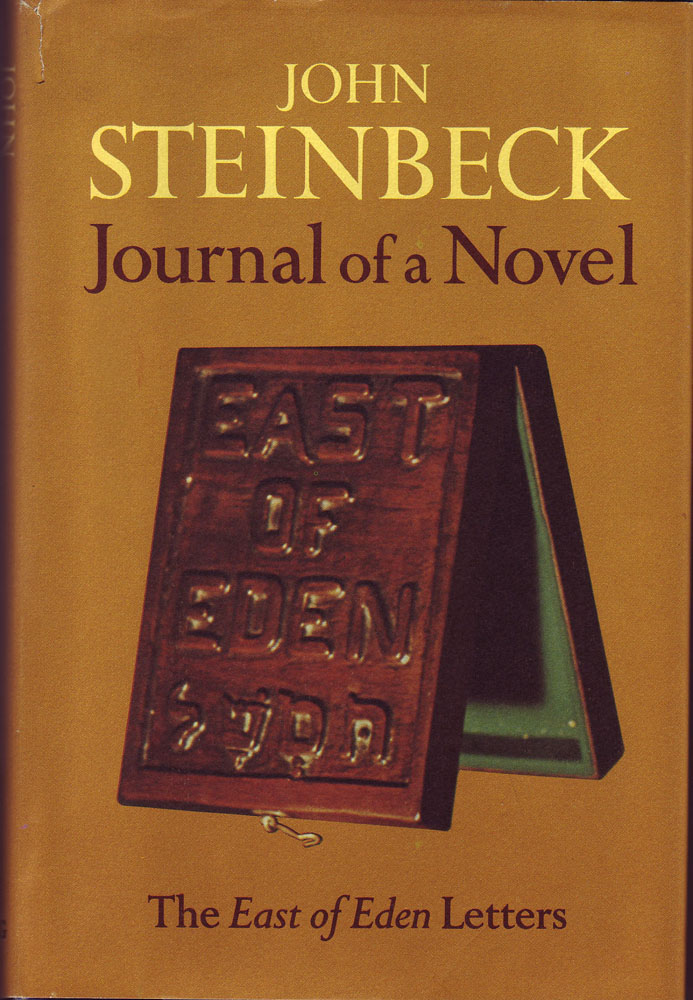
Journal of a Novel: The East of Eden Letters by John Steinbeck

Friday, November 16, 2012

Title: Journal of a Novel: The East of Eden Letters
Author: John Steinbeck
Genre: Nonfiction, memoir
Publisher: Penguin Books, 1990 (obviously written before that)
Source: Library
Read for: Fun

It is a well-known fact on this blog that I love John Steinbeck's East of Eden. When my friend Allison told me about this book, which consists of letters Steinbeck wrote on alternating pages with his manuscript for the novel, I knew I needed to get my hands on it. I wasn't sorry that I did -- Journal of a Novel gave me great insights into both East of Eden and John Steinbeck himself.

One of the first things I noticed was that, despite the fact that the letters Steinbeck wrote were just warm-ups for his daily novel writing, he still writes so well. His writing style has always been incredibly poignant and powerful for me, and that didn't change in the unpolished East of Eden letters.

I also loved having Steinbeck's thoughts about his own characters. For example, the Hamilton family, who are juxtaposed against the main characters the Trasks throughout the novel. I assumed the Hamiltons were at least partially inspired by people from Steinbeck's life, as he referenced his own mother a few times, but I assumed that they were mostly fictional. From Journal of a Novel, I learned that almost everything about them in the novel (aside from their interactions with fictional characters) was true. I also enjoyed reading Steinbeck's reasons for including the Hamiltons in the novel, as well as his reasons for many other of the decisions he made with the novel.

I think my favorite part, however, was getting to know Steinbeck better as an individual. I loved some of his little observations on life, his obsession with having the perfect pencil (and thus needing his electric pencil sharpener to always be in perfect working order), his desire to constantly be inventing and carving things. In many ways I felt that Steinbeck was a kindred spirit for me, such as his descriptions of the way things of the heart are unknowable to other people (something he explored quite a bit in The Winter of Our Discontent) and his complete and utter inability to relax (me too, Steinbeck! me too!). Having that added insight into his personality will, I think, help me to appreciate his work even more.

Anyone who has read East of Eden and wants to explore it further will benefit from Journal of a Novel. It will also bring great insight into (in my opinion) America's great author. Journal of a Novel was a fascinating journey into Steinbeck's mind and the background of East of Eden.

4 stars

Warnings: Mild language, spoilers for East of Eden (obvs)

Spiritual Sundays: Agency in Literature

Sunday, October 21, 2012


It has been a long time since I've written a "Spiritual Sundays" post, but lately some of the concepts I've been coming across in books I've been reading spurred the desire to write this post. 

My entire life, I've been taught the importance of the concept of "agency." My church's definition of agency is: 
Agency is the ability and privilege God gives us to choose and to act for ourselves. Agency is essential in the plan of salvation. Without agency, we would not be able to learn or progress or follow the Savior. With it, we are “free to choose liberty and eternal life, through the great Mediator of all men, or to choose captivity and death, according to the captivity and power of the devil” (2 Nephi 2:27).
So basically, agency is the principle that all people on earth have the right and the ability to make their own choices. Those choices come with consequences, whether positive or negative, but the choice is always present. I grew up being taught that agency was one of the most important gifts from God to humankind -- without it, our actions would be meaningless. (Boethius explores the idea of agency vs. fate/foreordination quite a bit in his Consolation of Philosophy, which I read in college, but I can't remember what his conclusions were... just thought I'd throw that fact in there while we were talking about agency). 

So what does this have to do with literature? Well, in the last few weeks I read two different passages in two different books that illustrated this principle, and I just wanted to bring them together because I thought it was really interesting and beautiful that a concept that I believe is an absolute truth was showing up multiple times in the books I was reading. 

The first passage is from The Giver. In this book, the protagonists live in a society where agency has been taken away. Everything is organized and set up so that people live perfectly happy, easy lives. However, there is a complete lack of emotion and meaning to these peoples' lives, and the protagonist, Jonah, realizes this:
‘But now that I can see colors, at least sometimes, I was just thinking: what if we could hold up things that were bright red, or bright yellow, and he could choose? Instead of the Sameness.’
            ‘He might make wrong choices.’
            ‘Oh.’ Jonas was silent for a minute. ‘Oh, I see what you mean. It wouldn’t matter for a newchild’s toy. But later it does matter, doesn’t it? We don’t dare to let people make choices of their own.’
            ‘Not safe?’ The Giver suggested.
            ‘Definitely not safe,’ Jonas said with certainty. ‘What if they were allowed to choose their own mate? And chose wrong?
            'Or what if,’ he went on, almost laughing at the absurdity, ‘they chose their own jobs?
            ‘Frightening, isn’t it?’ The Giver said.
            Jonas chuckled. ‘Very frightening. I can’t even imagine it. We really have to protect people from wrong choices.’
            ‘It’s safer.’
            ‘Yes,’ Jonas agreed. ‘Much safer.’
            But when the conversation turned to other things, Jonas was left, still, with a feeling of frustration that he didn’t understand.
I found this passage so interesting, because we actually believe that Satan wanted to implement a similar plan in opposition to that of God; instead of allowing people to make their own choices, he wanted to eliminate choice and give people a "fool-proof" life that was essentially devoid of meaning and purpose. 

The second passage I came across is from East of Eden by John Steinbeck, and illustrates the importance of the word timshel, a Hebrew word found in Genesis in the story of Cain and Abel. 
‘Ah!’ said Lee. ‘I’ve wanted to tell you this for a long time. I even anticipated your questions and I am well prepared. Any writing which has influenced the thinking and the lives of innumerable people is important. Now, there are many millions in their sects and churches who feel the order “Do thou,” and throw their weight into obedience. And there are millions more who feel predestination in “Thou shalt.” Nothing they may do can interfere with what will be. But “Thou mayest!” Why, that makes a man great, that gives him stature with the gods, for in his weakness and his filth and his murder of his brother he has still the great choice. He can choose his course and fight it through and win.’ Lee’s voice was a chant of triumph.
            Adam said, ‘Do you believe that, Lee?’
            ‘Yes, I do. Yes, I do. It is easy out of laziness, out of weakness, to throw oneself into the lap of deity, saying, ‘I couldn’t help it; the way was set.’ But think of the glory of the choice! That makes a man a man. A cat has no choice, a bee must make honey. There’s no godliness there. [...] I have a new love for that glittering instrument, the human soul. It is a lovely and unique thing in the universe. It is always attacked and never destroyed – because “Thou mayest.”'
I love that recognition of the fact that mankind is able to become elevated, to become truly good, because we are able to make choices, to decide if we are going to do good things or evil things.  If we didn't have the ability to make those decisions, our actions would be meaningless. I loved coming across that over and over in the last few weeks. I'm grateful for the opportunity it provided to consider the importance of agency and reflect in gratitude that it is part of my life. 

Literary Lyrics: "Timshel" by Mumford and Sons

Thursday, October 18, 2012

Having recently reread East of Eden, I've become re-enchanted with the whole concept of timshel, which is a Hebrew word used in Genesis in the Old Testament when God is chastising Cain for giving an unacceptable offering. The word means "Thou mayest" and in the book is used to illustrate that all people have a choice to overcome the influences and natural urges of their lives -- basically to triumph over sin.

Lately I've been listening to Mumford & Sons (I know I'm a little behind the times) and when I saw that they had a song called "Timshel" I had to see if it had any tie to East of Eden (because honestly, how could it not?). The references are fairly vague but if you've read the book you can see it -- the references to brothers is clearly a Cain/Abel/Aron/Cal/Adam/Charles reference (yes, lots of brotherly relationships in this book), the reference to a mother could be Cathy (as well as the reference to a cold, cold mind), and the book directly refers to the concept of timshel as man's ladder to the stars. So there you go. Way to write an intelligent song, Mumford & Sons. :)

Timshel

Cold is the water
It freezes your already cold mind
Already cold, cold mind
And death is at your doorstep
And it will steal your innocence
But it will not steal your substance

But you are not alone in this
And you are not alone in this
As brothers we will stand and we'll hold your hand
Hold your hand

And you are the mother
The mother of your baby child
The one to whom you gave life
And you have your choices
And these are what make man great
His ladder to the stars

But you are not alone in this
And you are not alone in this
As brothers we will stand and we'll hold your hand
Hold your hand

And I will tell the night
Whisper, "Lose your sight"
But I can't move the mountains for you

- Mumford and Sons

East of Eden by John Steinbeck

Monday, October 08, 2012

Title: East of Eden
Author: John Steinbeck
Genre: Classic
Originally published: 1952
Source: Personal copy
Read for: A Classics Challenge, Back to the Classics 2, The Classics Club, Banned Books Week, Chunkster challenge

John Steinbeck said of East of Eden, "Nearly everything I have is in it, and it is not full. Pain and excitement are in it, and feeling good or bad and evil thoughts and good thoughts -- the pleasure of design and some despair and the indescribable joy of creation."

What can be said to summarize East of Eden? In its simplest form, it is an allegory of the story of Cain and Abel -- but with a twist -- what if Cain had chosen to overcome his mistakes and his jealousy, had tried to rise above the fate he believed he had for himself and become a whole person?

There is so much more to the story than that, but I don't know how to summarize it without drawing everything in and writing pages and pages and pages about it. Honestly, I don't know how to write about East of Eden -- it is a book that means so much to me. I first read it my senior year of high school for a classics project, and I was absolutely drawn in (thank you to my awesome AP English teacher, Ms. Taylor, for recommending it in the first place). I loved the message, the depth of the story, and of course the writing. When we were talking about names for our son (who is due in 39 days, hooray!), my husband (who also had read and fallen in love with East of Eden) brought up Caleb, Cal for short, the name of the protagonist/anti-hero. It seemed to just fit, and we both decided to reread the book. We love the symbolism of the character, the journey he takes from an uncertain, jealous, struggling boy to a man who takes his destiny into his own hands and overcomes the forces of sin and circumstance pressing against him. I'm starting to ramble at this point, but perhaps this gives you a sense of my personal connection to East of Eden.

As for the book itself, it is so rich and vivid and multilayered. The cast of characters is vast but richly developed. I feel as if these characters are a part of my life. From Cal's inner struggle to the unbelievably evil acts of Cathy, from the philosophical journeyings of Lee and Samuel Hamilton to the muddled idealism of Adam and Aron, the characters fly off the pages.

While the characters give the book life, I think the greatest value of it is in the writing and the ideals behind it. The central idea of the book is the concept of timshel, a Hebrew word meaning "Thou mayest" that occurs in the Cain and Abel verses in Genesis. The main idea is that when God chastised Cain for his misplaced offering and killing his brother, he told him that "thou mayest" triumph over his sins. He had the choice to change his life and become more than he was in the current state. It is such a powerful idea, one that Lee, the philosopher-servant of the Trask family, calls man's "ladder to the stars."

In addition, John Steinbeck's writing is unbelievable, which is no more than what I expect of him. The other day my husband and I decided that in our opinion John Steinbeck is the greatest of all American authors. Granted, we are both scientists with no literary training, but we are also reasonably well-read, and that is our opinion. :)

Obviously I can't be coherent or unbiased about this book, and this review is nothing but a rambling on and on of how much I love it. But honestly, pick it up. While I can't promise that it will affect you as much as it affected me, I do think it is worth a read. It will inspire a lot of thought whether or not you agree with what it professes to be true.

5 stars

Warnings: Brief strong profanity, prostitution, some innuendo

Literary Lyrics: "Monster" by Meg and Dia

Thursday, August 16, 2012

So, I don't actually know this song, but I was at a loss for what to use for this month's Literary Lyrics. I found this list on Wikipedia that references songs about or referencing literature, and I saw that the song "Monster" by Meg and Dia was inspired by Cathy Ames in East of Eden -- also known as the most evil character ever created (in my opinion). I couldn't resist learning about this song. 

His little whispers.
Love Me. Love Me.
That's all I ask for.
Love Me. Love Me.
He battered his tiny fists to feel something.
Wondered what it's like to touch and feel something.
Monster.
How should I feel?
Creatures lie here.
Looking through the window...
That night he caged her.
Bruised and broke her.
He struggled closer.
Then he stole her.
Violet wrists and then her ankles.
Silent Pain.
Then he slowly saw their nightmares were his dreams.
Monster.
How should I feel?
Creatures lie here.
Looking through the windows.
I will.
Hear their voices.
I'm a glass child.
I am Hannah's regrets.
Monster.
How should I feel?
Turn the sheets down.
Murder ears with pillow lace.
There's bath tubs.
Full of glow flies.
Bathe in kerosene.
Their words tattoed in his veins, yeah.


Pretty bleak, but so is the character in the book. Not my usual musical choice, but it was interesting to learn something new. 

Why I Read... Classics (part 1)

Thursday, September 22, 2011

In my mind, there are two denominations of a classic - the typical, traditional classic and the "modern classic." While I don't entirely agree with the term "modern classic" (to me, the term classic indicates the passage of some amount of time and the ability of a work to stand up to that passage of time), it is a genre that I enjoy, so for lack of a better term, I will continue to use it to classify that group of books.

However, for today, I would like to focus on, um, unmodern classics. Which for the purpose of this post, is defined as an old book (before 20th century) that has literary and aesthetic meaning and merit. 

Classics have almost always been a part of my literary diet. Hand in hand with my love of historical fiction, I grew up enjoying "old-fashioned" things. Even more old-fashioned than the stories written about the era after the fact are the stories written right in the thick of things. In elementary school I devoured every volume of the Great Illustrated Classics series that I could get my little hands on. I have no idea if this series is still in print, and unfortunately most of those books that I owned disappeared in a garage sale years ago, but I am definitely hoping that I have access to them once my children are at an age when they are an appropriate reading level. Those books introduced me to the classics and gave me a familiarity with the stories that allowed me to enjoy them later when the language got harder. (I also have to put in a little plug for Wishbone, which gave me that familiarity even earlier than the Great Illustrated Classics). 

My love of the classics in their unabridged form was ongoing throughout high school, interspersed with fantasy and sci fi, but it was intensified my senior year in AP English. Each semester, we were required to choose a classic and do a huge project on it, involving about 20 small 2 page papers and projects. The last two weeks of the semester, we all presented on our projects, aiming to give a familiarity with the canon to everyone in preparation for our AP lit test. I was lucky enough to have two very excellent books suggested to me (The Count of Monte Cristo and East of Eden) and discovered several more in the process of the presentation. Up until the last year or two, my reading was almost exclusively classics from that point. 

Anyway, I'm pontificating overmuch in this introduction. I guess to sum up, if you are even still reading, the classics are a huge part of my life. I love them.

Why I Read Classics

* Timelessness. The reason these stories have lasted is because they tell a story that appeals to many people, or explore a theme that is important across large groups of humanity. These aren't for specialized audiences - these are stories that have touched thousands and millions of people.
* Rich writing. This isn't present in every classic - sometimes the writing is thick rather than rich (now I feel like I'm talking about Yoplait). However, in general classics have beautiful, well-crafted, and sensorily appealing sentences.
* Complexity. Once again, not always the case, but many of the classics I love have many things going on, unfolding slowly over time. Love it. 
* The prestige factor. Mostly kidding. But it does lend a certain sense of pride to have finished some of the more difficult tomes. 

Recommendations

* Jane Eyre by Charlotte Bronte and Wuthering Heights by Emily Bronte - I love the Brontes. Haven't gotten acquainted with Anne yet, but I think that will also be a good experience. These Victorian slightly creepy romances are excellent autumn or winter reads and tell love stories that aren't as simple as love-at-first-sight-then-happily-ever-after. 
* Anne of Green Gables and just about everything else (excepting Jane of Lantern Hill, which I did not like) by L.M. Montgomery. These classics tell simpler stories, but I've never been able to get enough of them. They describe good, simple lives with romance, family, and personal development.
* The Count of Monte Cristo by Alexandre Dumas. Despite the 80-odd pages of history on the Napoleonic wars, this book has a powerful narrative with many intertwining plot lines. If the huge volume intimidates you, read the abridged version. It's better than nothing!
* Middlemarch by George Eliot. This isn't an easy book, but I was swept up by it. Give it a chance and skim the sections on local politics. 

For further recommendations, visit...

Dead White Guys. If you like your classics with a serving of snark, this will be your new home. 
Rebecca Reads.  Thoughtful reviews with a lot of depth. She also runs the Classics Circuit, another great resource for learning about classics in concentrated areas. 
A Room of One's Own - Jillian is one of the most passionate readers I know through the blogiverse. She is dedicatedly becoming well-read, tackling many challenging texts but also many children's classics. 
A Literary Odyssey - Allie is working through a 250-book long list of classics. She works through many of the classics that absolutely intimidate me (namely: the Greeks). Her reviews are personable and informative. 


The Three Musketeers by Alexandre Dumas: Readalong Post II

Thursday, March 31, 2011

Guys, this is going to be another lazy-lazy post. I'm not sure exactly why, but this week is leaving me totally drained. At least the semester is almost over!

I found myself enjoying the second half of the book much more than the first half. In the first half, the Three Musketeers and D'Artagnan seemed to just be messing around, spending all their money on foolish things and picking fights. The second half of the novel seemed much more serious to me. Suddenly, they had a goal (at times tenuously defined, it is true) - they wanted to protect Madame Bonacieux, the Duke of Buckingham (well, some of them wanted to do that...) and above all, D'Artagnan. They have a defined nemesis - while they are always more or less against the cardinal, Milady is their true enemy, and it is she against whom they are fighting. Once the Musketeers had a purpose, I saw a point in their escapades. They still did stupid things, but at least they were doing something other than trying to earn money, buying horses, losing the horses through gambling, etc. (How many times did that happen?)

In this more purposeful section, I noticed a strong disparity between the Musketeers - almost as if they were cut in half and divided into two groups. On one side of the spectrum we have Aramis and Porthos. These men are comical and (more) foolish. Porthos is obsessed with women, money, and fashion. He is a bumbling, dramatic man (but does have his good points). Aramis is more serious, but also foolish because he holds so fiercely to his ideal of becoming a priest, and yet cannot stay away from women. One the other side of the divide, we have Athos and D'Artagnan - also made fools by women, it is true, but able to calculate, to plan their next advances. I really enjoyed the character of Athos, with his quiet intensity and his ability to attend to his silent servant with hand-gestures. And while D'Artagnan is young and overly passionate in this story, it's obvious that he is intelligent and brave enough to plan his own destiny.

As I glanced through that last paragraph, I realized that in different ways, the main weakness of all the Musketeers (I just automatically consider D'Artagnan as a Musketeer) involves women. Porthos needs money, and he can only get money by seducing women. Aramis believes he is called to a holy life, but keeps messing around and putting off his ordination - because of women. Athos drinks all the time because a woman ruined his life, and D'Artagnan is in agony because of the two women he falls in love with in the story. So it makes sense that the arch-nemesis of the Musketeers is a woman, Milady Clarik.

I have always said that Kathy in East of Eden by John Steinbeck was the most evil character I have ever read, but Milady could give her a run for her money. Armed with beauty, a sweet voice, and a razor sharp desire for revenge, Milady ensnares men with her charms and then leaves them to die. Even though it was horrible, I was fascinated by how carefully plotted Milady's attacks were and the way she was able to be so sure of the effect of her charms. At the same time, I was bothered that Dumas chose to portray women as the downfall of men. I really think this was a major theme of the novel. I even think Dumas quoted some proverb about women being the downfall of men... but I'm too lazy to look it up now!

To sum up... this book was a decent read, but longer than it was enjoyable. Things got better toward the end. There are multiple sequels to this novel that are waiting for me on my Kindle. I think I need a little break, but I'll be curious to see if the musketeers ever grow up. I don't think Porthos will.
Related Posts Plugin for WordPress, Blogger...