Pregnancy weight gain is hard to bounce back from. At least, that is my experience, and I've heard it's other people's experience as well (the women in my community don't seem to have a problem with it. Maybe there should be a sequel to this book called Women in LA Don't Get Fat, Either). 10 months and a 9.5 lb delivery later, I'm still looking for answers, and French Women Don't Get Fat appealed to me on three levels: 1) Weight loss. 2) France 3) Supposedly you still get to eat things other than low carb wraps, vegetable juices, and celery. Could it be true?! Well, ask me in six months, I guess. While I haven't been at it long enough to know whether Guiliano's philosophies are effective, I do think her ideas are sound and well worth a try.
After all, she did start her analyses on why French women seem to stay thin so much better than American women after a study abroad left her 30 pounds heavier and looking like "a sack of potatoes," as her father charmingly stated it when picking her up from the airport. Her pastry devouring while at the Sorbonne didn't help matters until her mother discreetly set up an appointment with a "Dr. Miracle" who prescribed a weight loss program that worked, and that Guiliano shares in her book.
The basic form is that you take inventory by writing everything down and noting patterns of when and what you overeat; have a "Magical Leek Weekend" where all you eat is leek soup, and then spend three months "recasting" -- being stricter than you ordinarily would but knowing that at the end of it you can slowly add in the things you love -- in small doses -- and keep losing your weight. She also stresses the importance of variety -- eating a little bit of a lot of things -- and not restricting yourself overmuch.
I agreed with most of Guiliano's philosophies. Her descriptions of how French food and ingredients are better in every way might have annoyed me, except for the fact that I've experienced it firsthand and it's true. Also, the two months I spent in Paris were spent eating the richest, sugariest, fattiest food imaginable and I lost weight. She includes recipes as well. I did find myself skimming much of this portion of the book but it would be nice to have for reference in the future.
She doesn't have any research other than her own anecdotal experience and that of a few other women, and she can be pretty blunt, but I still thought French Women Don't Get Fat had a lot of good ideas, the crowning one being that food is good and you should feel good about eating it -- and you can, as long as you learn how to use restraint. Check back with me in six months and ask me if it worked.
4 stars
Warnings: None
Showing posts with label food. Show all posts
Paris My Sweet by Amy Thomas
Tuesday, January 31, 2012
Title: Paris My Sweet
Author: Amy Thomas
Genre: Food, memoir
Publisher: Sourcebooks, 2012
Source: NetGalley
Read for: Fun, Mixing it up Challenge
A lover of desserts, when Amy Thomas is offered a job in Paris, she feels as if she should be jumping at the chance. She's already visited multiple times, including what she calls her "tour de chocolat," an excursion when she planned out the best chocolatiers in the city along a bike route. However, she is in love with her home in New York as well. As you can probably tell from the title, she chooses to take the job in Paris and has a bittersweet -- but mostly sweet -- experience there.
There were things I adored about this book and things that were mediocre for me. I like to end on a positive note, so let's start with the aspect that didn't quite work for me. Throughout the book, Amy is having a conflict of Paris vs. New York that translates into some other life decisions as well, such as her status as a single woman as her friends get married and begin their families. She tried to connect these emotions and experiences with specific desserts. I really love the idea -- as a devoted food-lover myself, I know how much emotion can be tied to different foods -- but it didn't quite work for me. Some of the comparisons seemed strained, trying too hard to make a connection. I did enjoy reading about what Amy went through -- I think traveling can cause a reevaluation of priorities because the world is being seen through a new lens (whatever Emerson might think). When I lived in Paris I had my own bouts of insecurities and sadness. Living in a foreign country is hard, no matter how wonderful that foreign country is. Basically, I enjoyed both parts of the story, but at times it seemed as if the author were trying too hard to connect them together.
As far as the food goes, it was sheer, unadulterated delight. I absolutely loved reading the descriptions of deliriously good desserts in both Paris and New York. I highlighted countless patisseries and dessert bars, being sure of course to include the recommended treat. I had only visited a few of the locations Amy mentioned in Paris, and now I am determined to return and try more (for the record, I am a Laduree person. She doesn't pick a side, but it sounded to me as if she were a Pierre Herme. But that's okay).
In a nutshell, I enjoyed this book, especially the descriptions of food. While at times the structure seemed a bit contrived, it was an enjoyable read, and will certainly appeal to all travelers and gourmands.
3 stars
Warnings: Brief strong language
Author: Amy Thomas
Genre: Food, memoir
Publisher: Sourcebooks, 2012
Source: NetGalley
Read for: Fun, Mixing it up Challenge
A lover of desserts, when Amy Thomas is offered a job in Paris, she feels as if she should be jumping at the chance. She's already visited multiple times, including what she calls her "tour de chocolat," an excursion when she planned out the best chocolatiers in the city along a bike route. However, she is in love with her home in New York as well. As you can probably tell from the title, she chooses to take the job in Paris and has a bittersweet -- but mostly sweet -- experience there.
There were things I adored about this book and things that were mediocre for me. I like to end on a positive note, so let's start with the aspect that didn't quite work for me. Throughout the book, Amy is having a conflict of Paris vs. New York that translates into some other life decisions as well, such as her status as a single woman as her friends get married and begin their families. She tried to connect these emotions and experiences with specific desserts. I really love the idea -- as a devoted food-lover myself, I know how much emotion can be tied to different foods -- but it didn't quite work for me. Some of the comparisons seemed strained, trying too hard to make a connection. I did enjoy reading about what Amy went through -- I think traveling can cause a reevaluation of priorities because the world is being seen through a new lens (whatever Emerson might think). When I lived in Paris I had my own bouts of insecurities and sadness. Living in a foreign country is hard, no matter how wonderful that foreign country is. Basically, I enjoyed both parts of the story, but at times it seemed as if the author were trying too hard to connect them together.
As far as the food goes, it was sheer, unadulterated delight. I absolutely loved reading the descriptions of deliriously good desserts in both Paris and New York. I highlighted countless patisseries and dessert bars, being sure of course to include the recommended treat. I had only visited a few of the locations Amy mentioned in Paris, and now I am determined to return and try more (for the record, I am a Laduree person. She doesn't pick a side, but it sounded to me as if she were a Pierre Herme. But that's okay).
In a nutshell, I enjoyed this book, especially the descriptions of food. While at times the structure seemed a bit contrived, it was an enjoyable read, and will certainly appeal to all travelers and gourmands.
3 stars
Warnings: Brief strong language
Gourmet Rhapsody
Monday, August 30, 2010
Sorry about the delay in getting book reviews online. I have just moved to a new apartment with my husband and our internet is not working yet. Anyway...

Gourmet Rhapsody is the deathbed confession of Pierre Arthens, a celebrated food critic. When he learns he has fewer than 48 hours to live, the desire for a flavor that would bring him comfort and meaning in his last days plagues his senses. He journeys through his memories and different types of food as he searches for the elusive flavor. Alternating between these chapters are the reactions of various players in Arthens' lives when they hear the news of his imminent demise.
Gourmet Rhapsody was a delight for many reasons, but two in particular endeared the book to me. Arthens' sumptuous descriptions of gourmet foods titillated both my imagination and my taste buds. A "taste" of the sushi course:

"True sashimi is not so much bitten into as allowed to melt on the tongue. It calls for slow, supple chewing, not to bring about a change in the nature of the food but merely to allow one to savor its airy, satiny texture. Yes, it is like a fabric: shashimi is velvet dust, verging on silk, or a bit of both, an dthe extraordinary alchemy of its gossamer essence allows it to preserve a milky density unknown even by clouds." (Barbery, 73)
Being on my honeymoon when I finished this book, I had the opportunity to experience the "gourmet" a little more than usual. My husband and I ate at a restaurant called Napa Rose on the final night of the honeymoon. It was probably th
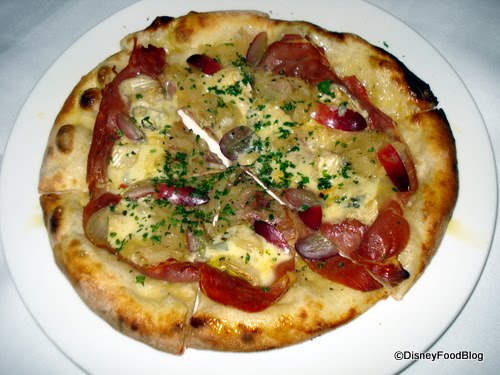
e fanciest restaurant I have eaten at in the United States. My meal consisted of an appetizer pizzeta of red grapes, French cheese, prosciutto, and caramelized onions (picture to the left), and my main course was salmon on wild rice with pine nuts and a blackberry salsa. I won't attempt to describe the meal in an Arthens-worthy manner, but just having read the book, with Arthens' adjectives fresh in my mind, I was able to have a richer experience. Arthens critiqued food not based solely on taste sensations - he also paid attention to its appearance, its scent, its texture, and most importantly, the emotions it evoked. This all-encompassing sensory experience became almost holy to him, and reminded me of something I heard when I was staying in Paris - that eating was a holy experience, a sacrament dedicated to nourishing both our bodies and our relationships.
The other thing I loved about this book may have been due to one of my idiosyncratic interests. In the 7th grade we had to take a "Life Skills" class where we learned about drugs, etc. We also learned about how there are four dimensions to personality: what you know and others know, what you know that others don't know, what you don't know that others also don'
t know, and what you don't know that others do know. Ever since this class, I have always wondered what other people know about me that I don't know about myself. The chapters alternating between Arthens' internal monologue about food are the reflections of people he has encountered and how they feel about him, from his family members to the homeless man he passes each day on the street. The different views on his life contrast and complement to form a very complete picture of this strange and complicated man (His own self description: "If I had been a woman, I would have been Scarlett [of Gone With the Wind]-- the one who survives in a world that is dying"). (pg 102). The perspectives of others to complete the portrait are fascinating. I will let you unwrap the layers of Arthens' relationships to discover who he really was.
To summarize (because I have to get to my chemistry class), I give this book 3.5 out of 5 stars. The concept is beautiful and different from anything else I have read. However, the wordiness of some of the passages makes the writing a bit obscure. (It might just be above my intellectual level. ) Check this book out from the library.

Gourmet Rhapsody is the deathbed confession of Pierre Arthens, a celebrated food critic. When he learns he has fewer than 48 hours to live, the desire for a flavor that would bring him comfort and meaning in his last days plagues his senses. He journeys through his memories and different types of food as he searches for the elusive flavor. Alternating between these chapters are the reactions of various players in Arthens' lives when they hear the news of his imminent demise.
Gourmet Rhapsody was a delight for many reasons, but two in particular endeared the book to me. Arthens' sumptuous descriptions of gourmet foods titillated both my imagination and my taste buds. A "taste" of the sushi course:

"True sashimi is not so much bitten into as allowed to melt on the tongue. It calls for slow, supple chewing, not to bring about a change in the nature of the food but merely to allow one to savor its airy, satiny texture. Yes, it is like a fabric: shashimi is velvet dust, verging on silk, or a bit of both, an dthe extraordinary alchemy of its gossamer essence allows it to preserve a milky density unknown even by clouds." (Barbery, 73)
Being on my honeymoon when I finished this book, I had the opportunity to experience the "gourmet" a little more than usual. My husband and I ate at a restaurant called Napa Rose on the final night of the honeymoon. It was probably th
e fanciest restaurant I have eaten at in the United States. My meal consisted of an appetizer pizzeta of red grapes, French cheese, prosciutto, and caramelized onions (picture to the left), and my main course was salmon on wild rice with pine nuts and a blackberry salsa. I won't attempt to describe the meal in an Arthens-worthy manner, but just having read the book, with Arthens' adjectives fresh in my mind, I was able to have a richer experience. Arthens critiqued food not based solely on taste sensations - he also paid attention to its appearance, its scent, its texture, and most importantly, the emotions it evoked. This all-encompassing sensory experience became almost holy to him, and reminded me of something I heard when I was staying in Paris - that eating was a holy experience, a sacrament dedicated to nourishing both our bodies and our relationships.The other thing I loved about this book may have been due to one of my idiosyncratic interests. In the 7th grade we had to take a "Life Skills" class where we learned about drugs, etc. We also learned about how there are four dimensions to personality: what you know and others know, what you know that others don't know, what you don't know that others also don'
t know, and what you don't know that others do know. Ever since this class, I have always wondered what other people know about me that I don't know about myself. The chapters alternating between Arthens' internal monologue about food are the reflections of people he has encountered and how they feel about him, from his family members to the homeless man he passes each day on the street. The different views on his life contrast and complement to form a very complete picture of this strange and complicated man (His own self description: "If I had been a woman, I would have been Scarlett [of Gone With the Wind]-- the one who survives in a world that is dying"). (pg 102). The perspectives of others to complete the portrait are fascinating. I will let you unwrap the layers of Arthens' relationships to discover who he really was.To summarize (because I have to get to my chemistry class), I give this book 3.5 out of 5 stars. The concept is beautiful and different from anything else I have read. However, the wordiness of some of the passages makes the writing a bit obscure. (It might just be above my intellectual level. ) Check this book out from the library.
Subscribe to:
Posts (Atom)