Title: Arrowsmith
Author: Sinclair Lewis
Genre: Classic, award-winner, medical
Published: 1925
Read for: Battle of the Prizes, American Version and Back to the Classics Challenge 2011
Source: Personal copy
Martin Arrowsmith was introduced to medicine at an early age as he worked as an assistant to a small-town doctor. He decides to become a doctor, but while he is in medical school, he falls in love with research. Torn between his need to provide for his family and his love for pure science, Arrowsmith goes through several occupations and circumstances in his life before coming to a place where he can immerse himself in knowledge.
In a previous life I was a neuroscience major, and my hero was Dr. Dawson Hedges, who taught my introductory psychology class and my behavioral neuroscience class. He is hilarious and also happens to know everything. Anyway, he mentioned this book in passing one day in class, I scribbled it down, and when I discovered it won a Pulitzer, I knew it would be a winning choice for me (I've yet to fail with a Pulitzer. I know it will happen sooner or later and my faith in the prize will be dashed to smithereens and I won't know where to turn for a fantastic book. But until then...). I was correct -- Arrowsmith was a perfect read for my medical, science-nerd side, and was written well enough to satisfy my lovely-language-loving side.
I have recently made the acquaintance of the term bildungsroman. I am unsure of the translation (and yes, I know I can google it) but essentially, it is a book about the development of a person. I have also come to realize this is my favorite type of book. Perhaps it is because I am in my twenties and am still trying to figure out my future (sure, I'm married and have gone to college (twice) but there are still many, many uncertain things), but books that slowly unravel a person's mishaps and victories on the path to self-dom tend to reach me more personally than any others. And Arrowsmith definitely goes through many changes. He was so very human and fallible, constantly hurting people accidentally, changing his mind about his occupation (general doctor? public health administrator? lab rat?), and falling in and out of love. I have changed my major extensively and am certainly susceptible to making all variations of dumb mistakes, as I think most people are, so this reverberated with me. At times I would cringe at Arrowsmith's choices, and at times I didn't like him as a character. However, I saw in him myself and others that I know. And while Arrowsmith didn't necessarily follow the path I would have chosen for him, he found what made him happy and fulfilled, despite the many missteps along the way.
I also loved all of the medical references. This book was written nearly 100 years ago, but many of the issues it presents are still relevant to medicine today. Do we overprotect in matters of public health? Are scientific discoveries of any worth if they can't be applied directly to health? Do we wait to prove those discoveries through properly controlled and randomized trials, or is it unethical to withhold a treatment we think might help? These are issues I think about on a daily basis, and although people who aren't involved in medical occupations and studies may not think about them as frequently, they certainly apply to all of us, especially in light of recent changes in litigation.
Another part of the novel that fascinated me was Arrowsmith's relationship with Leora. Granted, I know that she is a detriment to feminism. Malleable and submissive and at times mistreated by Arrowsmith (generally through idiocy rather than genuine malice on his part), she certainly isn't a good role model or a strong woman. And their relationship wasn't perfect, either -- she supports him too much, while supports her too little. However, there was something about their love for each other, despite the differences and the foolish mistakes and the inequality, that was touching. They are so close to each other that at times they seem to blend together. This isn't a popular concept in our modern day and age -- we are all about asserting ourselves and having our own identities and preserving our sense of self no matter how many children we have or who we are in relationships with -- but to me, there is still something romantic about it. I think I believe that real love means a willingness to give everything to each other -- but hopefully, being with someone who respects you enough to keep you yourself. I am now getting off topic and waxing philosophical.
So, in brief, Arrowsmith is a fantastic and complex book. Whether or not you have a particular interest in the medical world, I think it has a lot of offer. The Pulitzers have yet to let me down.
4 stars
Warnings: I honestly can't remember. It's probably rated PG? I don't remember anything appallingly offensive, but there is probably something in there that would offend someone sensitive.
Showing posts with label back to the classics challenge. Show all posts
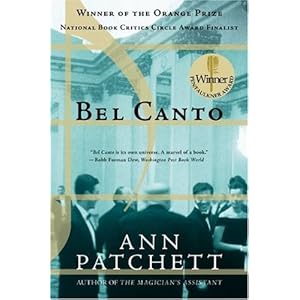
Bel Canto by Ann Patchett
Monday, November 28, 2011
Title: Bel Canto
Author: Ann Patchett
Genre: Literary fiction, contemporary fiction
Publisher: Harper Perennial, 2002
Source: Borrowed from my sister-in-law
Read for: Back to the Classics Challenge (21st century "classic")
One evening in an unknown South American country, a group of influential and wealthy are gathered at a birthday party for Mr. Hosokawa, an opera enthusiast. In order to lure the influential Japanese businessman to the country (in the hopes that he will build a factory there), the renowned soprano Roxane Coss has been paid to perform. However, the idyllic evening takes a dark turn when the house is ambushed by terrorists hoping to capture the president of the country. When the president proves to be absent, the entire party is taken as hostages. As the days pass, the lines blur and the people in the house begin a new life shaped and directed by the music of Roxane Coss present in the house.
Before I say anything else about this book, I have to draw attention to the beautiful writing. Nothing draws me in like elegant language, and Patchett had me from page one. She is capable of delineating emotions and relationships that rang with sharp clarity to my own experience. Her sentences were either soothing and flowing or sharp and powerful. I will definitely be reading more of her work from the loveliness of the writing alone.
The story itself started out uncertainly for me. I'm not that interested in opera or political intrigue and I was beginning to have my doubts as the first few pages unfolded. However, as the days trapped in the house lengthened for the hostages and I became better acquainted with the hostages and the terrorists, I fell in love with each of their characters and became invested in their stories. Despite the seemingly thrilling (in a frightening way, obviously, not an exciting one) idea of being kidnapped and held hostage, in general the characters' days drag on in a quiet house with few events. However, we are given glimpses into their lives and they transform as their limits are tested. A quiet Japanese man is revealed to be a stunning pianist. A boorish, loud Russian man is shown to have the soul of an artist. A coarse, angry, teenage terrorist is discovered to have the voice of an angel. And a few unlikely characters have the opportunity to discover love. As everything unfolded, I was desperate to know what happened next. I understood with the characters that the uneasy truce the hostages and the terrorists had reached, their seemingly impossible co-existance and unlikely friendships that had to be carefully maintained so their way of life was not upset. Despite the slow beginning, by the ending I was completely invested, completely in love with the characters.
Another interesting aspect of the book is the opera. As I said before, I'm not a huge opera fan. I've been to one opera (The Marriage of Figaro), and while it was fun, I didn't know enough about it to form much of an opinion. The farthest I've ever really gone is "operettas," musicals like The Phantom of the Opera and Les Miserables that are pretty much completely music with no speaking but more like musical theater than an opera. However, music has always been a pretty integral part of my life, although it has tapered off in the last few years. In high school I was very involved in choir, solo voice competitions, and piano competitions, and I spent easily at least three hours a day practicing. When I decided not to study music in college, I spent less and less time with music. Although it is still something I love and something very important to me, it often falls away. However, with this book I was craving music. I found myself going to my piano or guitar and playing for hours. While this book has inspired me to look into a few operas, I am mostly grateful for the way it reminded me of the importance of music in my life. I think in a world so full of sound and information at my fingertips, it is easy to think I have everything I need. For the hostages, their world was slowed down. They lived for music and art -- it was the ray of light that illumined their bleak existence. Music, and the relationships they formed with each other. I think it is a good lesson for those of us who are perhaps held "hostage" by our schedules that are packed with insignificant busy-work.
Despite a slow beginning, I fell in love with the characters and the story. Ann Patchett's writing was strong straight through and has definitely inspired me to read more of her work. Bel Canto is a lovely novel that won't disappoint someone looking for a thought-provoking read with lyrical writing.
4.25 stars
Warnings: A few swears, innuendo, off-the-page sensuality
The Grapes of Wrath by John Steinbeck
Tuesday, August 23, 2011
Title: The Grapes of WrathAuthor: John Steinbeck
Genre: Classic, literary fiction
Published: 1940
Source: Library
The Grapes of Wrath explores the plight of migrant workers in California through the eyes of the Joad family. Uprooted from the land they farmed for generations in Oklahoma, they travel to California, only to find that the high numbers of migrant workers have made work scarce and prejudice rampant.
Steinbeck is my go-to man for beautiful writing about the human condition. While the story wheezed along like the rusty, overloaded truck the Joads forced to California by sheer will-power, the poignancy of the words and the vivid characterization kept my invested. Take this sentence, containing the title of the book (and aren't Steinbeck's titles fantastic? They all have some hidden meaning or allusion): "In the souls of the people the grapes of wrath are filling and growing heavy, growing heavy for the vintage." The perfection of those words just leaves a fullness in my soul. I can feel the anger, heavy in my chest, ready to be harvested. While at first the heavily accented dialogue between the characters bothered me, but I found myself falling into the cadences of their speech and enjoying the rhythms.
Steinbeck employs an interesting technique that I thought was very effective. He alternates chapters of narrative about the Joad family with generalized chapters describing the migrant workers as a whole. Frequently, I would silently beg Steinbeck not to let the horrible things happening in the "general" chapters befall the Joads. As their family is whittled away one by one I was desperate for some mercy, fully invested in their plight. The more general chapters gave a wider glimpse of the situation - because in truth, the novel is about a situation, not a family - while the chapters about the Joads made the story personal and important, something to pay attention to.
The Joad family were cleverly created to display both quirkiness and universality. They are all unique, nothing like the characters in Steinbeck's more allegorical works like The Pearl, but they still relate poignantly to human nature. There is Jim Casy, the man who is searching for truth, stumbling his way through religion and philosophy in an attempt to find something that satisfies his soul; Tom Joad, a man who is susceptible to his temper and his failings but wants to help his family survive; Ma, who shows more strength and resourcefulness than any man in the family; Rose of Sharon, whose glow at the dream of motherhood is dashed by the family's tragic circumstances, but who still manages to nourish and sustain life. They were what they were - simple people, displaced and desperate for survival - but they were more than that, because they were so human and desperate to overcome.

It is clear why this is considered a great work of literature. It is a maste
rpiece of style, prose, and message. While it can be rather heavy and ponderous, in the end it is a work of beauty that illustrates the triumph of human nature.
4 stars
Warnings: Language, innuendo, violence
PS: Check out The Classics Circuit for more about Steinbeck over the next few weeks!
The Age of Innocence: Book 2 and Review
Wednesday, March 02, 2011

This is going to be spoiler-tastic, but I'll put a brief review at the end of the write-up in case you haven't read the book and want to know my thoughts on it. If you haven't read this book you are definitely not going to want to read the next sentence, so close your eyes, okay?
I was BLOWN AWAY when I started reading Book 2 of The Age of Innocence. I hadn't read the book in a few days after finishing Book 1, and I was expecting Newland to waffle around and have some introspection before his wedding. My foolish, naive little heart thought that perhaps he would have another real heart-to-heart with May and tell her that she had been right, there was someone else, and that he was going to throw society out the window and be a bohemian and live in a shabby house for the rest of his life.
Okay, I didn't really think he would do that. This is Edith Wharton, here - has she ever let one of her characters off easy? But I hoped that he would. So I was very shocked when the first page of the second half had Newland fidgeting with the ring and waiting for his blushing bride to glide down the aisle. I think that is one of the more poignant moments in the book - that realization that even though he has changed his mind, he already made his choice. He loved himself and that immaterial concept of a good name far more than he loved Ellen Olenska. I don't think May had anything to do with his decision by that point.
Of course, he couldn't just let Ellen go at first. He has a few fleeting moments of perceived marital bliss during the honeymoon, but soon he realizes that his fears about May didn't go away with time - they magnified in their reality. She is sweet, she is accommodating, she is beautiful, and she will spend his life trying to please him. She is white bread, nourishing and good, but Ellen is like chocolate cake, bad for you but irresistible. (I'm eating right now, hence the cheesy food analogies).
Newland and Ellen begin to explore their relationship in a passionate but unphysical way. "A stolen kiss isn't what I want," he pleads with her. "He had known the love that is fed on caresses and feeds them; but this passion that was closer than his bones was not to be superficially satisfied." I think that is the real tragedy of the story. So many stories of unfaithfulness result from boredom, or lust, or stupidity. But Newland has found a spirit that is the same as his, and he can't have her. I almost burst into tears at this line - "Suddenly he felt something stiff and cold on his lashes, and perceived that he had been crying, and that the wind had frozen his tears." For some reason, the image of this somewhat reserved and self-possessed, albeit susceptible to forbidden emotions, vulnerable and crying just breaks my heart.
Shortly after that, the story skips years ahead to Newland in his old age. May has passed away - he has made no attempt to find Ellen. His son is marrying Fanny Beaufort, the daughter of a union that was a huge scandal in Newland's day, but which no one thinks twice about now. His son, Dallas, seems to understand instinctively everything about his parents' marriage and how Newland feels about Ellen, and he takes it all in stride. He reveals to Newland that his mother knew how he felt about Ellen the whole time. In some ways it makes me like her a little better - she has her one nasty moment, throwing a send-off party for Ellen and throwing the whole situation in both Ellen and Newland's faces with grace and a sweet smile. He also says that they are to meet with Ellen that afternoon.
And this part is the worst, because Newland has that opportunity to see her again. They are both free, and not so horribly old, and his feelings for her haven't changed. But he sits and starts thinking about the way she has lived and met people and done what she wanted in her freedom, and the way he has followed convention and lived the perfect life he always dreamed of, and how it was always flavorless, and he can't face her. So he turns and walks away.
Part of me wanted to scream, WHY ARE YOU DOING THIS? It seems like Newland kicks every fleeting chance he has at happiness out the door with a vengeance. But really, I think it was the only way the story could have ended. I do think that if he had gone through the door, he would have been surprised. I think she would have welcomed him and that maybe their relationship would have a chance at redemption. But I think that the way Newland lived his life had planted him in a different direction, and he could never grow toward Ellen. While he thought he stayed back because of how much she must have changed, really he had just cemented himself in following Society, and even though he knew things were different, he couldn't take that final step. He aligned his life with May's and was used to accepting life with wide, innocent eyes - he didn't want the bloom of life that Ellen would have brought him. And so he died, alone. (He didn't actually die).
END SPOILERISH SECTION --------> ENTER REVIEW SECTION
I loved this book. It was heart-breaking, but stunningly beautiful. I was correct in thinking that even though it moved slowly at the beginning, it would blossom into something that touched my heart. The book evokes some serious thoughts of what is worth sacrificing. Is a life without "the flower" a life worth living? Probably. But I'd rather not experiment to find out. I strongly recommend it to anyone, regardless of whether or not you usually read classics. It will start slowly, but I think you will love it.
Readability: A bit slow at first, with a few unfamiliar words. However, I think in general anyone could understand it.
Plot: 5 Captivating and heart-breaking.
Characters: 5 Well developed.
Aesthetics/literary merit: 5 I have a writer-crush on Edith Wharton. She is a stunning writer.
Personal response: 5 This is officially in my top five favorite books.
Overall: 5
Oh and also, the end of this book talks about Paris, which makes me nostalgic and even in more in love with it.
While we're on the subject of heart-break, I love this song (like everyone else on the planet right now). I'm actually pretty happy with my life right now, but I love these two heart-breaking things and I think they go well together. You should probably put it on repeat and read the end of this book and cry.
The Call of the Wild by Jack London
Thursday, January 27, 2011
I missed out on reading The Call of the Wild by Jack London with everyone else in the eighth grade because I was in an advanced class that replaced the literature requirement. (I also missed out on Lord of the Flies and The Outsiders). So when I signed up for Sarah's Back to the Classics Challenge, I knew I had to choose this for my young adult/children's classic.The story chronicles the adventures of Buck, a big friendly dog used to spending his days running outside with his family. However, one day Buck is surreptitiously sold off to Alaska to pay a hired man's gambling debts. Once Buck is immersed in the wild, he slowly begins to recall his ancient role in the wild and begins to feel the call (get it?) to return to nature.
In recent years, I have acquired a distaste for animal books. More specifically, I don't love animal books that are trying to be realistic, or in other words, books where the animal is thinking or hoping or acting like a mute human. I do not deny that I loved Brian Jacques Redwall series and a few similar books growing up, but they were pure fantasy. The Call of the Wild is trying to tell us a realistic story from a dog's point of view, and that doesn't generally work for me. So I was feeling a bit sarcastic about the book from the beginning.
It was better than I expected. The writing was gorgeous. The descriptions of the stark Alaskan wilderness have a cold, alien beauty. London's descriptions of Buck's communion with "the call of the wild" are intriguing and lovely -
There is an ecstasy that marks the summit of life, and beyond which life cannot rise. And such is the paradox of living, this ecstasy comes when one is most alive, and it comes as a complete forgetfulness that one is alive. [...] He was mastered by the sheer surging of life, the tidal wave of being, the perfect joy of each separate muscle, joint, and sinew in that it was everything that was not death, that it was aglow and rampant, expressing itself in movement, flying exultantly under the stars and over the face of dead matter that did not move.Not bad. And I did find the story interesting. I didn't connect with it that much, but it was well-executed and vaguely interesting. I probably won't read White Fang, but I enjoyed the little trip to the wilds.
Accessibility/readability - Quite.
Aesthetics/literary merit - 4
Plot - 3.5
Characters - 3
Personal response - 3
Overall: 3.5
Back-to-the-Classics Challenge
Tuesday, December 07, 2010

This is one of my most anticipated challenges for the upcoming year. Hosted by Sarah Reads Too Much, the Back-t0-the-Challenge requires the completion of eight different tasks involving classics to be completed between January 1, 2011 and June 30, 2011.
Here are the tasks, and my potential reads for each.
- A Banned Book - Lolita
- A Book with a Wartime Setting (can be any war)
- A Pulitzer Prize (Fiction) Winner or Runner Up: a list can be found here - The Age of Innocence
- A Children's/Young Adult Classic - Call of the Wild
- 19th Century Classic - Great Expectations
- 20th Century Classic -If On a Winter's Night a Traveler
- A Book you think should be considered a 21st Century Classic
- Re-Read a book from your High School/College Classes - To Kill A Mockingbird
Subscribe to:
Posts (Atom)