Pregnancy weight gain is hard to bounce back from. At least, that is my experience, and I've heard it's other people's experience as well (the women in my community don't seem to have a problem with it. Maybe there should be a sequel to this book called Women in LA Don't Get Fat, Either). 10 months and a 9.5 lb delivery later, I'm still looking for answers, and French Women Don't Get Fat appealed to me on three levels: 1) Weight loss. 2) France 3) Supposedly you still get to eat things other than low carb wraps, vegetable juices, and celery. Could it be true?! Well, ask me in six months, I guess. While I haven't been at it long enough to know whether Guiliano's philosophies are effective, I do think her ideas are sound and well worth a try.
After all, she did start her analyses on why French women seem to stay thin so much better than American women after a study abroad left her 30 pounds heavier and looking like "a sack of potatoes," as her father charmingly stated it when picking her up from the airport. Her pastry devouring while at the Sorbonne didn't help matters until her mother discreetly set up an appointment with a "Dr. Miracle" who prescribed a weight loss program that worked, and that Guiliano shares in her book.
The basic form is that you take inventory by writing everything down and noting patterns of when and what you overeat; have a "Magical Leek Weekend" where all you eat is leek soup, and then spend three months "recasting" -- being stricter than you ordinarily would but knowing that at the end of it you can slowly add in the things you love -- in small doses -- and keep losing your weight. She also stresses the importance of variety -- eating a little bit of a lot of things -- and not restricting yourself overmuch.
I agreed with most of Guiliano's philosophies. Her descriptions of how French food and ingredients are better in every way might have annoyed me, except for the fact that I've experienced it firsthand and it's true. Also, the two months I spent in Paris were spent eating the richest, sugariest, fattiest food imaginable and I lost weight. She includes recipes as well. I did find myself skimming much of this portion of the book but it would be nice to have for reference in the future.
She doesn't have any research other than her own anecdotal experience and that of a few other women, and she can be pretty blunt, but I still thought French Women Don't Get Fat had a lot of good ideas, the crowning one being that food is good and you should feel good about eating it -- and you can, as long as you learn how to use restraint. Check back with me in six months and ask me if it worked.
4 stars
Warnings: None
Showing posts with label France. Show all posts
Mini-Reviews: Memoirs and Biographies
Tuesday, July 09, 2013
Heaven is For Real by Todd Burpo
Heaven is For Real is the story of a little boy who had a near-death experience and went to heaven, where he met Jesus Christ, his grandfather, and experienced many other things. I'm not going to get into the validity of the book -- religion is based on faith, and if you don't have faith, you're going to say this book was a lie, and if you do, you're going to say this book was amazing. For me, I enjoyed the story and thought Colton's experience was very interesting and left quite a bit to ponder.
3.5 stars
Warnings: None
Autobiography of a Face by Lucy Grealy
Lucy Grealy was diagnosed with cancer as a young child and spent much of her life undergoing surgeries, chemo, and radiation. While she survived the cancer, it left her face transformed -- much of her lower jaw was removed and despite numerous surgeries, was never fully reconstructed again. Grealy explores the way the pain and fear of cancer affected her, as well as the way her face affected the way others treated her and the way she viewed herself.
I read this book after reading Ann Patchett's memoir of her close friendship with Grealy, Truth and Beauty (which I recommend reading first if you plan on reading both books). Thus, I already had an idea of what Grealy had been through and the way her life played out. However, hearing it in her own voice, so to speak, was incredibly powerful. I am a nurse for children with cancer, and reading this firsthand account of the oddness of her early life was so heartrending. For a while, she didn't even know she had cancer -- obviously she knew there was something wrong, but no one gave that appellation. Her family constantly pressured her to be strong and positive, which left her believing that her fear and pain was not legitimate or acceptable. Later, she always noticed people staring at her, and believed herself unworthy of love due to the fact that she believed she could never be considered beautiful.
These explorations are dark at times, and the end of Grealy's story is not a happy one, but her thoughts do broach many questions that are important in this society -- a society that values physical appearance very highly and makes lightning judgments based on first impressions. I think Autobiography of a Face poses important questions. And it's a bonus that Grealy is a poet, and her writing is gorgeous.
3.5 stars
Warnings: Some sensuality, language, thematic material
French Milk by Lucy Knisley
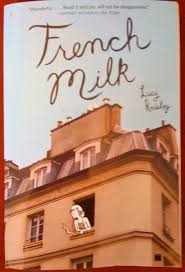
French Milk is a graphic novel of a twenty-something's six week trip to Paris with her mother. I love Paris, and I love the idea of graphic novels, but here's the thing -- this one didn't give me enough. I liked Lucy's random observations, her drawings of art and food, and her voice, but the book just didn't feel like enough. I wanted more details. I'm not sure if that is me not appreciating the art of the graphic novel or the graphic novel not doing a good enough job, but it left me wanting. Also, sometimes Knisley made me mad by doing stupid things, like starting to smoke so she would fit in in Paris. It's not just because I'm a parent that is closer to thirty than twenty that causes me to want to shake some sense into her, is it? Doesn't everyone know that smoking is the worst health decision you could possibly, possibly make? Okay, throwing yourself off a bridge is probably a worse health decision, but seriously, smoking cigarettes is the most preventable risk factor in just about EVERY chronic disease. Okay, taking deep breaths, end of rant. Other than that, I thought she was funny and witty, and I liked her honesty about her grumps and enjoyments.
3 stars
Warnings: Language, endorsement of cigarettes!!, some drawings of nude paintings, talking about non-graphic sex
MWF Seeking BFF by Rachel Bertsche
I've heard a lot of mixed reviews of MWF Seeking BFF, which disappointed me, because from what I'd heard about it, I thought I would love it, being a recently married twenty-something in a new city myself. Fortunately, for me, this book was everything I hoped it would be and more. I absolutely loved it. I understand the issues that some people had with the book -- at times Bertsche gets too focused on the letter of her quest, frenetically seeking her 52 friend-dates at the risk of her own sanity and at times even her marriage. She also at times bothered me with her desire to find "the" best friend instead of appreciating the great friendships she had (and she had many), and she had a laundry list of what she didn't want. However, first of all, I think she genuinely grows throughout her quest, learning new things about friendship, its importance to her, and the fact that she is able to be friends with people she never would have approached originally. Secondly, as someone trying to make new friends, I appreciated the insights she had on the best places to make friends as well as the research she performed on what causes people to stay friends and make friends. I thought the entire book was engaging and fascinating, and I adored it. Rachel, be my BFF? (Even though I don't meet your distance requirements?)
5 stars
Warnings: Can't think of any
Taylor Swift: An Unauthorized Biography by Liv Spencer
Okay, okay, laugh all you want. Yes, I requested a Taylor Swift biography on NetGalley. I saw it there and just couldn't resist. Don't tell me that you haven't wondered who all those songs were about. That was definitely my primary motive in reading the book.
It was mildly interesting. I liked reading about Swift's pathway to success, and especially her determination and goal-setting. I think she is a good role model for girls, which is refreshing because most teen/young twenties celebrities are making poor decisions. I also loved learning the details about each of her songs. There are chapters that go through information on who each song is about, how Swift came to write it, and other "fun facts." Because my main interest in reading the book was who all those songs were written about, those chapters (entitled "Swift Notes") were definitely interesting to me.
The writing of the book was pure cheese. The author took an almost worshipful stance at Taylor Swift, calling her "Swifty," "The Swift One," and "The Sparkly One." I might have thrown up in my mouth a few times. Also, when describing a line in the song "Picture to Burn," in which Taylor Swift sings, "That's fine, I'll tell mine you're gay," the author quickly explains that on the radio edit, the line has been changed, because "Taylor would never offend anyone." Okay... but she did write the line. I'm not defending or condemning her -- just thought the line was cheesy.
Basically, it did what I wanted it to. But it was cheesy.
2.5 stars
Warnings: You might throw up in your mouth when you read about "The Sparkly One."
Top Ten Tuesday: Travel Books
Tuesday, June 04, 2013
Hosted by The Broke and the Bookish
Who doesn't love books about travel, especially now that it is summer and roadtrip/vacation season? I decided to split my list into books I've read about travel and books I want to read about travel.
Books I've Read
1. Eat Pray Love by Elizabeth Gilbert -- I loved this book. I read it while I was in Paris and absolutely devoured it. The idea of moving freely to new experiences in new countries was just beautiful to me, as was the journey of self discovery made by the author.
2. 13 Little Blue Envelopes (and The Last Little Blue Envelope) by Maureen Johnson -- These books were so fun. I loved seeing where the next envelope would lead, and Maureen Johnson hits on the humor in awkward situations perfectly.
3. Amy and Roger's Epic Detour by Morgan Matson -- This book was fun. From hitting up every unique burger joint across the nation (I've gotta try a crumbly burger, now!) to fabulous playlists, this book combines travel, romance, and a few issues with more depth to them, too.
4. Revolution by Jennifer Donnelly -- I don't know if this is technically a travel book, but the main character does travel to Paris, so I am counting it. And she travels through history as well. Winner? I think so. This book is so powerful and passionate. Writing about it makes me think it's about time for a reread.
5. Paris My Sweet by Amy Thomas -- If you know me well at all, you know that a) I'm obsessed with Paris and b) I have the world's worst sweet tooth. This book combines the two, with some New York splashed in for variety. My only regret is that I read it after going to Paris, and now there are so many more patisseries I want to visit and I don't know when I'll have the chance.
Books I want to Read
1. A Moveable Feast by Ernest Hemingway -- Paris. I'm reading this one for the Classics Spin, and I'm very excited.
2. Travels with Charley by John Steinbeck -- I love Steinbeck inordinately (I named my child after one of his characters). This book looks absolutely delicious to me.
3. French Milk by Lucy Knisley -- Paris in a graphic novel. Sounds perfect to me.
4. 60 Million Frenchmen Can't Be Wrong by Jean-Benoit Nadeau and Julie Barlow -- I've actually started this one as research for my novel but forgot about it for a while. Still, I want to finish it soon. :)
5. Almost French: Love and a New Life in Paris by Sarah Turnbull -- Paris. Seeing a trend yet? I've heard good things about this one and can't wait to read it.
Les Miserables by Victor Hugo
Monday, September 03, 2012
Title: Les Miserables
Author: Victor Hugo
Translator: Julie Rose
Genre: Classic
Publisher: Modern Library, 2008 (Original publication date: 1862)
Source: Gift from my husband
Read for: Back to the Classics Challenge, Chunkster Challenge, A Classics Challenge
I know that I've been posting extensively about Les Miserables, but for those of you who haven't been following along with the in-depth posts about each individual section of Les Miserables, I thought this book deserved a few words as an intro.
Les Miserables is the story of Jean Valjean, a convict who reforms after a saintly bishop rewards his thieving behavior with an unbelievable gift and forgiveness. Trying to escape his past while building a worthwhile future, Valjean saves a town, rescues a young girl from poverty, and plays a heroic part in the 1832 June Rebellion in Paris. Woven into his story are the very heights and depths of the human character, from the most beautiful romance and stirring heroism to the lowest levels of despicableness.
There is so much to say about Les Miserables (and I know I've had a lot to say already) that I hardly know where to begin, so I'll just start with the translation. I was extremely impressed with Julie Rose's rendering of Les Miserables. I don't speak French well enough to judge how accurate or idiomatic it was, but I do know that I read an earlier translation several years ago and found the book extremely difficult. While the Julie Rose translation was by no means an easy read (wade through those Waterloo chapters and see how you feel afterwards), I found it much clearer. In addition, the imagery was beautiful.
Speaking of the imagery, while I'm sure some of it was related to Julie Rose's skill as translator, it is clear that the majority is Victor Hugo's exquisite skill as a writer. He has a way of taking a simple emotion or experience and translating it into sheer poetry. I was constantly awed by the power and loveliness of the images conveyed in the words.
The characters were also extremely powerful, going through the entire range of human emotion and capability. I won't go into details here, because they are available in all the other posts I've written about this book, but I found so much to love and respect in so many of the characters (and so much to despise in others). I feel attached to these characters as if they are living beings -- in those 1200+ pages there is quite a bit of time to get to know them.
The plot of Les Miserables is difficult at times because the action is interspersed with pages of historical and political commentary. It is rendered skillfully and interestingly, but it can get a little dense. I think these sections are the biggest reason Les Miserables is a challenge to readers. However, the more plot-driven sections move very quickly. I tried to learn a lot from the historical sections, but I will confess at times they still went over my head. However, I think they are worth the effort in order to enjoy the book as a whole.
Les Miserables is a masterpiece, and I don't really feel up to the task of finding appropriate words to truly express that. I think anyone who takes the time and effort to read it will be duly rewarded.
5 stars
Warnings: Violence, some language, prostitution
Author: Victor Hugo
Translator: Julie Rose
Genre: Classic
Publisher: Modern Library, 2008 (Original publication date: 1862)
Source: Gift from my husband
Read for: Back to the Classics Challenge, Chunkster Challenge, A Classics Challenge
I know that I've been posting extensively about Les Miserables, but for those of you who haven't been following along with the in-depth posts about each individual section of Les Miserables, I thought this book deserved a few words as an intro.
Les Miserables is the story of Jean Valjean, a convict who reforms after a saintly bishop rewards his thieving behavior with an unbelievable gift and forgiveness. Trying to escape his past while building a worthwhile future, Valjean saves a town, rescues a young girl from poverty, and plays a heroic part in the 1832 June Rebellion in Paris. Woven into his story are the very heights and depths of the human character, from the most beautiful romance and stirring heroism to the lowest levels of despicableness.
There is so much to say about Les Miserables (and I know I've had a lot to say already) that I hardly know where to begin, so I'll just start with the translation. I was extremely impressed with Julie Rose's rendering of Les Miserables. I don't speak French well enough to judge how accurate or idiomatic it was, but I do know that I read an earlier translation several years ago and found the book extremely difficult. While the Julie Rose translation was by no means an easy read (wade through those Waterloo chapters and see how you feel afterwards), I found it much clearer. In addition, the imagery was beautiful.
Speaking of the imagery, while I'm sure some of it was related to Julie Rose's skill as translator, it is clear that the majority is Victor Hugo's exquisite skill as a writer. He has a way of taking a simple emotion or experience and translating it into sheer poetry. I was constantly awed by the power and loveliness of the images conveyed in the words.
The characters were also extremely powerful, going through the entire range of human emotion and capability. I won't go into details here, because they are available in all the other posts I've written about this book, but I found so much to love and respect in so many of the characters (and so much to despise in others). I feel attached to these characters as if they are living beings -- in those 1200+ pages there is quite a bit of time to get to know them.
The plot of Les Miserables is difficult at times because the action is interspersed with pages of historical and political commentary. It is rendered skillfully and interestingly, but it can get a little dense. I think these sections are the biggest reason Les Miserables is a challenge to readers. However, the more plot-driven sections move very quickly. I tried to learn a lot from the historical sections, but I will confess at times they still went over my head. However, I think they are worth the effort in order to enjoy the book as a whole.
Les Miserables is a masterpiece, and I don't really feel up to the task of finding appropriate words to truly express that. I think anyone who takes the time and effort to read it will be duly rewarded.
5 stars
Warnings: Violence, some language, prostitution
Les Miserables Book 5: Jean Valjean
Wednesday, August 29, 2012
The last epic section in a book of epic sections, culminating with the pivotal character in the whole cast of dynamic characters. This write-up will have spoilers and will be an analysis and then next week I will write a final review. Book 5 begins where Book 4 leaves off, in the midst of the drama among the barricades. Jean Valjean joins the students as they pit their last defenses against the National Guard and go down in a blaze of glory and martyrdom. This occurs after discovering that Cosette is in love and, to his singularly loving mind, losing her. He decides to save the wounded Marius and transports him through a complicated web of sewers, saving Javert's life and running into Thernardier in the process. Marius is reunited with his grandfather, who, once Marius is healed, permits him to marry Cosette. Jean Valjean is also invited to live in the house, but shamed at his status as ex-convict, he confesses his past to Marius and visits Cosette each evening, slowly decreasing the visits. Near his death, Thenardier reveals the truth of Valjean's saintly actions to Marius. As a result, Cosette visits him, learns the truth of who he is, and Jean Valjean dies.
So, in effect, a very action-packed last section of the book. Jean Valjean is the only character that stays with us throughout the entire book, and is a metaphor for how the human spirit can rise above misery and triumph. He is a Christ-figure, despised by the man who owes him most, but never acting in selfishness after he is redeemed by the love of the bishop of Digne. Jean Valjean's final trials are the hardest to read about because his confessions lead Marius to believe the worst of him. True to his nature, Jean Valjean only reveals the dark parts of his past with none of the redeeming qualities. While Cosette knows nothing of her father's past and is puzzled by his growing distance from her, she is so blinded by her happiness at being married to Marius that she doesn't think much of it. Meanwhile, Marius is distrusting of Jean Valjean and makes him as unwelcome as possible, not lighting the fire and removing the armchairs from the room in which they sit. Once Marius finally learns the truth about Jean Valjean, he is absolutely mortified and crestfallen at how he treated his savior.
The other part of this section that was especially poignant for me was the wedding scene between Marius and Cosette. Their happiness was described as being the most transcendent possible because of the purity with which Marius and Cosette had treated their relationship and their absolute commitment to each other. The description of their joy was so gorgeously written and moving that it brought me to tears. I don't think their relationship was idealized because of the era -- I think it was just treated with care that we seldom see in modern-day relationships. It was inspiring and beautiful.
The last section of Les Miserables is a beautiful ending to a stunning book. I'll post my full review next week.
So, in effect, a very action-packed last section of the book. Jean Valjean is the only character that stays with us throughout the entire book, and is a metaphor for how the human spirit can rise above misery and triumph. He is a Christ-figure, despised by the man who owes him most, but never acting in selfishness after he is redeemed by the love of the bishop of Digne. Jean Valjean's final trials are the hardest to read about because his confessions lead Marius to believe the worst of him. True to his nature, Jean Valjean only reveals the dark parts of his past with none of the redeeming qualities. While Cosette knows nothing of her father's past and is puzzled by his growing distance from her, she is so blinded by her happiness at being married to Marius that she doesn't think much of it. Meanwhile, Marius is distrusting of Jean Valjean and makes him as unwelcome as possible, not lighting the fire and removing the armchairs from the room in which they sit. Once Marius finally learns the truth about Jean Valjean, he is absolutely mortified and crestfallen at how he treated his savior.
The other part of this section that was especially poignant for me was the wedding scene between Marius and Cosette. Their happiness was described as being the most transcendent possible because of the purity with which Marius and Cosette had treated their relationship and their absolute commitment to each other. The description of their joy was so gorgeously written and moving that it brought me to tears. I don't think their relationship was idealized because of the era -- I think it was just treated with care that we seldom see in modern-day relationships. It was inspiring and beautiful.
The last section of Les Miserables is a beautiful ending to a stunning book. I'll post my full review next week.
Les Miserables Book 4: The Idyll of the Rue Plumet and the Epic of the Rue Saint-Denis
Monday, August 20, 2012
Book 4 of Les Miserables, The Idyll of the Rue Plumet and the Epic of the Rue Saint-Denis, is the only book that is not named after a main character. Instead of exploring one particular character, everything comes together. First, Marius and Cosette, after weeks and months of batting their eyes at each other, finally meet and fall in love, and second, the barricades rise and the epic battle that is the climax of Les Miserables begins.
Being more familiar with the musical rather than the novel, I was always fairly annoyed with Marius and Cosette's relationship -- they simply bump into each other on a crowded street and fall into insta-love. The story is infinitely better in the book. I had forgotten how lovely Hugo can make a romance. So much of the book is history, and no matter how well that history is written, it can get a little dry after a few hundred pages. The romance is the perfect dessert after a vigorously healthy, multi-course meal. While Marius and Cosette are attracted to each other from a distance for a long time, once they get to know each other, their relationship is sweet and endearing. I loved the description of their first long talk --
So much for the Idyll of the Rue Plumet. The Epic of the Rue Saint-Denis brings us to the death of General Lamarque and the riots that erupt across Paris as a result. Heading it off, of course, is Enjolras, the man whose only love is France herself. I absolutely love the Friends of the ABC and their various personalities and different ways of relating to the cause. Book 4 generally just builds the tension to a head, bringing in all the main characters -- Eponine, Javert, Jean Valjean, Gavroche, Marius. For the most part the heroic sacrifices are saved for the final book, but we do see Father Mabeuf, old friend of Marius' father, give up his life on the barricade. This second part of Book 4 pales in comparison with the beginning of Book 5, but of course, to have a Book 5 we need a set up.
I've finished the book so I am excited to wrap up my thoughts with my review of book 5 next week and the complete review the week after that. Reading Les Miserables has been an amazing experience!
Being more familiar with the musical rather than the novel, I was always fairly annoyed with Marius and Cosette's relationship -- they simply bump into each other on a crowded street and fall into insta-love. The story is infinitely better in the book. I had forgotten how lovely Hugo can make a romance. So much of the book is history, and no matter how well that history is written, it can get a little dry after a few hundred pages. The romance is the perfect dessert after a vigorously healthy, multi-course meal. While Marius and Cosette are attracted to each other from a distance for a long time, once they get to know each other, their relationship is sweet and endearing. I loved the description of their first long talk --
"These two hearts poured themselves out to each other and into each other, so that at the end of an hour, the young man had the soul of the young girl and the young girl had the soul of the young man. They entered each other, enchanted each other, dazzled each other."I also absolutely melted at the letter that Marius wrote to Cosette before their first meeting. If you love a good romantic story, it is worth wading through the history just for this moment alone.
So much for the Idyll of the Rue Plumet. The Epic of the Rue Saint-Denis brings us to the death of General Lamarque and the riots that erupt across Paris as a result. Heading it off, of course, is Enjolras, the man whose only love is France herself. I absolutely love the Friends of the ABC and their various personalities and different ways of relating to the cause. Book 4 generally just builds the tension to a head, bringing in all the main characters -- Eponine, Javert, Jean Valjean, Gavroche, Marius. For the most part the heroic sacrifices are saved for the final book, but we do see Father Mabeuf, old friend of Marius' father, give up his life on the barricade. This second part of Book 4 pales in comparison with the beginning of Book 5, but of course, to have a Book 5 we need a set up.
I've finished the book so I am excited to wrap up my thoughts with my review of book 5 next week and the complete review the week after that. Reading Les Miserables has been an amazing experience!
Book 1 of Les Miserables: Fantine
Thursday, May 03, 2012
I don't usually post multiple times on one book, but Les Miserables is such a beast that I feel like one concise little review just isn't going to do it. I've decided to have some discussion-type posts for each book and then I will do a more general review after I finish. Because the separate "Book X" posts are more of a discussion format, spoilers are fair game here, so if you want to avoid them, avoid these posts.
Book 1 begins with Bishop Myriel of Digne, an essentially perfect man whose one worldly weakness is a love for eating with silver cutlery. He switches his handsome parish home with the small parish hospital because he doesn't feel he needs as much room as the sick. Whenever he acquires wealth, he instantly spends it on the poor. He risks life and limb to minister to small, underserved village. He is, in essence, a saint, excepting his one tiny worldly flaw of loving his silver cutlery.
However, when a vagrant comes into his home, a convict despised and rejected by everyone else in Digne of whom he has sought shelter, Bishop Myriel takes him in, and his final vice is tested and refined. Jean Val-jean, a released convict who spent nineteen years in captivity due to the fact that he stole some bread to feed his sister's starving family and then attempted multiple times to escape, has molded into what others expect of him by stealing the bishop's silver and attempting to run away. Instead of turning him in and relegating him again to a life of captivity, the bishop treats Valjean as if he offered the silver to him in the first place, relinquishing his last worldly desire.
Thus begins the tale of Jean Valjean, a man of the lowest status who elevates himself to a level of kindness and goodness comparable to the bishop himself. I love the way these men are painted and the time spent on the development of their characters. Hugo is absolutely thorough. Reading Les Miserables isn't like being carried along by a thread of narrative -- it is total immersion in the world and lives of characters that are realized to the fullest extent.
Several years later, Valjean is a success. He has helped the town he came to by revolutionizing an industry and taking over the factory. He is nominated the mayor. With his exceptional strength, he has even saved a man's life -- at risk of revealing his previous identity to a suspicious inspector, Javert, who is one of the best and most complex villains I have ever read about.
In Valjean's factory works Fantine, a woman whose innocence and love betrayed her, who is now living at the edges of life trying to support her daughter Cosette, who lives with a voraciously greedy innkeeper and his wife. I am very familiar with the musical Les Miserables, and while I read the book about eight years ago in a different translation, I still felt I was learning something new about Fantine this time around. In Book 1 we are given the chance to see the relationship that leads to Cosette, and in some ways it is very disappointing. She was passionately in love, but the truth is that her lover, Tholomyes, is pretty despicable and unlovable. Still, to her he was everything, and I suppose that is the way that love is for many people -- we see only the traits that make that person attractive to us and miss the rest. Once alone, Fantine exhausts every possible avenue to keep Cosette alive, and eventually it is her downfall.
In the past in Les Miserables, Eponine was the character I sympathized with most. A lovesick girl stuck forever in the friend zone -- that is an experience that rang true for me in high school more than once. However, this time around, I've been sympathizing much more with Fantine, and I was very touched by her experiences and her death. While I'm lucky enough to not be abandoned by my lover, I can relate to Fantine's fierce love for her daughter and desire to sacrifice everything to keep her safe and healthy. I haven't actually given birth to a child yet, but let's just say I am much closer to the motherhood phase of my life rather than the rejected crush phase of my life. I'm curious to see if I will still relate to Eponine once I am further into the book. (I think I will, just because I related so much to her for so long).
Now I am stuck in the beginning of Book 2, the dreaded Waterloo section. Hopefully I'll power through that tonight so I can write my Book 2 post soon!
Book 1 begins with Bishop Myriel of Digne, an essentially perfect man whose one worldly weakness is a love for eating with silver cutlery. He switches his handsome parish home with the small parish hospital because he doesn't feel he needs as much room as the sick. Whenever he acquires wealth, he instantly spends it on the poor. He risks life and limb to minister to small, underserved village. He is, in essence, a saint, excepting his one tiny worldly flaw of loving his silver cutlery.
However, when a vagrant comes into his home, a convict despised and rejected by everyone else in Digne of whom he has sought shelter, Bishop Myriel takes him in, and his final vice is tested and refined. Jean Val-jean, a released convict who spent nineteen years in captivity due to the fact that he stole some bread to feed his sister's starving family and then attempted multiple times to escape, has molded into what others expect of him by stealing the bishop's silver and attempting to run away. Instead of turning him in and relegating him again to a life of captivity, the bishop treats Valjean as if he offered the silver to him in the first place, relinquishing his last worldly desire.
Thus begins the tale of Jean Valjean, a man of the lowest status who elevates himself to a level of kindness and goodness comparable to the bishop himself. I love the way these men are painted and the time spent on the development of their characters. Hugo is absolutely thorough. Reading Les Miserables isn't like being carried along by a thread of narrative -- it is total immersion in the world and lives of characters that are realized to the fullest extent.
Several years later, Valjean is a success. He has helped the town he came to by revolutionizing an industry and taking over the factory. He is nominated the mayor. With his exceptional strength, he has even saved a man's life -- at risk of revealing his previous identity to a suspicious inspector, Javert, who is one of the best and most complex villains I have ever read about.
In Valjean's factory works Fantine, a woman whose innocence and love betrayed her, who is now living at the edges of life trying to support her daughter Cosette, who lives with a voraciously greedy innkeeper and his wife. I am very familiar with the musical Les Miserables, and while I read the book about eight years ago in a different translation, I still felt I was learning something new about Fantine this time around. In Book 1 we are given the chance to see the relationship that leads to Cosette, and in some ways it is very disappointing. She was passionately in love, but the truth is that her lover, Tholomyes, is pretty despicable and unlovable. Still, to her he was everything, and I suppose that is the way that love is for many people -- we see only the traits that make that person attractive to us and miss the rest. Once alone, Fantine exhausts every possible avenue to keep Cosette alive, and eventually it is her downfall.
In the past in Les Miserables, Eponine was the character I sympathized with most. A lovesick girl stuck forever in the friend zone -- that is an experience that rang true for me in high school more than once. However, this time around, I've been sympathizing much more with Fantine, and I was very touched by her experiences and her death. While I'm lucky enough to not be abandoned by my lover, I can relate to Fantine's fierce love for her daughter and desire to sacrifice everything to keep her safe and healthy. I haven't actually given birth to a child yet, but let's just say I am much closer to the motherhood phase of my life rather than the rejected crush phase of my life. I'm curious to see if I will still relate to Eponine once I am further into the book. (I think I will, just because I related so much to her for so long).
Now I am stuck in the beginning of Book 2, the dreaded Waterloo section. Hopefully I'll power through that tonight so I can write my Book 2 post soon!
Madame Tussaud by Michelle Moran
Wednesday, September 14, 2011
Title: Madame TussaudAuthor: Michelle Moran
Genre: Historical fiction
Publisher: Crown, 2011
Source: Library (really, why do I even assume otherwise?)
Read for: Fun!
Marie Grosholtz is an ambitious artist, hoping to reap money and fame from the salon that she and her "uncle," Curtius, run. She goes to public events hoping to capture famous faces for her wax models. Her exposure to the famous is increased when she is invited by the king's sister to spend time at Versailles and tutor her in the art of making wax figures. However, with tensions from the unhappy citizens of France mounting to what will erupt into the French Revolution, Marie is forced to make choices - between royalty and the common citizens, right and wrong, and love and ambition.
I was pleasantly blown away by this novel. I honestly came into it with low expectations. I had a lukewarm experience with Nefertiti - not unpleasant, bear in mind, but certainly not sweeping. I had heard that Madame Tussaud suffered from similar flaws and so I assumed it would be a similar experience. I was unprepared for the torrent of vivid imagery and naked emotion, as well as a healthy dose of history to feed my brain.
Whether she is describing the gown of Marie Antoinette, the stunning architecture of Versailles (and the filth that overlays it), or the depravity of a convict's leer, Moran's writing requires very little effort from the imagination. Everything is described minutely; however, this did not slow down the story for me. Marie lived every moment taking in details of appearance and mannerism so she could realistically create perfect copies in her models, and the presentation of those details worked. It was fascinating to read the way she noted certain features and facial twitches and linked them to the personality of her model. This talent allowed the horrors of the French Revolution to sink in more powerfully than they have with any other book in my experience. It wasn't always a beautiful image that imprinted itself on my mind, but it was always a moving one. With the capturing of such details of brutality and violence came strong emotions that left me strongly invested in the story.
I also enjoyed the history. I am no expert on the French Revolution, but the details of the events along with the historical notes at the conclusion of the book lead me to believe that much of it was factual. I remember going to Madame Tussaud's wax museum in Las Vegas, but I had no idea that she was an artist from the French Revolution era, forced to make death masks of prominent traitors (or patriots, depending on whose opinion it was). I also knew very little about Marie Antoinette other than her youth at the age of marriage and the fact that she was criticized harshly for lavish expenditures during her reign as queen. This book opened my eyes to pieces of history from this era that I had never been exposed to before.
I thought I would only enjoy this book as a francophile, but I enjoyed it on many levels, enjoying the process of learning, the visual details, the relationships and strongly stirred emotions. If you love learning about the French Revolution, read it. If you're a history buff, read it. But even if you're not, there's a great chance that you will still relate to this book strongly. So... read it!
4 stars
Warnings: Violence, non-explicit sexuality
YA Friday: Revolution by Jennifer Donnelly
Friday, May 20, 2011
Title: RevolutionAuthor: Jennifer Donnelly
Genre: YA, historical fiction
Publisher: Delacorte Press, 2010
Source: Library
Revolution by Jennifer Donnelly tells two parallel stories. The first is that of Andi, flunking out of her senior year, floundering in a broken family after the death of her younger brother, and solaced only by her guitar. The other is that of Alexandrine, a young revolutionary in eighteenth century Paris. The girls' stories combine in a terrifying and moving adventure that teaches both the meaning of rising above a world that can be dark.
This is one of the smartest books I have ever read. Page after page, I was blown away at Donnelly's finesse in bringing together Andi and Alex's stories. The plot is complex and multi-layered, but never obscure or confusing. She interweaves the two main story lines with a third character that intersects them both - the (unfortunately fictional) classical guitarist Amade Malherbeau, subject of Andi's senior thesis and Parisian contemporary of Alex. The story is structured into three parts, following Dante's Divine Comedy and prefaced by quotes - Hell, Purgatory, and Paradise. Andi's Brooklyn world and Alex's Paris world are both meticulously detailed, making the story come to life in a vivid way.
The characters Donnelly created were also compelling, although the plot is the star of this story. Andi's friend Virgil is a fascinating character, someone who has already achieved what seems to elude her - the ability to have stability and grace in a mixed-up, unfair world. Virgil is edgy with his graveyard cab driving job and his intimate knowledge of the catacombs, yet sweet with his need for music and concern for Andi. I also loved Malherbeau, the guitarist Andi studies, although I think if I explain why I will spoil some of the best surprises of the story, so please read it and find out exactly why I loved him. Alex was also an interesting character - she was propelled by many different motives, and played many different roles, a fitting life for an actress. She changes drastically from the beginning of her account of the revolution to the end, and makes an interesting case for herself as one who is by no means innocent but seeks to redeem herself.
I liked Andi, too, but she became a little tiresome for me from time to time because of all her anger and raging and pill-popping. However, it wasn't the character that annoyed me - it was her personality. Does that make sense? I think Andi had to be that way, and Donnelly did a great job of realizing her. She's just a frustrating character at times. However, she especially goes through a lot of growth in the novel, which is always a good sign for me.
As I said before, Donnelly does a fantastic job of incorporating small details to make the world come alive, especially the eighteenth century of Paris (I've never read such vivid descriptions of smells). However, occasionally the writing annoying to me in a nit-picky way. This may be because Andi was narrating in the first person for most of the story, and occasionally Andi would start to bother me. Some of the descriptions are told in a breathless, fragmented style that seemed a little melodramatic for me. Example:
One note, just one note. That's all I need. But it's hard tonight. So hard that I stop playing. And look up at the sky instead. It's black. No moon. No stars.Like I said, nothing technically wrong with this, but it didn't work for me. But Donelly definitely redeems herself with some gorgeous and unique passages, like this one:
Vermeer and Rembrandt and da Vinci put together couldn't do it. Even if they got the shade right - a clear, startling Windex blue - they'd still fail because Truman's eyes were totally transparent. That whole windows to the soul thing? That was him. When you looked into his eyes, you could see everything he thought and felt and loved. You could see Lyra and Pan. The Temple of Dendur. Bottle rockets. Garry Kasparov. Beck. Kyuma. Chili cheese dogs. Derek Jeter. And us.Nit-picking aside, this book blew me away and was quite possibly one of my best reads this year. It was one of those books that, after I finished, I didn't want to start reading another book because I just wanted to keep thinking about this one. It made me want to learn more about the French Revolution and Amade Malherbeau (until I googled him and found out he wasn't real... sadness). Cheesy tidbit - I went to the piano and started playing through some of the Bach preludes I played in high school because Andi always talks about playing Bach. It is a book that makes a powerful impression.
Readability: Very readable.
Plot: 5
Characters: 4
Writing: 4
Personal Response: 5
Overall: 4.5
Literary Blog Hop: Beginnings
Thursday, January 06, 2011
It's time again for the Literary Blog Hop hosted by The Blue Bookcase. This week's question comes from Debbie at Reader Buzz:
How did you find your way to reading literary fiction and nonfiction?
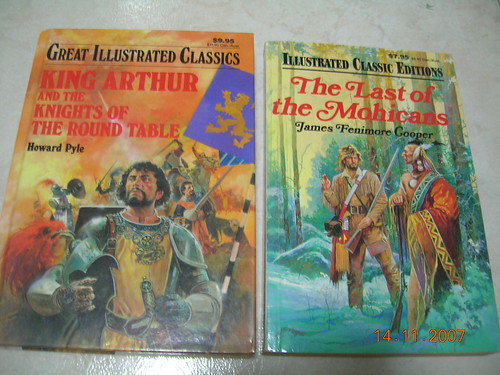
I find myself truly appreciating this question, because I've never thought about what caused me to start reading literary fiction and nonfiction. I have been a bookworm since I started to read - I didn't learn until the end of kindergarten but immediately started reading chapter books. I was a big fan of Nancy Drew and the Babysitter's Club in those days, but I do remember devouring the Great Illustrated Classics books as well. I think my real first brush with the classics came about as a result of the Ac
celerated Reader program. All the books in my elementary school library had difficulty levels and points assigned to them, and we were required to take quizzes on the books to attain specific point levels. I am a pretty competitive person, and when rumors of high level books (Little Women and Gone With the Wind are the ones I remember) I turned to those because the Great Illustrated Classics didn't count. (Although I do remember having my points revoked when I tried to take the Little Women quiz having just read the abridged version).
So Accelerated Reader probably gave me my first little introduction to classics. However, my grandma also encouraged me to read quality literature. She would buy me books at garage sales and give me books for my birthday. She also had a good friend who was a voracious reader, and that lady would recommend books that my grandma would pass on to me.
Despite my interest in the classics, I was a pretty devoted sci-fi/fantasy reader until high school. I still like the occasional sci-fi/fantasy novel, although after reading 20-30, they all started to sound the same to me. In my English classes in high school, I was again exposed to many classics I had never heard of. In one class, we were required to pick one book for each semester and do about 10 projects on it. I decided to read The Count of Monte Cristo by Alexandre Dumas and East of Eden by John Steinbeck. Getting fully involved in these books showed me how rewarding the classics could be. I fell in love with the complexity of the plots and characters. Character driven novels are much more rewarding for me than plot driven novels, and I found more of what I was looking for in the classics. For a few years, into college, I almost exclusively read classics (although I made an exception for Harry Potter and Twilight!)
I have only recently begun reading mainstream, modern literary fiction. I think my first discoveries of more recent books happened in France, where I fell in with a wonderful little bookstore that sold only English books and French books translated from English books. I attempted to talk about literature in French with the owner, and he recommended several books to me. And thus my journey into literary fiction commenced. Hooray!
celerated Reader program. All the books in my elementary school library had difficulty levels and points assigned to them, and we were required to take quizzes on the books to attain specific point levels. I am a pretty competitive person, and when rumors of high level books (Little Women and Gone With the Wind are the ones I remember) I turned to those because the Great Illustrated Classics didn't count. (Although I do remember having my points revoked when I tried to take the Little Women quiz having just read the abridged version).So Accelerated Reader probably gave me my first little introduction to classics. However, my grandma also encouraged me to read quality literature. She would buy me books at garage sales and give me books for my birthday. She also had a good friend who was a voracious reader, and that lady would recommend books that my grandma would pass on to me.
Despite my interest in the classics, I was a pretty devoted sci-fi/fantasy reader until high school. I still like the occasional sci-fi/fantasy novel, although after reading 20-30, they all started to sound the same to me. In my English classes in high school, I was again exposed to many classics I had never heard of. In one class, we were required to pick one book for each semester and do about 10 projects on it. I decided to read The Count of Monte Cristo by Alexandre Dumas and East of Eden by John Steinbeck. Getting fully involved in these books showed me how rewarding the classics could be. I fell in love with the complexity of the plots and characters. Character driven novels are much more rewarding for me than plot driven novels, and I found more of what I was looking for in the classics. For a few years, into college, I almost exclusively read classics (although I made an exception for Harry Potter and Twilight!)
I have only recently begun reading mainstream, modern literary fiction. I think my first discoveries of more recent books happened in France, where I fell in with a wonderful little bookstore that sold only English books and French books translated from English books. I attempted to talk about literature in French with the owner, and he recommended several books to me. And thus my journey into literary fiction commenced. Hooray!
A Kindred Spirit
Sunday, November 14, 2010
The copy of John Adams I checked out is due on Wednesday, and I am only half-way through this 650 page chunker. So today I've been alternating my responsibilities (cooking, tidying up, catching up on wedding thank yous, working on a Christmas surprise for someone I won't mention just in case they read this) with reading John Adams in ten page increments. I just found an anecdote that I love, and have to share just in case I don't have time to copy it down later.

I think I spent more money on books than anything else when I was in Paris (except maybe food) and this little story about Jefferson made me so nostalgic for those Paris bookshops. Although I don't have time today, one of these days I am going to have to write a special post about my two favorite bookstores in Paris. Something to look forward to when I finish exams and my library books. Hope you are all having a lovely Sunday evening!
ADDITION: Ok, I just read this post to my husband because he appreciates my nerd-ness. And he told me that his ancestors in Virginia bought slaves from Thomas Jefferson! He told me that his grandma told her best friend that they had the document from when they bought the slaves from Thomas Jefferson and the next day, her best friend had cut out the signature of Thomas Jefferson. Some friend, huh? Not so cool that my husband's family were slaveowners (although mine were outlaws in the Dalton Gang, so I don't know who is more infamous), but pretty cool that they had a document with Thomas Jefferson's signature. Especially now that I know he is my kindred spirit.
Paris booksellers soon found they had an American patron like no other. In the bookshops and stalls along the Seine were volumes in numbers and variety such as Jefferson had never seen, and his pleasure was boundless. To Madison he would describe the surpassing pleasure of 'examining all the principal bookstores, turning over every book with my own hand and putting by everything related to America, and indeed whatever was rare and valuable to every science.' There were weeks when he was buying books every day. In his first month in Paris, he could not buy them fast enough, and ran up bills totaling nearly 800 francs. Nor was the book-buying spree to end. The grand total of books he acquired in France was about 2,000, but he also bought books by the boxful for Washington, Franklin, and James Madison. (pg. 321)
I think I spent more money on books than anything else when I was in Paris (except maybe food) and this little story about Jefferson made me so nostalgic for those Paris bookshops. Although I don't have time today, one of these days I am going to have to write a special post about my two favorite bookstores in Paris. Something to look forward to when I finish exams and my library books. Hope you are all having a lovely Sunday evening!
ADDITION: Ok, I just read this post to my husband because he appreciates my nerd-ness. And he told me that his ancestors in Virginia bought slaves from Thomas Jefferson! He told me that his grandma told her best friend that they had the document from when they bought the slaves from Thomas Jefferson and the next day, her best friend had cut out the signature of Thomas Jefferson. Some friend, huh? Not so cool that my husband's family were slaveowners (although mine were outlaws in the Dalton Gang, so I don't know who is more infamous), but pretty cool that they had a document with Thomas Jefferson's signature. Especially now that I know he is my kindred spirit.
Inferno
Saturday, November 06, 2010

Oh Dante.
My first exposure to Dante was in my senior AP English class. Over the door, my teacher had made a sign saying, "Abandon hope, all ye who enter here." Lovely. (It was actually my favorite class of my high school experience). As part of our unit on mythology, Ms. Taylor went on a rant about Dante. I can't remember if we actually read an excerpt or not. But she told us all about how he descends into Hell, puts people he doesn't like into various circles of Hell, including some who haven't died yet, and then we moved on to Sisyphus. (There is Sisyphus-like punishment for the avaricious - forever pushing rocks and fighting each other in opposing directions). I thought this was very interesting and that maybe someday I would actually read it. Then I promptly forgot about it, until Husband told me I should read it. Except for this random sculpture by Rodin called The Gates of Hell that I took a picture of in France. I just looked it up and it does in fact feature a scene from the Divine Comedy, although I didn't know this when I took the picture. Anyway...

So, a little background on The Husband. He lived in Italy for two years serving a religious mission and is now minoring in Italian and teaching the Italian 101 class at the university we both attend. His Italian class this semester is on The Divine Comedy. As he was reading, he kept talking about the freakish trials Dante experiences and telling me that I should read Inferno. As Halloween was approaching, I thought it would make a good seasonal read. Of course, he read it in Italian. But fortunately his book has one page in Italian and the corresponding in English, so it worked out for me.
It is a very complex book, but the premise is this: Dante fell in love with his donna scala (if I
have misspelled this, The Husband will tell me and I will fix it), Beatrice. The donna scala is a woman who is supposed to inspire a man to come closer to God, but you are not supposed to fall in love with her, and Dante does. When she dies, Dante is not sure what to do with himself (and here there is a gap in my knowledge, because all my knowledge comes from Husband's knowledge) but as part of his making up for loving Beatrice, he must journey through hell, purgatory, and paradise and write about it. (His experience with Beatrice living are told in Vita Nuova, another book I should read someday...) Anyway, so Inferno begins with Dante's fearful descent into Hell and all that he observes there.Here is a lovely diagram of Hell.
I could go on and on about the punishments, because they are many and disgusting, but I will just describe a few to keep this post reasonably short.The river Phlegethon is rather horrible. It is a river of boiling blood that serves as the final resting place for tyrants and murders in the 7th circle of hell.
Another interesting punishment (also in the 7th circle of hell) was for suicides. They became plants that could only speak if you broke them, and blood would pour out. This is because they wanted to stop their natural progression through life, and they rejected the bodies God gave them, so they are now wooden. Dante cries when he breaks the bush to speak to it. He cries a lot, actually, and faints and is distraught - and who could blame him? But he did put some of these people in there (there is a lot of politics and history in Inferno, most of which I understood nothing of) so I don't think he is really crying.
The book was very dark and dreary, and extremely gory (another circle has Mohammed being constantly cleaved down the middle for fraud against God). However, the line that chilled me the most occurred near the beginning. Dante asks,
And after the great sentence --
o master -- will these torments grow, or else
be less, or will they be just as intense?
And he to me, "Remember now your science,
which says that when a thing has more perfection,
so much the greater is its pain or its pleasure.
Though these accursed sinners never shall
attain the true perfection, yet they can
expect to be more perfect then than now. (p. 57)
o master -- will these torments grow, or else
be less, or will they be just as intense?
And he to me, "Remember now your science,
which says that when a thing has more perfection,
so much the greater is its pain or its pleasure.
Though these accursed sinners never shall
attain the true perfection, yet they can
expect to be more perfect then than now. (p. 57)
Shivers. There is so much more to this book, I wish I could expound all that I got from it, which is definitely only a fraction of the whole. It was nice to ask The Husband questions about it. I read the Mandelbaum translation, which I highly recommend. It might also be good to get a study guide or dictionary of things in Dante. (We have one, but it is in Italian, so I didn't use it... obviously. I just used my human dictionary).
I cannot possibly give this book a rating. I didn't always enjoy reading it, and I was very glad to be done with it. But it is a rich novel full of many things to think about. I think everyone should read it. I am still trying to decide if I should read Purgatory and Paradise. Husband isn't enjoying those as much, and I'm sure at any rate they are less shocking than Inferno. I'm glad I read this one, so I'll probably get to the other ones after a buffer period. Read it. But get help.
Gourmet Rhapsody
Monday, August 30, 2010
Sorry about the delay in getting book reviews online. I have just moved to a new apartment with my husband and our internet is not working yet. Anyway...

Gourmet Rhapsody is the deathbed confession of Pierre Arthens, a celebrated food critic. When he learns he has fewer than 48 hours to live, the desire for a flavor that would bring him comfort and meaning in his last days plagues his senses. He journeys through his memories and different types of food as he searches for the elusive flavor. Alternating between these chapters are the reactions of various players in Arthens' lives when they hear the news of his imminent demise.
Gourmet Rhapsody was a delight for many reasons, but two in particular endeared the book to me. Arthens' sumptuous descriptions of gourmet foods titillated both my imagination and my taste buds. A "taste" of the sushi course:

"True sashimi is not so much bitten into as allowed to melt on the tongue. It calls for slow, supple chewing, not to bring about a change in the nature of the food but merely to allow one to savor its airy, satiny texture. Yes, it is like a fabric: shashimi is velvet dust, verging on silk, or a bit of both, an dthe extraordinary alchemy of its gossamer essence allows it to preserve a milky density unknown even by clouds." (Barbery, 73)
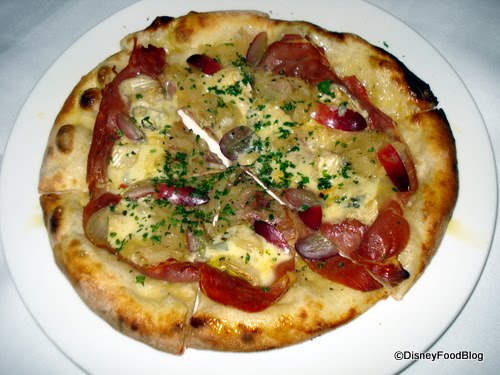
Being on my honeymoon when I finished this book, I had the opportunity to experience the "gourmet" a little more than usual. My husband and I ate at a restaurant called Napa Rose on the final night of the honeymoon. It was probably th
e fanciest restaurant I have eaten at in the United States. My meal consisted of an appetizer pizzeta of red grapes, French cheese, prosciutto, and caramelized onions (picture to the left), and my main course was salmon on wild rice with pine nuts and a blackberry salsa. I won't attempt to describe the meal in an Arthens-worthy manner, but just having read the book, with Arthens' adjectives fresh in my mind, I was able to have a richer experience. Arthens critiqued food not based solely on taste sensations - he also paid attention to its appearance, its scent, its texture, and most importantly, the emotions it evoked. This all-encompassing sensory experience became almost holy to him, and reminded me of something I heard when I was staying in Paris - that eating was a holy experience, a sacrament dedicated to nourishing both our bodies and our relationships.
The other thing I loved about this book may have been due to one of my idiosyncratic interests. In the 7th grade we had to take a "Life Skills" class where we learned about drugs, etc. We also learned about how there are four dimensions to personality: what you know and others know, what you know that others don't know, what you don't know that others also don'
t know, and what you don't know that others do know. Ever since this class, I have always wondered what other people know about me that I don't know about myself. The chapters alternating between Arthens' internal monologue about food are the reflections of people he has encountered and how they feel about him, from his family members to the homeless man he passes each day on the street. The different views on his life contrast and complement to form a very complete picture of this strange and complicated man (His own self description: "If I had been a woman, I would have been Scarlett [of Gone With the Wind]-- the one who survives in a world that is dying"). (pg 102). The perspectives of others to complete the portrait are fascinating. I will let you unwrap the layers of Arthens' relationships to discover who he really was.
To summarize (because I have to get to my chemistry class), I give this book 3.5 out of 5 stars. The concept is beautiful and different from anything else I have read. However, the wordiness of some of the passages makes the writing a bit obscure. (It might just be above my intellectual level. ) Check this book out from the library.

Gourmet Rhapsody is the deathbed confession of Pierre Arthens, a celebrated food critic. When he learns he has fewer than 48 hours to live, the desire for a flavor that would bring him comfort and meaning in his last days plagues his senses. He journeys through his memories and different types of food as he searches for the elusive flavor. Alternating between these chapters are the reactions of various players in Arthens' lives when they hear the news of his imminent demise.
Gourmet Rhapsody was a delight for many reasons, but two in particular endeared the book to me. Arthens' sumptuous descriptions of gourmet foods titillated both my imagination and my taste buds. A "taste" of the sushi course:

"True sashimi is not so much bitten into as allowed to melt on the tongue. It calls for slow, supple chewing, not to bring about a change in the nature of the food but merely to allow one to savor its airy, satiny texture. Yes, it is like a fabric: shashimi is velvet dust, verging on silk, or a bit of both, an dthe extraordinary alchemy of its gossamer essence allows it to preserve a milky density unknown even by clouds." (Barbery, 73)
Being on my honeymoon when I finished this book, I had the opportunity to experience the "gourmet" a little more than usual. My husband and I ate at a restaurant called Napa Rose on the final night of the honeymoon. It was probably th
e fanciest restaurant I have eaten at in the United States. My meal consisted of an appetizer pizzeta of red grapes, French cheese, prosciutto, and caramelized onions (picture to the left), and my main course was salmon on wild rice with pine nuts and a blackberry salsa. I won't attempt to describe the meal in an Arthens-worthy manner, but just having read the book, with Arthens' adjectives fresh in my mind, I was able to have a richer experience. Arthens critiqued food not based solely on taste sensations - he also paid attention to its appearance, its scent, its texture, and most importantly, the emotions it evoked. This all-encompassing sensory experience became almost holy to him, and reminded me of something I heard when I was staying in Paris - that eating was a holy experience, a sacrament dedicated to nourishing both our bodies and our relationships.The other thing I loved about this book may have been due to one of my idiosyncratic interests. In the 7th grade we had to take a "Life Skills" class where we learned about drugs, etc. We also learned about how there are four dimensions to personality: what you know and others know, what you know that others don't know, what you don't know that others also don'
t know, and what you don't know that others do know. Ever since this class, I have always wondered what other people know about me that I don't know about myself. The chapters alternating between Arthens' internal monologue about food are the reflections of people he has encountered and how they feel about him, from his family members to the homeless man he passes each day on the street. The different views on his life contrast and complement to form a very complete picture of this strange and complicated man (His own self description: "If I had been a woman, I would have been Scarlett [of Gone With the Wind]-- the one who survives in a world that is dying"). (pg 102). The perspectives of others to complete the portrait are fascinating. I will let you unwrap the layers of Arthens' relationships to discover who he really was.To summarize (because I have to get to my chemistry class), I give this book 3.5 out of 5 stars. The concept is beautiful and different from anything else I have read. However, the wordiness of some of the passages makes the writing a bit obscure. (It might just be above my intellectual level. ) Check this book out from the library.
Subscribe to:
Posts (Atom)