Showing posts with label The Winter of Our Discontent. Show all posts

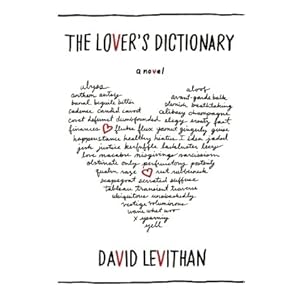
The Lover's Dictionary by David Levithan

Friday, February 18, 2011


Guys.

This book.

Well, I highlighted over half of it. And I read about a third of it out loud to my husband as he diligently tried to focus on his tissue biology homework. I didn't cry, but I think I connected with it on a deeper level than tears.

There is a passage in John Steinbeck's The Winter of Our Discontent where the main voice, Ethan, despairs because no matter how much he loves his wife, no matter how well he knows her habits and cadences and mannerisms, he cannot be inside her head. No matter what, he can't understand completely because he is separate. There is another book I read like this too, and I can't remember what it was but I think it was Madeleine L'Engle, and she says something along the same lines - we can't perfectly understand each other because we have bodies, and they separate our souls from each other so that we can't know each other perfectly.

The reason why I love books is because they transcend this barrier and let us right into the author's head. Or the character's head. Some authors are better at this than others, and in this book, David Levithan is the best. It always surprises me to find emotions that I thought were my private property echoed in someone else's voice. This book brings you right into the raw, conflicting, alternatingly beautiful and tragic facets of love.

I should back up. The Lover's Dictionary is a love story told in definitions. Each page has a word on it, and a little anecdote follows the word. Slowly and un-chronologically, the love story unfolds.

I loved both of these people so much. I was so sad when the book ended because I wanted to spend more time with them. They are at times cruel and petty, but also witty and passionate. In them I saw represented the faults that we all have - of getting annoyed over small interruptions to our routine, of being selfish, of refusing to admit that we are wrong - but also the greatness of the human soul when it is transformed by love. Which, thank goodness, is a capability we all have.

This book was also hilarious. Case in point:

anachronism, n.
"I'll go get the horse and buggy," you'll say.
And I'll say, "But I thought we were taking the hovercraft!"

Or try
scapegoat, n.
I think our top two are:
1. Not enough coffee.
2. Too much coffee.
And then there are those things that I thought were only hallmarks of how I acted in relationships: "I was still scared by every gap in our conversation, fearing that this was it, the point where we had nothing left to say." Or "I'm careful what songs I play. I try to speak to you with my selections." Or when the lovers trace back their random conversation to its roots.

I loved this book because it spoke to me. It touched my emotions, it made me laugh, and the only bad thing I can say about it is that it ended. The format was amazingly creative, the writing was beautiful and poignant, and I read it in one day, tossing aside all responsibilities to devour the pages.

Please read this book.

Love, me.

5 out of 5 stars. No further qualifications needed.

PS: 'Twas my February Just For Fun Challenge pick.

The Winter of Our Discontent

Saturday, November 27, 2010


I read this novel for book club. We're trying something new this month - instead of all reading the same book, we are all reading a book by Steinbeck. I chose The Winter of Our Discontent because I had heard the phrase and was curious to know where it came from. Turns out it's actually Shakespeare (forgive me - I'm a science major!) from the play Richard III. I'll have to read that baby sometime.

The premise: Ethan Allen Hawley lives in a New England fishing village. His family once had money, but in recent generations that money has run short and Ethan is now living as a grocery clerk, a role that bothers his family, his neighbors, and himself. He undergoes a transformation as he tries to elevate himself from his situation. I know it can be annoying to hear "the less you know about this book before you read it, the better" but I think it is really true in this case. The plot develops with tension and isolated events build on each other until you're dying to know what happens next - something that doesn't happen to me often with books. I don't want to deprive anyone else of that experience!

Before beginning the novel, Steinbeck leaves this little note: "Readers seeking to identify the fictional people and places here described would do better to inspect their own communities and search their own hearts, for this book is about a large part of America today." And it's true, on multiple levels. The main level, I think, is America's attitude about money. The novel depicts businessmen making less than perfectly honest deals, ripping each other off. It also depicts the desperate drive to acquire more - I love when the narrator explains to his wife, "Oh prince's daughter, there is no such thing as just enough money. Only two measures: No Money and Not Enough Money."

However, on a deeper level it reflects the aloneness we feel in our own minds, the thoughts we all have and wonder if other people have. "No man really knows about other human beings. The best he can do is suppose they are like himself," Ethan muses. Later, wondering what his wife really feels about their situation in life, he cries desperately in his mind, "Does anyone ever know even the outer fringe of another? What are you like in there? Mary - do you hear? Who are you in there?" This was my favorite part of this book - the experience of being in Ethan's head, of experiencing the twisting of his ideas and the development of the changes in him. His thoughts wander and flit around but somehow they are still easy to follow. And they are written by Steinbeck, so they are beautiful. Here's the mind-candy beautiful passage of the day:

The light-rimmed boundary of the east was July, for June had gone away in the night. July is brass where June is gold, and lead where June is silver. July leaves are heavy and fat and crowding. Birdsong of July is a flatulent refrain without passion, for the nests are empty now and dumpy fledglings teeter clumsily. No, July is not a month of promise or of fulfillment. Fruit is growing but unsweet and uncolored, corn is a limp green bundle with a young and yellow tassel. The squashes still wear umbilical crowns of dry blossom.

My other favorite thing about this book was the relationship between Ethan and his wife. So often literature exposes the dissatisfaction in marriage. While Ethan and Mary are dissatisfied with their lives, it isn't because they don't want to be married to each other. Even though they don't understand each other, they love each other deeply and sweetly. And while Ethan professes to not understand Mary, he makes poignant observations about her that suggest he understands more than he thinks - "My Mary knows she will live forever, that she will step from the living into another life as easily as she slips from sleep to wakefulness. She knows this with her whole body, so completely that she does not think of it any more than she thinks to breathe. Thus she has time to sleep, time to rest, time to cease to exist for a little." He picks her flowers, he calls her pet names, he wants more than anything to erase her shame, despite her love for him, that he is a store clerk. The relationship is refreshing and a fundamental theme in the novel.

Steinbeck won the Nobel for this in 1961, and he deserved it. This, his last novel, is beautiful, poignant, and even thrilling. I have so many pages bent over with the quotes that I love (sorry to all of you wincing because you keep your books pristine). I could go on all day with this review. But I will just leave you with this: READ THIS BOOK. You will not regret it!

Overall...
Accessibility/Readability: The beginning is weird, and when I read a sample of it, I was almost turned off from this book, ready to go pick up Grapes of Wrath. But after the first ten pages or so, you get used to Ethan's way of talking. There are also a few random shifts in the p.o.v., but they aren't hard to understand - they just might throw you off for a moment.
Aesthetics/literary merit: 5. Definitely.
Plot: 5. It is exciting, and made me eager to know what came next more than any other book I've read in the last several months.
Characters: 5. They are well developed, and you grow to love them. I feel like I know Ethan.
Personal Response: 5. Obvs.
Overall: 5

Related Posts Plugin for WordPress, Blogger...