Showing posts with label dystopian lit. Show all posts

The Good Mother Myth and Allegiant

Wednesday, February 12, 2014

Two reviews for the price of one today. I couldn't have picked two more different books to review together -- but they are the two I most recently finished.


The Good Mother Myth is a compilation of essays from women who do not fit the stereotype of "the good mother" that populates the internet. I think "the good mother" is probably a slightly different specter for everyone, but for me she takes the form of an Anthropologie-garbed woman who definitely had lost her baby weight in the first year, who had an unmedicated vaginal birth, who exclusively breastfed and never let her baby's lips touch a drop of formula, who feeds her child vegetables with every meal and snack, who keeps a beautiful home, who stays at home, who is already pregnant with number 2, who creates beautiful handmade crafts and gives them to friends -- heck, who actually manages to wrap gifts (I am notoriously awful at this and tend to just hand people things). Anyway, as you can see, the good mother myth is dangerous and permeates motherhood, at least for self-esteem challenged people like myself. I loved reading these essays from women who express their own experience, because when I am being honest with myself, I realize that there is not a single woman who believes she is fulfilling her own good mother myth. Not to say there are women who don't think they are good mothers, but I've never heard anyone say, "I'm perfectly satisfied with myself as a mother." We all fall short in our own ways.

This is deviating from a book review into a passionate rambling on this book, so let me wrap things up by saying that while some of the essays were way outside my experience and a few were even shocking to me, it was interesting to read so many different perspectives. It was good to know "the good mother" haunts others as well as myself and that despite what it sometimes looks like when I show up to church and see everyone dressed to the nines or walk inside someone's spotless house where their well-behaved child takes her three-hour nap, we all have struggles and merits.

3.5 stars

Warnings: Language, some thematic material

Doesn't it feel great to finish a series? I started the Divergent trilogy shortly after the first book was released and I love getting to the end of something. Many readers found Allegiant to be a disappointing ending, but I found it to be perfect -- to perfectly tie up the character development that has been happening all along. And so many books give in to a cop-out type of resolution -- everything builds up to a mountain of tension and no hope of a solution -- and then a loophole conveniently presents itself and everyone is fine. Allegiant didn't shy away from the tension, and it didn't give easy answers. 

I'm getting ahead of myself. In Allegiant, the once faction-divided city has been taken over by the Factionless leader, who wants to block the important information revealed by Tris at the end of Insurgent. Thus, Tris and a group of others known as the Allegiant decide to leave the city to find what is beyond their walls. What they find was just as unexpected to me as it was to them, creating a whole new opportunity for world-building within the series. I loved the new setting discovered in Allegiant as well as the tests the characters went through that developed them into whole, complicated people.

In short, a phenomenal ending to a great series.

4 stars

Warnings: Violence


Shakespeare Month, 2 mini-reviews, and hey, it's been a while

Wednesday, January 01, 2014

So... blogging. It's not so much been happening lately. The sad thing is I can trace the demise of my blogging life to when I started working night shifts. The good news is that I am back on days soon, hopefully for a long while, and it is New Year's Day, harbinger of all the best intentions. I can't promise I'll be perfectly consistent, but I'm not throwing in the towel yet, even if my "currently reading" button hasn't changed in over a year. (I'm still reading tons, just not writing on it).

I'm not going to be terribly organized about this because to be honest, the most important thing to me is to just keep going when I can. So this post is going to be random and all over the place.

First off, The Classics Club is hosting Shakespeare in January, a celebration of the Bard and his works. I have the best of intentions of reading all of his works at some point in my life, so I am looking forward to jumping head-first into this. I'd like to read/listen to 3 Shakespeare plays. I have an audiobook version of Hamlet and would also like to read King Lear and Richard II. They will be hosting a different event every month and while I don't plan on participating in every event, many of them appeal to me so plan on seeing more of that.

Finally, I finished two books today so I'm going to review them. I can't always keep up with blogging about all the books I read -- I read too many and have so many other obligations that sometimes they fall by the wayside. However, I have been fortunate enough to receive many great books from publishers and NetGalley and I want to attempt to review as many as I can. So... on with that.

Hyperbole and a Half by Allie Brosh

First of all, have you ever read the blog Hyperbole and a Half? I have been reading it for years and it is hilarious. She writes about her memories and simple every day emotions and events with a humor and bluntness that is refreshing and laugh-out-loud funny. I was very excited to see that Allie Brosh was writing a book from her blog; however, I was disappointed at how much of her content was simply repeated in the book. I was hoping to see more new stories. While there were some scattered throughout the book, they didn't quite live up to the original blog posts. Honestly, I'd recommend simply visiting her blog -- you could easily spend hours there (I have). However, if you want to get to the best-of posts quickly, the book is the way to go.

3 stars

Insurgent by Veronica Roth (Divergent #2)

I read Divergent about 18 months ago, and I liked it decently, although to me it didn't measure up to The Hunger Games, to which it is frequently compared. While I liked it, I wasn't overly excited to dive into the remaining books in the trilogy. However, with the final book finally out and the buzz surrounding the movie, I decided it was finally time to finish this series. I found Insurgent to be more compelling than Divergent. The characters and their choices are more complex than I sometimes see in YA and especially dystopian YA -- there are so many nuances to each decision. In that sense, Insurgent reminded me of Mockingjay. A war is being fought but there are more than just two sides, and each side has many flaws as well as merits. The adventure of the story kept me invested, and the many twists kept me reeling. While Insurgent is not a book that shattered my illusions or had a lasting impact on me, it was an entertaining read.

3 stars

Birthmarked by Caragh M. O'Brien

Friday, October 11, 2013


I read the audiobook of Birthmarked and got it digitally from the library, so when I googled covers for this post I loved seeing how gorgeous they are! It isn't the most important part of the book, of course, but it is nice when it is done well.

Birthmarked takes place several decades in the future, where society is dichotomized: the privileged few live in the Enclave, and they provide everyone else with food, water, and the Tvaltar (aka, movie theater). Gaia and her mother are midwives outside the wall, and their practice is ruled by the baby quota -- the first three babies delivered by each midwife each month must be delivered to the Enclave. No one knows why, but no one questions it -- without the Enclave, they would have nothing. However, when Gaia's parents go missing, she is determined to find out what happened and how she can save them -- even if it means breaking into the Enclave.

I had never heard about this book and picked it up when my nursing preceptor recommended it. While at first I was a little put off by the writing style (there are some redundancy and over-writing issues), the story itself was fascinating and the plot was rock-solid. I was first drawn in by Gaia's life -- ever since having my own child, I have been fascinated by childbirth, and the nurse in me was interested as well. Other medical details crop up later in the story, and while not everything is perfectly accurate, its clear that O'Brien did some research. I also loved the intricacy of the plot. There are many different elements at play, and they eventually weave together, but I couldn't see how for quite a while. It left me eager to get to the next part of the book and uncertain what would happen next, something that is especially valuable in an audiobook.

As I stated above, the writing did leave something to be desired for me -- it wasn't awful but there were flaws that particularly stood out as the audiobook was read rather slowly. However, Birthmarked was fun and exciting, and sometimes that is exactly what I need in a book -- something to entertain and keep me guessing. I am looking forward to the rest of the series. 

3.75 stars

Warnings: Brief references to sensuality, some descriptive birthing scenes

Mini-Reviews: Trilogies that are finished at last!

Thursday, June 13, 2013

I have been following several trilogies that ended this spring. While some of the finales were satisfying and some were not, I love being able to cross them off my list!

The Goddess Inheritance by Aimee Carter (The Goddess Test series)


I lost steam with this series. Initially, I was very excited about this retelling of the Persephone myth, but the plot of each story seemed to become more and more muddled. I found Kate's attraction to Henry to be far-fetched, and the world building also felt somewhat scattered and disorganized. While I enjoyed seeing a new imagining of a myth, ultimately this series did not deliver for me. I think the main highlight for me was Kate's love for her son, something that doesn't often come up in young adult fiction.

2.5 stars

Warnings: Violence, mild innuendo, possibly some mild language

Sever by Lauren DeStefano (The Chemical Garden series)


I think The Chemical Garden trilogy has long stood out for its lovely covers. I also found the subject matter intriguing on multiple levels -- the human race is dying out early due to a failed attempt to genetically engineer a disease-free world. Rhine has been kidnapped and married to a wealthy young man, along with two other "brides," to continue the human race. However, her husband Linden's father, Vaughan, has some sinister intentions.

I think this series is well-done. Lauren Destefano writes vividly. The plot is interesting and fast-paced. The book causes discomfort and introspection with the odd situation of three young women sharing a husband. I definitely enjoyed Sever the most of all the books -- it is lighter, and I feel that we finally have the chance to really understand some of the main characters (especially Cecily). However, for some reason the plot points of these books do not last long in my mind. I definitely enjoy them while I am reading, but they aren't especially memorable for me after the fact.

3.5 stars

Warnings: Mild innuendo, some language, disturbing themes

Reached by Ally Condie (Matched series)


Reached was a final book that I wasn't sure would be satisfying. While I'd enjoyed Matched, Crossed had left me very dissatisfied, and I wasn't sure where Condie was going with the series. I think Reached was better than Crossed. It evaluated some important themes, such as how your heart can exist in two places at once, and whether a revolution will actually bring peace. I also enjoyed the medical aspect of this novel -- it was interesting to read about the research, the mutations of the disease that dominates most of the plot, and the way Cassia's ability to sort plays into everything. I definitely liked it. Again, like Sever, it hasn't really lasted with me, but it was an enjoyable read, and I think the ending was satisfying.

3.5 stars

Warnings: Mildly disturbing themes and violence


Requiem by Lauren Oliver (Delirium series)


The ending to the Delirium trilogy, Requiem, has been heartily disliked by most of the reviewers I know. I approached reading the last book with trepidation. Delirium and Pandemonium had both been powerful and completely devastating, and I wanted some kind of satisfaction at the end of Requiem. I will say that in some ways that resolution is frustrating, but I do think that the ending is right for the trilogy. I won't say more -- I don't want to spoil it -- but I think the end illustrates the entire message of the trilogy.  

Ending aside, Requiem was probably my least favorite of the trilogy. Much of the book was spent on the run and strategizing, which generally doesn't hold my interest well. However, I enjoyed the different tensions between all of the characters -- romantic, familial, political, friendships -- they are what truly made this book. I also really loved having Hana's perspective. I loved her character in Delirium and was gratified at her return in Requiem. I certainly loved the trilogy and will probably reread it at some point. (Anyone know if the TV show is going to take off?)

4 stars

Warnings: Violence, language, innuendo

Clockwork Princess by Cassandra Clare (Infernal Devices series)


You guys. I can't be rational about this trilogy. I can't even attempt it. It began with Clockwork Angel, which I thought sounded extremely weird but which enough people encouraged me to read that I gave it a chance. I was shocked at how much I loved it. It continued with Clockwork Prince, where my heartstrings were tugged to the breaking point. I have been so antsy for Clockwork Princess, and I have to say it surpassed all my expectations. It was incredible. The way everything worked out was so satisfying, and yet there were no cop-outs. The characters had to make sacrifices and suffer intense, emotional and physical pain, but the way things worked out ultimately had me regaling my husband with the entire plot (he is a very patient man). I also love the way Cassandra Clare worked in so much literature. The quotes at the beginning of each chapter were perfect, and I also love the way literature defines Will and Tessa's relationship. In some ways, this book is a guilty pleasure, with all of its love triangle drama and gratuitous demon destruction (um, Mr. Lightwood, anyone?), but there is definitely intelligence behind the thrills. And honestly, any book that makes one so full of squee is worth reading, in my opinion. I purposely have held off on The Mortal Instruments until I finished this series, and now I must say that I am dying to dive in (although I will definitely miss the steampunk element of The Infernal Devices). 

5 stars

Warnings: Gratuitous demon destruction, some of it gory; a non-explicit bedroom scene, mild language

Super Series Saturday: The Giver Quartet by Lois Lowry

Saturday, February 09, 2013

I loved The Giver growing up, but never had any particular interest in the two companion novels, Gathering Blue and Messenger -- until I read the synopsis for the fourth and final book in the series, Son. Pregnant with my own son, I was intrigued by both the return to characters from The Giver and the theme of motherhood. I decided to reread The Giver and complete the quartet.

The Giver is a classic, and I read it several times growing up (although I did get sick of it when I had to read it a third time for school). Set in a society where everything is rigidly controlled and strong emotions like love are nullified, the young man Jonah receives a strange assignment with the rest of the children of his age receiving their occupational assignments. Through this assignment, he learns about the burden and blessing of choice, something that has been taken away from the people in his society. Something about that eerily placid community fascinated me from the first time I read the novel, and Lowry's stark prose vividly portrays the uncomfortable truths Jonah's dystopian town raise. While I certainly enjoyed the story growing up, I think as an adult it has more significance to me as I have come to better understand the underlying themes. It is an extremely powerful novel.

Gathering Blue initially seems to have nothing to do with the world of The Giver, except for the fact that it takes place in a dysfunctional society. This society is much more primitive, with rigid class separations, the ritual killing of those with deformities and illnesses, and a song sung every year telling the history of their village. Kira is plucked from her home due to her talent for sewing, and initially she is thrilled -- a new home, recognition, safety. However, she soon learns that those who chose her are restricting the expression of the people in the village, and she begins to see the importance of having that freedom of expression. To be honest, this book didn't appeal to me nearly as much as The Giver or of any of the other books in the quartet. I definitely appreciate its message, but the story was slow moving and didn't pull me in.

Messenger, on the other hand, was much more interesting to me, although it became slightly bizarre and more fantasy-like than the other novels. It follows Matty, a character we meet in Gathering Blue, and his life in a new village that has sought to cast off the injustice and rigidity of the many different dystopian societies that fill the world. However, problems are creeping into even the tolerant Village (utopia becomes dystopia...), and Matty's special talents make him pivotal in saving the Village and the friends he has come to see as family. Again, some of the elements in Messenger were decidedly bizarre, but it was much more adventurous than Gathering Blue or even The Giver and the climax was powerful and devastating.


Son, the final book in the quartet, had a very different feel than any of the others. The story is about Claire, the mother of Gabe, a character we meet in The Giver. Claire has the role of Birth Mother, providing children for the perfect little families in Jonah's community. However, something goes wrong with her birth, and she is given another assignment. What the authorities don't know is that Claire saw her son and has become attached to him, and willing to find him at all costs. However, the journey is unlike what she expects. A criticism I've read of this book is that Claire's maternal search for Gabe is something that kids, the target audience of Son, won't be able to relate to. However, I think many of Son's readers are those of us who enjoyed The Giver as children. With that said, it does have a slightly different feel than the rest of the quartet. It is much longer, for one thing, and also has that same fantastical element that permeates Messenger. Overall, it does an excellent job of binding the characters from the previous two books together and illustrating the overall message of the series: the importance of choice and loyalty to oneself.

YA Friday: Divergent by Veronica Roth

Friday, July 06, 2012

Title: Divergent
Author: Veronica Roth
Series: Divergent #1
Genre: YA, dystopian
Publisher: Katherine Tegen Books, 2011
Source: Library
Read for: Fun

Tris lives in a world of five factions: Abnegation, Amity, Candor, Dauntless, and Erudite. Your faction is more important than your family, and it determines your way of life -- what you know, who you marry, where you live. However, when Tris's placement test gives her some unexpected results, she must decide which faction she really belongs in, and in the process discovers an ugliness about the world that must be fought.

I had heard about Divergent for almost a year before I had the opportunity to read it and discover for myself what all the fuss was about. I'd heard it touted as the next Hunger Games, with very few dissenters saying they didn't enjoy it. While I can certainly see where the comparisons to The Hunger Games arose, Divergent is a very different but very enjoyable story.

While I greatly enjoyed Divergent, it took me several pages to really become invested in the story. I think the main reason for this was that the two factions I most related to, the Candor and the Erudite, were the two that Tris hated most. And I can definitely say that Dauntless, the faction that is most highlighted in this book, is one place I know I would never, ever choose. The brutality of Tris's training and the constant competition in The Hub were the aspects of the book that most reminded me of the Hunger Games, but they were very unappealing to me in this book at first, I think because I was picturing living an entire life in that setting. I simply couldn't see the appeal.

However, as I became better acquainted with the characters, I became more involved in Divergent. While Tris's decisions were at times alien to me, I loved getting to know her character. I loved the fact that she was tiny, with an upbringing that didn't prepare her at all for the life she was facing in Dauntless, and yet she still continued fighting and working to overcome the greatest odds. I loved seeing her past affecting the decisions she made in a positive way. I also loved -- loved -- Four. I frequently feel as if I can't really picture the love interests in YA novels. I feel as if the characters are so blinded by their emotions that the only picture I get of the love interest is an emotional one made up of the narrating character's reactions. However, Four was clearly painted, an individual apart from his and Tris's developing relationship. He was also deeply complex, revealing layers of himself slowly throughout the novel. I also absolutely loved the way he came to be called Four, although I'll leave that for you to discover in the novel.

While the training scenes (especially the First Stage) were distasteful to me at first, as the plot developed I became more and more involved in the novel. Much of Divergent is Tris's initiation into her new faction and the struggle that is, but the last several pages build into a climax that affects her entire world, setting up the next book excellently. I am hungry for more and excited to see the new paths the characters take.

For those who enjoy the dystopian genre, Divergent is a no-brainer must-read. Even those who are not die-hard fans may find something to love in this unique and exciting series.

4 stars

Warnings: Mild references to sexuality, violence

YA Friday: Fever by Lauren DeStefano

Friday, May 11, 2012

Title: Fever
Author: Lauren DeStefano
Series: The Chemical Garden #2
Genre: Dystopian, post-apocalyptic, YA
Publisher: Simon & Schuster Children's Publishing, 2012
Source: Library
Read for: fun

**SPOILERS** for Book 1, Wither, are inevitable.

Rhine and Gabriel have escaped from Vaughan, and they are out in the world, free, for better or worse -- for a couple of hours. After stumbling on a twisted circus, Rhine and Gabriel find a whole new brand of captivity -- that of the scarlet districts, where dying girls exist only to bring momentary pleasure to a dying race. Gabriel, raised in the comfort of Vaughan's mansion, begins to question Rhine's decision to "escape" -- and Rhine too wonders if the reason she left, to find her brother, Rowan, has long since become beyond her reach.

I never realized how very dark and dismal this series was until my sister picked it up off the couch and began reading a paragraph out loud. For some reason, hearing the words somewhere other than my own mind was pretty shocking. However, it wasn't just the experience of hearing the words out loud -- Fever is definitely darker than Wither. 


While Housemaster Vaughan's totalitarian rule and creepy experiments were horrific, the drugged, hazy existence of the circus is also hellish. The ringmaster, as it were, is Madame, a woman who names all the girls that find her after colors and puts them in their respective tents. The girls have children, of course, and one of these is the deformed Maddie, who is rejected by Madame but who seems to know some secrets about the past. Ultimately, it is Maddie who help Rhine and Gabriel the most as they seek to escape the circus. And while the circus is probably the most twisted step on their journey, the book travels through several other areas before its shattering conclusion, all the while with Vaughan pursuing Gabriel and Rhine. The plot moved more quickly in Fever than in Wither, with more key events occurring. While I couldn't put Wither down, either, I definitely enjoyed the faster pace in Fever.


The character development was somewhat lacking for me. While Rhine is having new and dangerous experiences, she doesn't really change as a person. She still doggedly seeks after the same principles and goals. While many of these are good and worthwhile, I would expect her to develop more after all she experiences. Gabriel continues to be the quiet, somewhat blank presence he was in Wither -- sweet, romantic, but not especially interesting. He does have some dark moments in Fever, such as recovering from addiction to the drug Madame fed him in the circus, and flashes of annoyance at Rhine for convincing him to leave the relative comfort of the mansion, but overall he is muted without much change or personality. The only character that continues to shift and change is Cecily, Linden's youngest bride. Cecily can be foolish and is overly trusting of Vaughan, to the point of betraying Rhine multiple times, but as the book continues she finds her preconceptions challenged. I don't think she will ever truly move beyond her desire to be a bride and her level of comfort with what Rhine saw as imprisonment, but she definitely reveals new sides to her personality as Fever progresses.

DeStefano's writing continues to be lush and descriptive, with poignant images of both beauty and decay illustrating the strange worlds the characters inhabit. Occasionally, if I looked carefully at a metaphor or phrase, there were certain issues that didn't quite mesh. I should have written down examples, but unfortunately I already returned the book to the library. However, for the most part, the writing was just as powerful as it was in Wither. I think the real strength of this series is the disturbing, fantastical atmosphere DeStefano creates, and I think her most powerful tool is her ability to create powerful imagery, rather than characters or plot.

Fever is a dark, quick-paced sequel to Wither. While the characters do not seem to develop, instead simply struggling to achieve their goals, the pace is faster and many events transpire, leading Rhine to learn additional secrets about her world and the dark basement of Housemaster Vaughan. I am curious to see where the conclusion will lead.

3.5 stars

Warnings: Dark thematic material (including prostitution), drug use, violence, some language

Pandemonium by Lauren Oliver

Thursday, May 10, 2012

Title: Pandemonium
Author: Lauren Oliver
Series: Delirium #2
Genre: YA, dystopian
Publisher: Harper Teen, 2012
Source: Gift
Read for: Fun

** SPOILERS ** for Delirium are inherent in this review, so steer clear if you haven't read it.

Lena made it to the Wilds -- without Alex. And while she sacrificed the only life she ever knew to be allowed to experience the delirium of love, in the process she lost the reason for it. Still, Lena is determined to survive and be accepted into the hard, unforgiving life of survival necessary in the Wilds.

A few months later, she is back in civilization as an undercover piece of the Resistance. Her task? To watch Julian Fineman, the son of the leader of Deliria-Free America, a propaganda organization set on ridding the nation of deliria permanently. However, her goals are even more difficult than they seem -- society has become aware of the Resistance and is determined to fight it, and Julian is much more than his seemingly puppet-like role in the DFA would indicate. Will Lena fall victim to the deliria again?

So a few things up front. A) That is the ugliest cover I have ever seen. I truly love this book, but shudder at the cover. B) I was so shattered by this book that I can't wait to schedule my review out on a Friday like I usually do for YA novels -- this baby gets its own day of the week.

The structure of Pandemonium is very different from that of Delirium. Delirium is told linearly, with one event following the next. Pandemonium is told in alternating chapters entitled "then" and "now." "Then" is the story of Lena's life in the Wilds, and "now" is the story of the Resistance and her uncertain relationship with Julian. While the format may have bothered me due to the lack of consistency between the two novels, in the end I think it really worked for the story. Lena's time in the Wilds, while interesting and important, is slow-moving, while the Resistance chapters have more urgency. Alternating the two chapters gave a sense of mystery and urgency to the entire story, leaving me wanting more information as each chapter ended.

One thing that hasn't changed between the two books is Lauren Oliver's gorgeous, poetic writing. She manages to be beautifully descriptive without slogging her plot up with too many images, something I think is a very difficult trick to master. Her phrases are unique and yet capture poignant emotions that I know I've felt in my life, but which I could never express that perfectly. An example:
He barely whispers it; but I can feel his lips moving against my neck, as though the words are being spelled there.
Tell me that isn't perfection in a sentence. It gives me chills.

Pandemonium also introduces several new and fascinating characters. Lena herself is almost like a new character -- while I could see the scared, obedient girl from the beginning of Delirium, as she hardens and strengthens herself in the Wilds and somehow manages to still be capable of love, she is definitely a changed character. We also get to know Raven, the ruler of the small community Lena finds in the Wilds. Raven is complex -- she loves the people in her homestead and is willing to do anything to save them, but at times her principles and her need to be utilitarian in order to save the greatest amount of people clouds her judgment. She and Lena have a tentative but powerful relationship as the story progresses.

And then we have Julian Fineman (interesting choice in the last name, especially considering how handsome he is described to be). As Lena spends more time with Julian, they become closer and closer, and she learns that the poster-boy for the DFA has more depth and emotion to him than she was expecting. I enjoyed learning who Julian truly was beneath the rally speeches and dramatic gestures; however, comparisons to Alex, Lena's love in Delirium, are inevitable, and for me, Julian just didn't hold up. Julian is incredibly vulnerable and naive once he is alone in a room instead of behind a podium, but I didn't find it endearing. While I thought it was sweet that he was desperate for information from Lena and willing to learn, I just couldn't see a reason for Lena to be attracted to him compared with Alex's strength and vitality.

And of course, in true Lauren Oliver style, the ending was absolutely shattering. I am thinking of writing a spoilerific post at some point to discuss what exactly happened and predictions for book 3. I can't believe that it is almost a year away. Fortunately this time when I read the book, it had already been published so I had some people to "squee" with.

Overall, Pandemonium was a great follow-up to Delirium. I am dying for the second book, despite my unimpressed feelings toward Julian. This series is proving to be one of my favorites of the last few years.

4.5 stars

Warnings: Language, violence, some heavy kissing

YA Friday: Pure by Julianna Baggott

Friday, February 24, 2012

Title: Pure
Author: Julianna Baggott
Series: Pure #1
Genre: YA, dystopian, post-apocalyptic, science fiction
Publisher: Grand Central Publishing, 2012
Source: NetGalley
Read for: Review

Years ago, the Detonations restructured the face of the world. Most died, and those who didn't were changed forever; fused to the objects they were holding when the Detonations occurred. Everyone, that is, except the people in the Dome, who sent them a message saying that some day they would come out and help them. The people of the world have held to that hope, but as food gets harder and harder to find and the ramshackle government outside the Dome gets more and more power-hungry, the world seems as if it is going to fly apart. Pressia Belze is trying to escape from her obligation to join the OSR now that she is sixteen. Partridge Willux is trying to escape from the Dome once he finds out that he has been lied to most of his life. Together, Pressia and Partridge make a shocking discovery that could change the lives of everyone in both their worlds.

I should mention that this book isn't officially considered to be YA. The protagonists are in their teens, but this book is written in a slightly more mature style and deals with some disturbing concepts. I'm classifying it as YA because most of the people I know of who have read it are YA readers. Okay, end disclaimer.

I had mixed reactions to Pure. For a long time, I found the book difficult to become involved with. For one thing, it is grotesque. The mutations that affect everyone outside the Dome are disturbing, the substance of nightmares, and while it is definitely interesting to read about them, it isn't necessarily enjoyable. I was also somewhat bothered by the fact that some of those mutations weren't scientifically sound. Some of them were; objects being fused to people's limbs, for example, and maybe people becoming fused together. However, I have my doubts about people becoming fused with machines and functioning as part of the machines, as well as the people that became fused to rocks and animals. Maybe it was possible, but it was pretty difficult for me to suspend my disbelief.

The book is also very long, taking many chapters before any action begins to take place. I understand that it was important to build the world -- it is a unique world with many different features. However, my attention lagged for the first two-thirds of the book.

Fortunately, once things started happening, I was immediately more invested in the book. There is a tangle of complicated relationships and mysteries and I was fascinated to see how they all unraveled. The unexpected twists were perfectly constructed, weaving effortlessly into the world Baggott spent so many pages introducing at the beginning of the book. At first grudgingly, I found myself really enjoying the story by the end, and I was moved by the fight for life and freedom displayed by the characters.

There is also a subtle beauty hovering around the ashes and the grotesque mutations of the book. Despite her malformed hand, Pressia creates beautiful mechanical butterflies and trades them for food. Despite the ugly secrets in Partridge's past, it is revealed to him in a fairytale. And despite the pressure to survive and take what you can get, a beautiful relationship develops that isn't the central focus of the book, but that is sweet and touching.

So, will I continue in this series? I think I might give the second book a chance. While Pure wasn't my favorite book, it certainly shows promise, and I am curious to know what will happen to the characters in the next installment.

3.25 stars

Warnings: Violence, talk of an affair

YA Friday: Crossed by Ally Condie

Friday, October 28, 2011

Title: Crossed
Author: Ally Condie
Series: Matched #2
Genre: YA, dystopian
Publisher: Dutton Juvenile, 2011
Source: Won at the Utah Book Bloggers Social
Read for: Review

Crossed picks up where Matched left off, with Cassia working far from home before she gets her final occupational assignment and Ky far away in the Outer Provinces. Cassia is determined to find Ky at any cost, and Ky is determined to escape the brutal existence as a decoy for the Enemy attacking the Society. Their goals take them further than they would have ever imagined, but will Ky and Cassia's different ambitions drive them apart? And how will both of their relationships with Xander affect their relationship with each other?

Any second book in a highly anticipated trilogy has a bit of a gauntlet to run. Obviously the first book was good, or nobody would care about the sequel. And the third book is going to tie up the loose ends, reveal all the missing information, place the heroine with one of the two boys she is trying to decide between (in dystopian fiction, right?). But the second book walks a thin line. It can't reveal too much, because readers need to be desperate and hungry for book three. However, it also runs the risk of being reduced to filler, merely bridging the intriguing beginning and the exciting end. In some ways, Crossed is a victim of second book syndrome, but the book was a decent read and maintained my interest in the trilogy.

Crossed is a very different book from Matched. In Matched, we are being exposed to the inner workings of the Society. We are watching Cassia fall for both men in her life. We are tasting the first hints of rebellion from the rigid government. In Crossed, we're skirting the edges of the Society and dealing with relationship conflicts. Those subjects are not quite as fun to read about. I really loved the world-building in Matched -- the sterile, form-fitted government that anticipated all needs and eliminated inequalities (unless, of course, you were an Aberration or an Anomaly). The world in Crossed is just as stark as that of Matched (you can really tell that Ally Condie is from Utah), but it is less developed and was for me less compelling. I felt as if I knew the Society well, despite their dishonesty and disguised intentions. However, the farmers, the Outer Provinces, and the Rising seemed vague to me. I realize that some of this may be revealed in the final installment, but it felt undeveloped enough to distract me a bit.

Other than the fact that I felt as if I was lacking information (and again, second book syndrome, but it doesn't make me feel any better!), I really enjoyed Crossed. I loved being inside of Ky's head and understanding more of his motives and his past. I enjoyed seeing Cassia displaced from the world she was used to and the fact that she was able to rise to the occasion and survive. I enjoyed getting to know the new characters -- Indie with her toughness, Eli with his innocence, Vick with his secrets. I love Ally Condie's gentle writing and the way beautiful art and poetry is prized as a precious thing -- and the way it is transformed into something more than scraps of paper and simple prints for Cassia as she leaves the Society.

In the end, I wasn't satisfied by Crossed, because I was left with more questions than answers. However, that doesn't mean that I didn't enjoy the book, and I am looking forward to the final installment.

3.5 stars

Warnings: Some war violence.

Why I Read... Dystopian Fiction

Thursday, October 27, 2011

I remember my first exposure to The Hunger Games. I was sitting at the kitchen table with my two brand new roommates that I didn't know very well yet, and one of them started reading out loud from the first chapter. After finishing it, she retreated to her room and read steadily until morning, after which she promptly collapsed into an exhausted heap and slept through the day.

Accordingly, the next weekend I decided to finish the book that Krista had been so absorbed in the weekend before. And I did exactly the same thing. It was the first time that I had ever pulled an all-nighter to finish a book. After that, I patiently waited for each new book of the trilogy to come out, and pounced on them as soon as possible (always timing my pouncing with the weekend, of course, so I would have no interruptions).

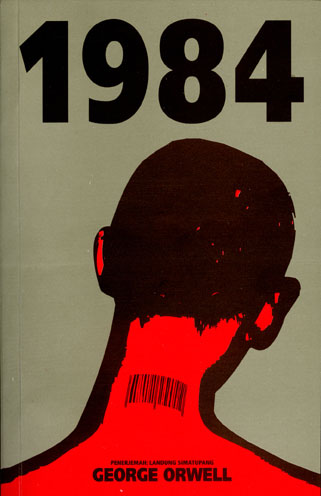
Honestly, The Hunger Games wasn't my first exposure to dystopian fic. I loved The Giver (the first time I read it, at least... the subsequent three times it was assigned for class didn't quite thrill me as much). I was fascinated and horrified by Fahrenheit 451 and 1984. So it really isn't a surprise that with the new trend of dystopian fiction in YA, I was one of the masses to be sucked in.

Why I Read Dystopian Fiction

* A mirror into our own society. I think dystopian fiction gives readers a chance to look at attributes of daily life and ethical dilemmas that, taken to excess, could lead to disastrous consequences. It gives us the chance to evaluate structures and systems that we have in place, and things that we should maybe change.
* Emotionally charged. Because these dystopias take situations that, on first glance, look appealing (No war? Yes please!), I find that my emotional reactions to them are very strong. I love being able to relate to a book, and even 
* Thrilling. These tend to be page turners. And while in general I prefer a character-driven story, every once in a while the excitement and intensity of a good dystopian is just what I need. 
* Love triangles. I'm totally kidding, as far as that being the reason why I read dystopian books. But it does seem to be an unwritten requirement for most of them. 

Recommendations

* 1984 by George Orwell. To me, this is the mother of all dystopian books -- the first book I ever read where the government had absolute, terrifying control. 
* Fahrenheit 451 by Ray Bradbury. The most terrifying of any dystopian literature to a book lover -- a land where books are illegal and burned by firemen? Where people sleep with headphones in their ears... oh wait, that already happens (the headphone thing, not the books. Obvs). 

* The Hunger Games series by Suzanne Collins. I would be remiss if I didn't acknowledge this series. The world Suzanne Collins created is terrifying but engaging, and the politics of control with hunger is hideously fascinating. 
* Delirium by Lauren Oliver. I unabashedly adored this book, set in a future where love has been eradicated by a neural procedure at the age of 18. 

For more recommendations, visit...

The Story Siren. Kristi reads a wide variety of YA books, but I've found that the dystopian lit that she reads is usually right up my alley. 

The Revisionists by Thomas Mullen

Wednesday, October 05, 2011

Title: The Revisionists
Author: Thomas Mullen
Genre: Dystopian, science fiction
Publisher: Mulholland Books, 2011
Source: NetGalley
Read for: Review

Thousands of years into the future, war has been eradicated. Everyone has mixed into one race. Any past grief is erased by the government. It is the Perfect Present.

In the Perfect Present, the technology to travel through time has been discovered, which means that a rebel political group known formally as the Revisionists and informally as hags (historical agitators) go back through time to prevent horrible events. They want to stop 9/11, prevent assassinations, heal the world. The problem? If those events don't proceed as they did originally, the Perfect Present will be threatened. Enter the Protectors, government officials who also travel backwards through time to prevent the hags from changing anything. Zed is one of those Protectors, but his assumptions are going to be challenged.

The premise of this book sounded awesome. First of all, with the glut of dystopian books in YA fiction, I was excited to read a dystopian novel aimed at adults. Secondly, it has been publicized as a "literary thriller," two words I hadn't ever heard together. My only experience with thrillers are the Dan Brown books about Robert Langdon, and they went like this: The Da Vinci Code: Love at first sight. I couldn't get enough of it. Angels and Demons: Entertaining, but repetitive. The Lost Symbol: Would have been okay if it was a first date, but was dumping material for how far the relationship should have been progressing. So when I heard literary, I thought, hmm, perhaps this book and I could hit it off.

And we did hit it off, at first. I was impressed with the writing. The Revisionists is literary. The writing is clever, and it delves below surface events to examine deeper meanings and repercussions. We aren't just dealing with a barrage of conspiracy theorists, politics, and clandestine killings. We are examining the deeper concept of how the past shapes and influences the future, and where exactly the present stands in all of this. The Revisionists is an interesting examination of the fluidity of time and also the ethics of acting in the past (if such a thing were actually possible).

However, in the end, Revisionists didn't have the "thrilling" aspect that I expected to drive the book. Mullen follows four main characters - Zed, the Protector, Leo, a man who is involved with a secretive political group, Sari, a young Indonesian woman working like a slave for a South Korean diplomat, and  Tasha, a corporate lawyer whose personal sense of ethics conflicts with her employers' ethical responsibilities. They all become entangled in each others' lives because Zed has the obligation to protect an Event of historical significance to the Perfect Present - however, as he interacts with people in the time period he is monitoring, the logistics of the Event are changed and he is led to question his employers, the value of protecting Events, and who is really doing the "revising." For me, everything started to get muddled and murky as everyone was chasing each other around. The interesting premise wasn't quite enough for me to stay engaged. While I finished the book, I was dragging my feet by the end.

While the general idea of the book is interesting, it dragged on and lacked the powerful finish I hoped for with The Revisionists' strong beginning. If you love political intrigue, you may find more to love in this book than I did.

3 stars

Warnings: Brief sensuality, language, gun violence

YA Friday: Wither by Lauren DeStefano

Friday, September 23, 2011

Title: Wither
Series: The Chemical Garden Trilogy, #1
Author: Lauren DeStefano
Genre:YA, dystopian, fantasy
Publisher: Simon & Schuster, 2011
Source: Library
Read for: Fun

In a frenzy of genetic manipulation, trying to keep the world's population healthy, a fatal mistake is made. Now males die at the age of 25 and females die at the age of 20. Some are hopeless, thinking it is the fate of the human race to die out. Some are frantically experimenting and researching, hoping to find a cure. And some are joining polygamous marriages and reproducing before they wither (heh - get it). Rhine belongs to the latter camp, kidnapped against her will and now married to Linden with two other girls, Cecily and Jenna. Rhine lives a life of luxury with Linden - but is it worth the loss of her freedom?

Okay, two things about this book. First of all - lovely writing, intriguing characters, absorbing plot. Second of all - totally unrealistic. This is why I have this pegged as fantasy. Because there is no way that the disease would automatically affect people with age, the world is mysterious and vague (granted, most of the story takes place in Linden's mansion, in which there is little to no contact with the outside world). This isn't a book that you can think too hard about as far as world development and global repercussions go. My other issue about realistic-ness has to do with Rhine's standing in the house, and it involves a spoiler, so highlight over if you'd like to read it - I don't know how she would get to be the first wife if she didn't consummate her marriage with Linden. I understand why she didn't, and I'm glad she didn't - but I just don't understand how he would perceive her as his favorite and spend every night snuggling up to her with nothing ever progressing beyond that. 

However, if you can get past the cerebral issues, it is quite enjoyable, even alluring. First of all, Lauren DeStefano's writing is every bit as dazzling as that cover. Unfortunately, I returned the book without copying down any passages - none stood out to me in particular. However, the book as a whole was almost visual in its descriptions. Rhine moves from a bleak, desperate world into a world of color and privilege, with special gowns and makeup designed exclusively for her to allure her husband and countless gardens and pavilions surrounding Linden's home. The characters are also described exceptionally well - I have vivid mental images of all of them (Cecily is a young, short Amy Adams, in case you were wondering). I honestly think the reason I was so absorbed in this book was the magic of the writing, because honestly, there isn't always much going on. There is mystery and tension, but the book is about a group of girls that live in a house and don't leave. Obviously more than that happens, but with that premise we aren't always getting tons of action. Fortunately, DeStefano's writing prevents that from becoming a problem.

I also enjoyed the characters, for the most part. I loved Rhine's relationships with her sister-wives and the friendships that developed between them. I've always wondered how women in polygamous families could stand each other, but the tentative friendships that blossom into sisterhood are one of the most compelling aspects of this book. Rhine not only becomes close with her sister wives, she also has a special friendship with Linden's first wife, Rose, who at twenty, doesn't stick around for long. She also has a remarkable friendship with Linden, her naive but sweet husband. In fact, I grew to like Linden quite a bit. Because of his sheltered life, he doesn't always understand or perceive the unethical aspects of his lifestyle; however, he does everything he can to make his wives comfortable and happy. He is suffering from loss just like every other character in the book (grief is a difficult emotion to avoid when everyone dies in their twenties). I also liked Gabriel, but I noticed a slightly annoying trend that has also appeared in similar books. Whenever I read a YA book written in first person, for some reason I never get a clear picture of the love interest. It's as if they are blacked out by the narrator's emotions - I know just how that person feels about the character, but I feel like I can't get a clear picture of what the character is actually like. I liked Gabriel, don't get me wrong - but I felt as if I knew much more about Linden. Gabriel was still a mystery to me - even though I knew he liked boats and had lived his life in the mansion, I felt like I didn't know much about him. I'm hoping that his character is fleshed out more as the trilogy progresses.

So, what's the verdict? While this book was imperfect, I still truly enjoyed it. It was compelling and absorbing and swept me up into the story, allowing me to focus on little else until the book was finished. If you are willing to look past the things that don't quite mesh together, reading Wither should be a great experience for you.

4 stars

Warnings: Un-gory violence, marital sex (behind closed doors)

YA Friday: Bumped by Megan McCafferty

Friday, April 22, 2011

Title: Bumped
Author: Megan McCafferty
Genre: YA, dystopian
Publisher: Balzer & Bray, 2011
Source: Received from NetGalley

Bumped explores a world where over 75% of the human race is infertile after the age of eighteen thanks to a progressive virus. As a result, teen pregnancy is not an epidemic that needs to be stopped but a condition that is embraced and rewarded. Melody Mayflower is a genetically desirable teen waiting to sign her first "bumping" contract in order to provide a couple with a child. However, her plans are shaken when her twin sister, Harmony, appears from the doctrine-heavy community of Goodside, where they preach the wickedness of bumping for profit and encourage families and marriage. Harmony and Melody's opinions and goals are very different, but as they get to know each other, they start to question the societies in which they were raised.

This was an interesting read for me. I went into it knowing that I had the potential to be offended due to the scandalous subject material. However, what was offensive to me was not so much the cavalier attitude about sex - although that was present to a degree - but the way Christians (described in the book as "having God") were presented. They were presented as ignorant, blindly following their beliefs and forcing individuals into loveless marriages. This is a satire, and I know that both the abstaining viewpoint of Goodside and the let-it-all-go-wild viewpoint of the bumpers-for-profit were brought to extremes to illustrate a point. However, I didn't love the underlying message that people who wait until marriage also walk around in floor-length dresses wearing veils and gloves so their skin isn't sullied by the unclean eyes of unbelievers.

End of rant. Other than the fact that I felt like Christians were being mocked a little in this book, a few other issues bothered me. First of all, I felt that the characters were a bit shallow. While both Melody and Harmony undergo personal changes that lead them to question their respective lifestyles, these changes seemed to be superficial. They begin questioning the institutions after sudden, dramatic events in their lives, and it seemed unrealistic to me that they would have such drastic alterations in their belief systems, especially Melody. While Melody is a little nervous about the idea of bumping, she seems pretty convinced of the idea - light-heartedly jealous of "Ventura Vida's adorable six-month bump," excited about the prospect of being admired and rich. Harmony is more introspective throughout the book, but the change in her seems to come mainly from physical attraction to a man. Is that really a message we want to send to teens - change your standards so you can get a guy?

I also didn't love the ending. I know that trilogies end on a cliffhanger so we will all be desperate to buy the next book. I know it's good salesmanship and profitable. But everything happened so quickly in the end of the book that it seemed too obvious that McCafferty was trying to ensnare our attention for the next book. Everything is left hanging, and everything happens too quickly to process. I know, I know, I like my loose ends tied up. I know I can't expect that in the first book of a trilogy. But if at least a few of the ends were tied, the ending would have been less jarring and the book would have felt more complete.

Now that I've aired my grievances, there were also a few aspects of the book that I enjoyed. The plot was entertaining and I wanted to keep going to find out what happened to the twins. I also think the idea to turn on the head a generally accepted position of society - that teenage pregnancy, regardless of what you may think of premarital sexual activity, is not a good idea - was brave and interesting. I found the dichotomy between Goodside and the rest of the world to be interesting, and a good example of the proverb to be moderate in all things. Encouraging unbridled sexual activity to ensure the continuation of the human race resulted in many problems, especially exploitation. Rigidly controlling lives by enforcing stringent rules also resulted in a decreased quality of life and seclusion for many women. McCafferty does a good job of bringing both these situations to light. She doesn't present either group's ideas as truly viable - these are both corrupt societies. They are opposites of each other, so doing a one-eighty turn in philosophy isn't going to solve the problem.

So overall? This isn't an awful book. I was engaged. I wanted to know what happened next. I have a favorite quote. "Harmony really puts the fun in fundamentalism." A little cheesy, but it made me LOL - literally. Ha. But it did lack depth. It was written at the level of young YA readers, but the content was definitely adult. I also felt it was offensive toward Christians at times. I probably won't recommend this book to anyone, but I did feel that I gained some insight from it.

2 stars

YA er... Saturday: Uglies by Scott Westerfield

Saturday, April 02, 2011


I've been a bum of a blogger lately. I'm not sure what it was this week, but I didn't seem to get half the things done that I needed to do. Fortunately there are only two weeks of school left, and then I have a month of freedom before I sell my soul to nursing school. Right now my husband is here , at a biannual international meeting for my church. (This session is especially for men). So lucky me, I have time to catch up a bit on blogging. :)

Anyway...
Title: Uglies
Author: Scott Westerfield
Genre: YA, dystopian
Publisher: Simon Pulse, 2005
Source: Provo Library

Uglies is set in a society where, at the age of sixteen, everyone undergoes a plastic surgery operation to make them "pretty." Their features are averaged out and they go to live in New Pretty Town, a place of partying, romance, and fun. Tally has spent her life wishing to be pretty. Her eagerness is intensified when her best friend, Peris, turns sixteen and moves on to New Pretty Town without her. Tally makes friends with another ugly, Shay, also missing her friends and eager to turn sixteen - or so Tally initially thinks. Soon she learns that Shay has other plans for when she turns sixteen - and those other plans bring Tally into a world far more complicated than she'd imagined possible.

After reading Leviathan, I knew to expect a slightly younger feel to this book. With that expectation, I really enjoyed the plot. I don't want to reveal too much, because part of the charm of the story for me was the fact that I had no idea what was going to happen. Suffice it to say that Westerfield's alternate reality is interesting, and Tally's adventures will keep you eager to learn more.

I also enjoyed the characters. The major characters, Tally, Shay, and David, all had very different personalities, something I sometimes find lacking in other books where main characters' personalities are a bit too similar. I also loved the relationships between all the characters, especially Tally and Shay's friendship. I loved how quickly their friendship developed and how close they became - I miss that about the younger years of high school. Thinking about it now, I met most of my good friends about the time when Tally and Shay met, when I was fifteen. The dynamic of their friendship just seems really legitimate. The romance in this story is also quite believable - who hasn't stayed up all night talking to a boy, only to be completely incompetent the next morning? Westerfield deals with themes of jealousy, first love, and friendship in a way that, despite being set in a completely new world, rings true.

I really like the questions that this book raises. What if everyone was "pretty?" How does the government stratify society by imposing that? In the book, Tally sees "artifacts" of books and magazines with "ugly" people, and she is revolted by them, but later, she learns to appreciate the uniqueness in each individual face. I think these are great questions for younger teens to ask themselves, especially in a society where eating disorders run rampant and teens are often ostracized into different cliques (I know all high schools aren't clique-ish, but many are).

The one thing I didn't love about the book was the writing style. Once again, this may be a result of the intended audience, but everything felt a little cheesy and occasionally dumbed down to me. The slang was so obvious that it wasn't believable to me. "New Pretty Town" seems like a region of an amusement park, not a legitimate town. It wasn't awful, but the cheese just put me off a little bit.

Overall, it was a fun, light read. I really think this is a great book for younger teens to read, and older teens and adults if they can get past the slightly younger writing and cheesiness.

Readability: Easy read.
Plot: 3.5
Characters: 4
Writing: 2.5
Personal response: 3
Overall: 3.25

YA Friday: Matched by Ally Condie

Friday, March 04, 2011

Before you read my review, you should go to Ally Condie's website and get Matched. Pretty funny. Unfortunately, I was not Matched to my husband... dang it.

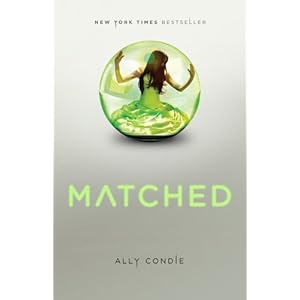
To back up - Matched by Ally Condie is set in Society, a perfectly organized world where you are assured a stable life with a job you are well-equipped to perform, meals that are perfectly proportioned to sustain a healthy body type, and, if you want to be married, a genetic match so perfect for you that you are practically guaranteed to fall in love with them. Cassia has been looking forward to the day of being Matched ever since she was a little girl. She has the perfect dress, the perfect accessories, and it turns out, the perfect Match - her best friend, Xander. However, when she goes to review her Match information, another face appears on the microchip she has been given - the face of Cassia and Xander's soft-spoken, somewhat mysterious friend, Ky Markham. Cassia begins to question whether the perfectly orchestrated Society is fatally flawed as she questions who her Match really should have been.

Matched falls into the currently very popular genre of dystopian literature, but it had a slightly different feel to it. In books like Delirium and The Hunger Games, there was a fast-paced, white-knuckled feeling of stress due to the constraints and control of Society. While that feeling surfaced occasionally in Matched, the overall feel of the book was a bit more peaceful and relaxed. The main character, Cassia, has absolute faith in Society at the beginning of the book - her parents were Matched and have a blissful, romantic relationship. She is good at her vocation and has the potential to be a high-ranking individual in society. She has been Matched with her best friend. However, when she sees Ky's face flash across the screen, and as she gets to know him better throughout the summer, she starts to wonder about Society's true purpose and whether or not it really does make life better.

I enjoyed getting to know the Society as Ally Condie slowly revealed Cassia's world. The beginning of the novel was a little slow, but I think that was necessary to describe the way Society worked. I also really liked the way it allowed the relationship between Ky and Cassia to develop in a realistic way. So often (especially in movies) characters meet and have this instant connection, and from that moment on it is taken for granted that they are in love and meant to be together. Cassia and Ky discover each other slowly and naturally, and for that reason their relationship seemed more powerful.

One aspect of the novel that was a little weaker to me was Cassia's relationship with Xander. I felt like it could have been described in more detail - generally we were just told that Xander was her "best friend" from childhood. Because Xander is not as present in the story, I felt like I didn't know his character as well, and it made the story feel a little unbalanced.

I really liked Cassia's parents' relationship and the contrast it showed to the Matching process. The Society isn't shown to be this absolutely evil entity - the system really does work for some people. Cassia's parents were genetically matched and predicted, and they fell head over heels for each other in love. I think this dichotomy between too much power and trying to provide for the well-being of the individuals was well illustrated by this contrasting relationship.

I was also struck with the beauty of the writing. Cassia's world is pretty stark and colorless. They are given food for nutritional reasons only (except on special occasions). Everyone wears the same color of plainclothes (except on special occasions). Only certain flowers are permitted in certain areas, and everyone must be the same and equal. Despite this barren world, Condie's descriptions are beautiful, and her observations about emotions are poignant. I loved the way Cassia analyzed poetry -
I only meant to tell him a few more lines, but once I start telling him it's hard to hold back, and I say the whole thing. The words go together. Some things are created to be together. [...] "I think it's because when we hear it we know we're not the only ones who ever felt this way."
Overall, I thought Matched was an interesting, enjoyable read. If you're not a fan of dystopian lit, I would maybe skip it. It definitely has some similarities to other dystopian novels such as Delirium by Lauren Oliver and The Giver by Lois Lowry. However, if you are a fan of YA dystopian lit, Matched is beautifully written and a compelling story.

Readability - Story flowed well, although at times there were plot transitions that jarred me a bit.
Plot - 4
Characters - 3
Aesthetics - 4
Personal Response - 4
Overall: 3.75

Delirium by Lauren Oliver

Tuesday, February 01, 2011

January was definitely the month of the YA novel. While I am not one of those book bloggers that looks down on YA - to me a good book is a good book - I usually do read mostly adult fiction and nonfiction. However, for some reason I kept picking up YA novels last month, and this one blew me away completely.

Delirium, the first book in a trilogy, describes a dystopian United States in which love, now clinically classified as the disease amor deliria nervosa, is being eliminated from the population. Everyone undergoes "the procedure" at the age of 18 (before that, it is too dangerous to developing brains) which liberates them from all feelings of love. This is essentially supposed to keep the peace and protect the people, but in order to enforce the ban on love, all communities are isolated by a barrier and full of regulators, who keep an open eye for people who wish they could still love (sympathizers) and people who are infected with love (Invalids). Enter Lena - a rule follower, one summer away from her own procedure. Add a handsome boy to the mix. You can figure out what happens from there.

Honestly, I expected this book to be cliche. Dystopian literature is a huge trend right now, especially in YA, and from the summaries and reviews I read, I thought Delirium would just be a mishmash of The Giver, The Hunger Games, and Matched. I thought it would be fun and exciting, but probably not too original. I was so wrong. Delirium does share similar themes and plot points with other dystopian lit, but it definitely has its own moving story.

I think the main reason Delirium can stand out in a sea of other dystopian tales is Lauren Oliver's beautiful writing. In contrast to her society, where emotion is discouraged and removed, Lena's emotions are stark, powerful, and gut-wrenching.
This is what I imagine it feels like to climb to the top of a mountain, where the air is so thin you can inhale and inhale and inhale and still feel like you can't take a breath.
In a bleak community where enjoyment of beauty is cause for legal investigation, Oliver paints dazzling scenes through Lena's eyes -
Above our heads, the stars flare and glitter and flash: thousands and thousands of them, so many thousands they look like snowflakes whirling away into the inky dark.
I also appreciated that in Oliver's world, romantic love isn't the only thing that is lost. This book isn't just about romance and hormones. After the procedure, Lena will not just lose the boy she loves - she will lose her love for family members and friends. Lena's relationship with her best friend, Hana, is almost as important to the story as her budding romance with Alex. The two girls have come from different backgrounds, but still have bonded as best friends throughout childhood. Once the procedure is performed, they will "pass each other on the streets with nothing more than a nod - different people, different worlds, two stars revolving silently, separated by thousands of miles of dark space."
Best friends for over ten years and in the end it all comes down to the edge of a scalpel, to the motion of a laser beam through the brain and a flashing surgical knife.
Lest you think Delirium is all contemplation about what we would lose in a world without love, allow me to reassure you that it is also packed with action (this is where it becomes more similar to The Hunger Games - overbearing government officials, electrified border fences, etc.). While the first half of the book was a little slow with Oliver building up and explaining the world she created, the second half kept me breathlessly tearing through the book. On the last page, I was literally yelling at my Kindle, "No, no, NO!" The ending was a punch in the stomach, although I do think it was the best possible way to end the story. (I am dying to know what will happen in the next two books). I called literally three people to tell them they have to buy the book as soon as it comes out because I needed to freak out about it with someone. The book is out in the wild, guys. Go get it.

Accessibility/readability - Quite.
Aesthetics/Literary merit - 5. Gorgeous writing.
Plot - 5. A little slow at first, but the end was so perfect and unbelievable that it saved the whole book.
Characters - 5. I loved them.
Personal Response - 5. (Obvs)
Overall: 5

In case you want a second opinion, I thought Erin Reads had an excellent, very objective review.

FTC Disclosure: E-Galley received from publisher
Related Posts Plugin for WordPress, Blogger...