Showing posts with label chunkster challenge. Show all posts

Son of the Shadows by Juliet Marillier

Wednesday, November 07, 2012

Title: Son of the Shadows
Author: Juliet Marillier
Series: Sevenwaters #2
Genre: Fantasy
Publisher: Tor Fantasy, 2002
Source: Borrowed from my mom
Read for: Fun

Like her mother, Sorcha, Liadan is gifted with healing. She is content to stay at Sevenwaters, helping her family in any way she can and remaining close to the forest. However, when Liadan's life goes down an unexpected path, she finds herself tested in ways she never could have imagined, as well as gifted with more power than she knew.

I'm starting to think that where Juliet Marillier's concerned, it's impossible to not hit gold. Sure, this is only the second of her novels that I have read. And I'll be honest, Daughter of the Forest was a better book, in my opinion. However, this sequel, Son of the Shadows, also kept me compelled to keep reading and entranced in the magical atmosphere and beautiful writing that I'm beginning to learn characterizes Juliet Marillier's work.

Son of the Shadows picks up several years past Daughter of the Forest, and focuses on Sorcha's children. Niamh, her vivacious oldest daughter, is tied up in a dangerous love affair. Sean, Liadan's twin, is learning to take over Sevenwaters some day. And Liadan is simply doing what she can to help everyone around her, although she is quickly blindsided by the realities of loss, marriage proposals, and an even more dangerous, unexpected adventure that shows her that there is more to people than meets the eye. Watching this adventure unfold and the revelations associated with it was probably one of my favorite parts of Son of the Shadows. When the adventure first began, I was leery of the new characters Liadan meets, but as the story unfolds it becomes clear that there is more to them than meets the eye. I think this is definitely one of Marillier's strengths -- her characters are developed and full. We even see some darkness in the "good guys" of Daughter of the Forest -- they are extremely complex and have some motives that aren't entirely pure. I enjoyed being introduced to the new characters as well as watching familiar characters develop further.

Son of the Shadows also has Marillier's trademark haunting, atmospheric writing. I love the Celtic feel to the story -- the hints of magic, earth spirits, and mysticism. Juliet Marillier also is able to convey powerful emotion in simple words by changing up her sentence structure etc. For example, this passage dealt me a blow to the heart --
That look said, this is a long good-bye, yet not time enough. I have no aptitude for this. I cannot learn this. I would hold on, and hold on, until my hands clutch at emptiness.
I mean, seriously. Simple words, but the way they are put together is a blow to the heart.

Overall, Son of the Shadows was an excellent read. I didn't love it quite as much as Daughter of the Forest -- for some reason the plot was not quite as compelling to me -- but it was still a rich and vivid reading experience. I am looking forward to the rest of the Sevenwaters books!

4 stars

Warnings: Abuse, violence, some scenes of sensuality (not graphic)
The Woman in White by Wilkie Collins

Wednesday, October 31, 2012

Title: The Woman in White
Author: Wilkie Collins
Genre: Mystery, suspense, classic
Published: 1859
Source: Personal Copy
Read for: R.I.P. VII, A Classics Challenge, Back to the Classics Challenge, Chunkster Challenge, The Classics Club

On his way to a new job as a drawing master, Walter Hartright comes across a mysterious woman dressed only in white, in desperate need of his help. Little does he know that the mysterious woman is connected with his new situation for work, or how the circumstances will reveal to him a new life of love, conspiracy, and mystery.

I knew nothing about The Woman in White going into it except that it was some kind of thriller, and that most people who had read it thoroughly enjoyed it. After reading it, I think it is best to know very little about it because there are several plot twists and surprising revelations, so I am going to keep this review somewhat short and vague to avoid spoiling this book for anyone else.

The first thing I noticed was that Wilkie Collins is exceptionally good at painting the quirks and foibles of his characters. There is an air of sarcasm and wit in his writing, especially about his most ridiculous characters. The three I most enjoyed were Mr. Fairlie, a hypochondriac who can't bear to have his convenience disturbed, Count Fosco, a simpering, excessively sentimental man with many secrets, and Marian Halcombe, who is an extremely capable woman for literature of that time. I had to laugh at the first description of Marian, who is apparently the original "but-her-face" -- the narrator (at that point in the story -- it switches several times) describes her elegant, beautiful figure as he first meets her, and his shock when she turns around -- "the lady was ugly!" Despite her apparent lack of attractiveness, in her face at least, she is one of the strongest characters, and my only irritation was that her beautiful and weak-willed younger sister is more admired and loved than she is (although I detected an element of sarcasm in this from Collins as well). I also loved Mr. Fairlie's narrative voice -- he is so obnoxious and selfish, but in print it becomes hilarious. Here are his observations on tears, which made me laugh out loud (although I read it to my husband and he didn't find it nearly as humorous, so we'll see what you all think of it) --
Except when the refining process of Art judiciously removes from them all resemblance to Nature, I distinctly object to tears. Tears are scientifically described as a Secretion. I can understand that a secretion may be healthy or unhealthy, but I cannot see the interest of a secretion from a sentimental point of view. Perhaps my own secretions being all wrong together, I am a little prejudiced on the subject.
Priceless.

One thing I also appreciated about the novel was that every thing was spelled out in the end. We are led through several twists and turns of plot, but in the end, every question is satisfied. I am always so annoyed by loose ends being left at the end of a novel, and I loved that I could depend on Collins to answer all my questions.

There are several interesting plot turns in the novel. Because of the amount of detail, at times they can be guessed, simply because we are given so much evidence about everything, but for the most part I still found myself being surprised and enjoyed trying to put together the information on my own before the veil was lifted and everything was revealed.

The Woman in White was definitely a fun read. While it was certainly dated as far as women's rights are concerned, I loved the development of the characters and will be reading more of Collins' work.

4 stars

Warnings: Mild violence

East of Eden by John Steinbeck

Monday, October 08, 2012

Title: East of Eden
Author: John Steinbeck
Genre: Classic
Originally published: 1952
Source: Personal copy
Read for: A Classics Challenge, Back to the Classics 2, The Classics Club, Banned Books Week, Chunkster challenge

John Steinbeck said of East of Eden, "Nearly everything I have is in it, and it is not full. Pain and excitement are in it, and feeling good or bad and evil thoughts and good thoughts -- the pleasure of design and some despair and the indescribable joy of creation."

What can be said to summarize East of Eden? In its simplest form, it is an allegory of the story of Cain and Abel -- but with a twist -- what if Cain had chosen to overcome his mistakes and his jealousy, had tried to rise above the fate he believed he had for himself and become a whole person?

There is so much more to the story than that, but I don't know how to summarize it without drawing everything in and writing pages and pages and pages about it. Honestly, I don't know how to write about East of Eden -- it is a book that means so much to me. I first read it my senior year of high school for a classics project, and I was absolutely drawn in (thank you to my awesome AP English teacher, Ms. Taylor, for recommending it in the first place). I loved the message, the depth of the story, and of course the writing. When we were talking about names for our son (who is due in 39 days, hooray!), my husband (who also had read and fallen in love with East of Eden) brought up Caleb, Cal for short, the name of the protagonist/anti-hero. It seemed to just fit, and we both decided to reread the book. We love the symbolism of the character, the journey he takes from an uncertain, jealous, struggling boy to a man who takes his destiny into his own hands and overcomes the forces of sin and circumstance pressing against him. I'm starting to ramble at this point, but perhaps this gives you a sense of my personal connection to East of Eden.

As for the book itself, it is so rich and vivid and multilayered. The cast of characters is vast but richly developed. I feel as if these characters are a part of my life. From Cal's inner struggle to the unbelievably evil acts of Cathy, from the philosophical journeyings of Lee and Samuel Hamilton to the muddled idealism of Adam and Aron, the characters fly off the pages.

While the characters give the book life, I think the greatest value of it is in the writing and the ideals behind it. The central idea of the book is the concept of timshel, a Hebrew word meaning "Thou mayest" that occurs in the Cain and Abel verses in Genesis. The main idea is that when God chastised Cain for his misplaced offering and killing his brother, he told him that "thou mayest" triumph over his sins. He had the choice to change his life and become more than he was in the current state. It is such a powerful idea, one that Lee, the philosopher-servant of the Trask family, calls man's "ladder to the stars."

In addition, John Steinbeck's writing is unbelievable, which is no more than what I expect of him. The other day my husband and I decided that in our opinion John Steinbeck is the greatest of all American authors. Granted, we are both scientists with no literary training, but we are also reasonably well-read, and that is our opinion. :)

Obviously I can't be coherent or unbiased about this book, and this review is nothing but a rambling on and on of how much I love it. But honestly, pick it up. While I can't promise that it will affect you as much as it affected me, I do think it is worth a read. It will inspire a lot of thought whether or not you agree with what it professes to be true.

5 stars

Warnings: Brief strong profanity, prostitution, some innuendo

Daughter of the Forest by Juliet Marillier

Wednesday, September 05, 2012

Title: Daughter of the Forest
Author: Juliet Marillier
Series: Sevenwaters #1
Genre: Fantasy, fairy-tale retelling
Publisher: Tor Books, 2001
Source: Gift from my mom
Read for: Alex Awards challenge, Chunkster challenge

Daughter of the Forest is a retelling of the six swans fairy tale. Sorcha is the seventh child of a seventh son and the only girl in her family. She loves her childhood with her six brothers, learning to heal and having strange encounters with the Fair Folk. However, Sorcha's life is turned upside down first when she encounters a Briton, sworn enemy of her people, and second when her father marries the beautiful but venomous Lady Oonagh. Her family torn apart, Sorcha begins a quest to save her brothers. However, her quest takes her places she could hardly have imagined.

I am not especially familiar with the fairy tale of the six swans, but I do know that Daughter of the Forest was a compelling and beautiful read, rich with descriptions and haunting mystery. I found myself completely enthralled in Sorcha's world and eager for the next installment of the trilogy.

I think one of the greatest strengths of Daughter of the Forest is the atmosphere. Marillier creates a world that is beautiful yet completely wild and untamable. The beliefs of Sorcha's family lend an eerie, mystical feel to the story. As Sorcha encounters the Britons, the atmosphere changes into more of the hearty, meat-and-potatoes, green countryside type of setting, but Sorcha keeps her haunting air of magic. The way the mood enveloped the story made it so powerful and entrancing.

Hand in hand with the atmosphere is the beauty of the writing. Marillier's voice is distinct and lovely, with vivid descriptions of the forests and the emotions of the characters. I felt completely invested, completely involved with Sorcha's tale. I think the ability to involve a person so deeply into a book that is so long and so different from my contemporary life demonstrates Marillier's remarkable skill as a writer, and I am looking forward to reading more of her work.

Another aspect of Daughter of the forest that was extremely compelling to me was the depth of emotion in each of the characters. They do not experience flat, simple urges and reactions. Instead, their experiences are complicated and their sentiments are reflections of that complexity. I  felt strongly about what Sorcha was going through, experiencing moments of anguish and joy as if they were my own, even when the circumstances were situations I have never experienced. The sheer emotion of the characters were transmitted exquisitely through the writing.

Daughter of the Forest was a powerful and lovely book. As a fantasy novel it satisfied me by providing an interesting world with magic, but it also satisfied me simply because it stirred my emotions and was beautifully written. I am looking forward to reading the next book, Son of Shadows.

5 stars

Warnings: Violence, a scene of sexual abuse

Les Miserables by Victor Hugo

Monday, September 03, 2012

Title: Les Miserables
Author: Victor Hugo
Translator: Julie Rose
Genre: Classic
Publisher: Modern Library, 2008 (Original publication date: 1862)
Source: Gift from my husband
Read for: Back to the Classics Challenge, Chunkster Challenge, A Classics Challenge

I know that I've been posting extensively about Les Miserables, but for those of you who haven't been following along with the in-depth posts about each individual section of Les Miserables, I thought this book deserved a few words as an intro.

Les Miserables is the story of Jean Valjean, a convict who reforms after a saintly bishop rewards his thieving behavior with an unbelievable gift and forgiveness. Trying to escape his past while building a worthwhile future, Valjean saves a town, rescues a young girl from poverty, and plays a heroic part in the 1832 June Rebellion in Paris. Woven into his story are the very heights and depths of the human character, from the most beautiful romance and stirring heroism to the lowest levels of despicableness.

There is so much to say about Les Miserables (and I know I've had a lot to say already) that I hardly know where to begin, so I'll just start with the translation. I was extremely impressed with Julie Rose's rendering of Les Miserables. I don't speak French well enough to judge how accurate or idiomatic it was, but I do know that I read an earlier translation several years ago and found the  book extremely difficult. While the Julie Rose translation was by no means an easy read (wade through those Waterloo chapters and see how you feel afterwards), I found it much clearer. In addition, the imagery was beautiful.

Speaking of the imagery, while I'm sure some of it was related to Julie Rose's skill as translator, it is clear that the majority is Victor Hugo's exquisite skill as a writer. He has a way of taking a simple emotion or experience and translating it into sheer poetry. I was constantly awed by the power and loveliness of the images conveyed in the words.

The characters were also extremely powerful, going through the entire range of human emotion and capability. I won't go into details here, because they are available in all the other posts I've written about this book, but I found so much to love and respect in so many of the characters (and so much to despise in others). I feel attached to these characters as if they are living beings -- in those 1200+ pages there is quite a bit of time to get to know them.

The plot of Les Miserables is difficult at times because the action is interspersed with pages of historical and political commentary. It is rendered skillfully and interestingly, but it can get a little dense. I think these sections are the biggest reason Les Miserables is a challenge to readers. However, the more plot-driven sections move very quickly. I tried to learn a lot from the historical sections, but I will confess at times they still went over my head. However, I think they are worth the effort in order to enjoy the book as a whole.

Les Miserables is a masterpiece, and I don't really feel up to the task of finding appropriate words to truly express that. I think anyone who takes the time and effort to read it will be duly rewarded.

5 stars

Warnings: Violence, some language, prostitution

The Name of the Wind by Patrick Rothfuss

Wednesday, August 08, 2012

Title: The Name of the Wind
Author: Patrick Rothfuss
Series: The Kingkiller Chronicle #1
Genre: Fantasy
Publisher: DAW Hardcover, 2007
Source: Library
Read for: Alex Awards Challenge, Chunkster Challenge

When Chronicler finds himself in an isolated tavern one night on the way to a scribe assignment, he doesn't expect to meet one of the most legendary people in the land. He also doesn't expect to be offered the opportunity to hear the man's story from his own mouth. Kvothe tells Chronicler that it will take him three days to tell his story. The Name of the Wind is the first day, taking us from Kvothe's beginning as a member of a traveling performance troupe to his experiences in the famed and at times mysterious University in Imre.

I'm a sucker for a good fantasy novel, especially this summer, but I was absolutely blown away by The Name of the Wind. The world-building, characters, and small details made this not only a book but an experience.

One of the first things I noticed at the beginning of The Name of the Wind was that as readers we are thrust instantly into the world Patrick Rothfuss has created. While it was confusing for a few pages, Rothfuss is expert at weaving in the necessary details to make the world make sense without being overly didactic or obvious. The reader is slowly woven into the fabric of Kvothe's world, integrated into the experience without it being too jarring.

And the world itself is fascinating. There are different languages and groups of people, different types of professions. My favorite part, and one that dominates most of the novel, is that of the University, where Kvothe learns the intricacies of sympathy, manipulation of small particles in a way that seems very like magic, fabrication, which is engineering with sympathy, and medicine. As I have been in college for the last six years (and went through seven majors and two degrees), I could appreciate Kvothe's penchant for taking on more than he could handle and not wanting to be tied down to only one subject.

I also fell in love with the characters. Kvothe himself was very relatable to me. I loved how quickly he learned, how passionate he was about the universe around him, how desperate he was to avenge the deaths of his parents. I could relate to his absorption with music (the first of my seven majors was music), the way immersing himself in it was the only thing that could calm him down. I loved getting to know this character and can't wait to learn more about him.

While I'm talking about characters I could relate to in this book, I also have to mention that for the first time in my life, I saw someone else with the same first name and spelling as I do. Lorren the Archivist, protector of the massive library that blossoms from the University, made me do a double take every time his name was on the page. I appreciated that he was an intense book lover as well.

The secondary characters of The Name of the Wind were also vivid and fully developed, something that to me is a deal-maker with an author. If they are willing to devote time and space to create fully realized secondary characters, they are probably creating a story that is rich and satisfying to me. I loved Kvothe's close friends, his first teacher, his love, Denna. I couldn't wait to get to know these characters better, eating up every page.

The Name of the Wind was one of the richest, most satisfying books I've read in a long time. I can't wait to devour The Wise Man's Fear, although I don't want to read it too soon because I have no idea when the third book will be released. I can't wait to see what Kvothe does next.

5 stars

Warnings: Some language, violence, innuendo

The Bronze Horseman by Paullina Simons

Monday, May 28, 2012

Title: The Bronze Horseman
Author: Paullina Simons
Series: Tatiana and Alexander #1
Genre: Historical fiction
Publisher: HarperTorch, 2002
Source: Library
Read for: New Adult Challenge, Chunkster Challenge

Tatiana meets Alexander the day Hitler invades Russia, and both events shape their lives in an unimaginable way. Alexander is a soldier in the Red Army with a hidden past; Tatiana is the lowest member of her family, constantly sacrificing to help everyone but herself. As the war progresses, they fall in love, but the obstacles to their happiness seem unsurmountable.

The Bronze Horseman was unlike any book I have read before. The Russian culture, which is very familiar with me, combined with the absolute misery and hardship endured by the characters, topped by their fierce and at times torturous love, made The Bronze Horseman a difficult but deep and rewarding read.

The most powerful part of the story was, for me, the depth of Tatiana and Alexander's love, a roller-coaster that resulted in emotions that were negative and positive but always strong. Tatiana and Alexander find themselves in many sticky situations with their relationship that seem unescapable. Both Tatiana's family and Alexander's closest "friend" (if friend he can be called) pose strong opposition to their happiness, and in trying to circumvent these difficulties, the two star-crossed lovers tend to make matters even more complicated than before. I had a few shake-the-book-and-yell-at-it moments. However, at the same time, there are many scenes of unbelievable sacrifice and love. I'll try and be vague to avoid a spoiler -- this event does occur later in the story but doesn't reveal any outcomes, so I'll share it. The most powerful scene to me is one in which Alexander has been severely wounded and has lost immense amounts of blood. To save his life, Tatiana attaches herself to him by an IV and drains her arterial blood -- aka the blood that has yet to bring oxygen to her tissues -- straight into his body. That is an image I won't soon forget.

Another element that made The Bronze Horseman a gripping read for me was the absolute poverty and suffering encountered by the characters. I have read many books that discuss tragic situations, but The Bronze Horseman's level of detail left me feeling as if my own body was slowly starving, as if my own limbs were turning blue with cold. When Germany invaded Russia in World War II, they laid a siege on Leningrad and there was virtually no food, no heat, no way of sustaining life. The book describes people falling dead in the streets as they walked to get the small amount of food rationed to them. Not only was I feeling more strongly and more connectedly with a tragedy of history than ever before, it was all new to me; I knew nothing of Russia's suffering in World War II.

In fact, I knew next to nothing about Russia at all. And while I still know very little, it was interesting to be exposed to the culture in The Bronze Horseman. It was fascinating to hear first-hand how a Communist family lived. I also loved and was simultaneously confused by the complex hierarchy of nicknames, the use of which seem to confer certain meanings on different situations. Tatiana had at least four, two of which got her in trouble more than once.

I was a little jarred at times by the writing in The Bronze Horseman. Paullina Simons uses italics frequently, as well as short, blunt little sentences that sound somehow immature. However, at the same time, her imagery was able to inspire powerful emotions and visceral reactions to the tragedies and joys described. I wouldn't say necessarily that I didn't like the writing, but at times it distracted me from the story.

The Bronze Horseman is not a comfortable book to read, but it is still one that I cannot erase from my mind. I am looking forward to the remaining two books in the trilogy.

4 stars

Warnings: There are some graphic sexual scenes that are pretty much clustered together. I just skipped several pages until they were over, but be warned that they were uncomfortable to me to the point of not reading them. There are also instances of soldier profanity and extreme thematic elements (starvation, bodies in the street, war violence).

Spiritual Sundays: Jesus the Christ by James E. Talmage

Sunday, April 08, 2012

I'm not going to write a real review of this book -- I'm not even going to say much at all, because I have been so sick for the last few days that I think my brain is severely deprived of oxygen and I can't form coherent sentences. However, I am excited to have reached my goal of reading Jesus the Christ by James E. Talmage between the Christmas season and Easter. In case you missed that post last November, I decided to read this 800+ page monster by reading six pages daily to make it last from late November (the day after Thanksgiving) until Easter, to help me understand the life of Christ better.

Jesus the Christ starts with Christ's life in the heavens before his advent into a mortal body and ends with prophecies of his second coming and millennial reign. Every statement is supported by scripture or commentary about Jewish life during the time of Christ's mortal life. I loved the detail -- while I've read the New Testament many times, there were so many details that I had missed that were pointed out to me in Jesus the Christ. I think one of the main things I took away from this book was the human-ness of Christ. That can be taken in a negative way, so please bear with me as I explain why this is a good thing. I already strongly believe in his godhood and the Atonement and Resurrection. However, at times it all seems a little distant to me -- Christ can seem like this huge, untouchable, great being that I can't relate to. Reading in this book about the details of Jewish life during Christ's lifetime helped me to feel closer to Christ on a personal level. He is this huge, powerful, glorious being -- but he also lived a mortal life, close to the people around him, touching them and healing them and having personal friendships with them. While he isn't a person that I can see, because of his love for me and for all humanity, I can still have that personal relationship through learning to emulate him and accepting his atoning sacrifice for me.

The author of this book, James E. Talmage, was one of the twelve apostles of The Church of Jesus Christ of Latter-day Saints (LDS church for short) during his lifetime. The purpose of that role in the church is to witness to the world that Jesus is the Christ, that he lived and was resurrected and redeems us all through his Atonement. This book was a very powerful testimony and witness of that fact. While James E. Talmage passed away in the 30's, there are always twelve living apostles in the LDS church who dedicate their lives to providing a witness of Christ. The video below is from one of the apostles living today, Elder Jeffrey R. Holland. I loved the talk that this little video was taken from, and just thought I would share it for Easter.


I hope you are all having a wonderful Easter, whatever your traditions are! I also hope that you got some chocolate. :) Happy Easter!

Berlin 1961

Thursday, April 05, 2012

Title: Berlin 1961
Author: Frederick Kempe
Genre: Nonfiction, history
Publisher: Putnam, 2011
Source: Publisher
Read for: Indie Lit Awards, Chunkster challenge

I've heard of the Cold War and the Berlin Wall, of course. However, I knew next to nothing about them -- essentially, that the Cold War was with Russia and we were competing to have bigger weapons, and that the Berlin Wall was a wall and it was hard for East Germans to escape (this courtesy of the awesome movie Night Crossing. For serious, watch it). Berlin 1961 delineates the dangerous, intense events leading to the construction of this wall and the face-off between Russian and United States forces at Checkpoint Charlie on the wall at the end of 1961.

Honestly, I was not expecting to like this book. While I find history to be interesting, too many details are a turn-off to me. Also, I tend to like events and personal stories, not complex political intrigues. Politics make me nauseated, in a word.

However, I thought Berlin 1961 was fantastic.

I'm not sure what it was, exactly, that drew me in. And of course, it wasn't an easy book for me to read -- it took me almost a month to get through it. In all honesty, it might be the fact that I am obsessed with the movie Night Crossing and was excited to learn more about why that division existed. But I absolutely loved it.

Kempe's writing is excellent, and I think that was key to my enjoyment of the novel. As I mentioned before, I struggle with excessive detail and politics, and Berlin 1961 abounded with both. Kempe's ability to turn a phrase made the 500+ pages fluid and interesting, leading me from one idea, one conversation, one diplomatic encounter to the next.

I also appreciated Kempe's attention to the personalities of the event. I felt that I become well-acquainted with Khruschev, a man I had not even heard of. His idiosyncrasies, his calculated outbursts at meetings, and his personal agenda came together to paint a picture of who this man was in history. I also felt better acquainted with Kennedy, and in particular his vulnerabilities at the beginning of his presidency. Lesser characters were also well realized, making me feel not like a was reading a dry story of political giants but instead an intimate rendering of a complex event and the way it was shaped by individual personalities.

The topic also became interesting to me -- I knew so little about that time period and the Cold War that it was interesting to learn about why events progressed as they did. My one complaint is that Kempe assumes that we have some knowledge already. I had no idea why Berlin was divided, or for that matter why Germany was divided (and I still am not completely sure -- Berlin was so far from the rest of West Germany. How did that work, exactly? Or am I understanding incorrectly?). While I picked information up as I read, the background was never completely clear to me. A brief summary of events leading up to 1961 would have been indispensable to me.

Overall, this book was a pleasantly fascinating surprise. I had the opportunity to learn about an event in history that I previously was almost completely ignorant of, and enjoyed Kempe's excellent writing.

4 stars

Warnings: Language, maybe some descriptions of Kennedy's affairs, but nothing explicit

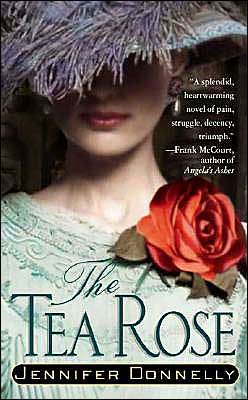
The Tea Rose by Jennifer Donnelly

Tuesday, July 12, 2011

Title: The Tea Rose
Author: Jennifer Donnelly
Genre: Historical fiction
Publisher: Thomas Dunne Books, 2003
Source: Library

Fiona Finnegan, a worker in Burton's tea factory, knows tea so well she can tell you what it is just by smelling it. Her dreams stretch beyond the factory to owning a tea shop of her own, and the handsome Joe Bristow wants to help her do it. However, as circumstances change and twist down unexpected paths, Fiona will take a turn away from Joe and into a life she never expected.

Oh, Jennifer Donnelly. You just have this way with you. At the beginning of this book, I was disappointed. The huge tome flitted back and forth between characters' perspectives in third person omniscient, a style I don't really care for that seems all too pervasive in historical fiction. I missed the strong, personality-filled first person voices of Donnelly's two young adult novels. And the drama that gave Revolution and A Northern Light so much passion at first seemed mawkish and over the top, with Fiona's loved ones dropping like flies. I almost felt like I didn't have to turn the page - I knew that someone was going to die, or some plan was going to fall through, or the money had run out, or the cows hadn't come home. After about 150 pages, I was ready to throw in the towel.

And then, somehow, Donnelly lured me in. Despite my annoyance at all the drama, despite my sense of being jarred as perspectives switched from character to character (all in the third person, mind you), I became emotionally invested in the story. Despite my lack of interest in the business world, or the fact that it did seem ludicrous that Fiona was thrust into society with the monopoly giants of her time. Despite the fact that it seemed absolutely silly to me to claim that she'd invented iced tea as a sales tactic to the South. Despite the fact that for much of the book Joe Bristow seemed like an absolute word-I-can't-say-in-a-public-space and I couldn't understand why she just wouldn't get over him.

Okay, that is a fairly long list of "despites." However, at the end of the book, I couldn't stop thinking of it. Once again, Donnelly pulled her trick of weaving in a historical event with astonishing believability - this time, with Jack the Ripper, a subject I was surprised to see lending itself so well to the story as a whole. She also had her invented historical character woven into the plot, although in this case it was Fiona herself, a tactic I don't think works quite as well with a main character. And by the end, Joe had grown up a little bit, and I was able to accept him. I honestly never loved him, but I was able to grant him the right to Fiona's heart.

The real pull for me in this story, I think, was Nicholas Soames, Fiona's best friend and right-hand man. He was the reason I couldn't get the story out of my head days after finishing it. For some reason I am absolutely entranced by stories of strong, platonic friendship love between men and women. Maybe it's because my own life romance grew out of a platonic friendship into something more. It's the element in a love story that will always seal the deal for me, even if the relationship never becomes a true love story. Nicholas and Fiona's relationship was unconventional in every way, but it solidified what would have been only a weak inclination toward the book.

The Tea Rose is definitely a first novel, lacking the polish and passion of the other works I've read by Donnelly. However, it still made a lasting impression, and I look forward to finishing the trilogy. I'm only giving it a 3.5 because I expect better from Donnelly, but don't let that keep you from reading it.

3.5 stars

Warnings for the sensitive reader: Some f-bombs from dock workers, 4-5 sex scenes I had to skim over because they were too graphic for me

YA Friday: Clockwork Angel by Cassandra Clare

Friday, June 24, 2011

Title: Clockwork Angel
Author: Cassandra Clare
Genre: YA, steampunk, fantasy
Publisher: Margaret K. McElderry, 2010
Source: Library

Tessa never thought she had magic powers - not until, upon leaving her home in America to go to London, she is kidnapped by two twisted women who force her to change shape. Confused about why she is there and from whence her power stems, Tessa becomes caught up in a complicated underworld of vampires, warlocks, werewolves, and, more than anything, the Nephilim - mysterious demon-hunters with angelic lineage who fight to rid the world of demons.

I have to be honest - I read this book a month ago. I am grievously behind in my YA reviews, as I post them only once a week but occasionally read them more frequently than that. Hopefully I will still be able to do this book justice.

To be honest, when I started out, I was concerned about where this would go. Yes, I read Twilight, and I enjoy the occasional medieval fantasy, but this dark, demon-infested world is territory I don't usually traverse. However, I stuck with it and soon became completely swept up in Ms. Clare's fascinating world. I think one of the unwritten rules for writing a good fantasy is to create the whole world, complete with rules, geography, and customs. While all of this may not find its way into the story, it has to be there for it to be believable and consistent. Clockwork Angel had this world, fully realized. Ms. Clare held secrets about the world tantalizingly over my head, making my eager to read more and find out what would happen next.

I also thought the characters were excellent, which is usually the deciding factor for me. If I were to pick a favorite, it would have to be Jessamine, the spoiled, prissy girl that hates violence and wants nothing more than a life of beautiful dresses and adoration. She is obnoxious and patronizing but beneath it all, the girl has a backbone, and I enjoyed her reluctant fighting scenes. I also thought Ms. Clare did an excellent job with the requisite paranormal romance love triangle - the boys were very different, and each compelling in their own way. Will is handsome, angry, and passionate - the perfect "bad boy." Jem is sensitive, understanding, and tragic - the "good guy" that we can't help but hope will get the girl (although we don't find out who will win out in this installment). They both have secrets of their own, some which are revealed and others which are held off until the next book.

I do have a complaint with the relationships in the book - they were predictable. Even the minor characters' inclinations were very obvious, leaving little room for suspense. Other aspects of the plot, such as the characters' secrets and certain plot twists, were surprising to me, but I did wish that the romances had a little more suspense.

Clockwork Angel also had the "bookish factor" - characters that were in love with books. Tessa was a bookworm, and Will also revealed bookish tendencies, saying that his favorite character is Sidney Carton, a statement I'm only now beginning to understand as I slowly work my way through A Tale of Two Cities. Each chapter was prefaced with some poetry, giving a feel for the Victorian era.

Overall, this was an exciting read. It is definitely not my usual fare, but I am looking forward to the next book in the series. Cassandra Clare is also writing a companion series to "The Infernal Devices," "The Mortal Instruments," which has four books already published. At this point, I am thinking of waiting to read it until I've finished "The Infernal Devices," just because when I have too many series up in the air I start to feel stressed out. Fans of fantasy and the paranormal should definitely check out this dark fantasy. This will also appeal to steampunk fans.

4 stars

Warnings for the sensitive reader: Gory fantasy violence.

Nefertiti by Michelle Moran

Monday, June 20, 2011

Title: Nefertiti
Author: Michelle Moran
Genre: Historical fiction
Publisher: Crown, 2007
Source: Borrowed from my sister-in-law

The untimely death of the pharaoh's oldest son leaves the kingdom wide open for Amunhotep, the ambitious and heretic second son. Nefertiti, the beautiful and intelligent niece of the Queen of Egypt, is a logical choice as his chief wife. However, as Amunhotep (later Akhenaten) pushes his new religious ideas on his reluctant subjects, the political climate of Egypt grows more and more unstable. Nefertiti's cat-eyed sister, Mutnodjmet, is thrown into the center of it all as she struggles to escape the tumult of royal life and establish a peaceful family life of her own.

This book sat on my nightstand for months, and I'm not sure why. I think it was one part my overwhelmed feeling with everything I had to read, one part my lack of interest in Egypt in general, and one part my reluctance to get into historical fiction. This is kind of laughable to me now, because since reading this book I have read practically nothing but historical fiction since.

To me, Nefertiti was mildly entertaining. The setting, however, was fantastic. In my mind I had a preconception that I wasn't interested in Egyptian history, but once I became swept up in the story I found the scenery and daily-life tidbits fascinating. Moran inserted little details of culture that made the events more believable. Her scenes were vivid - I could picture the city Nefertiti and Amunhotep were building and Mutnodjmet's herb garden.

I had mixed reactions to the characters. Mutnodjmet herself was an enjoyable character to read. She only wants to enjoy her life as a loved and fulfilled woman, but her family expects her to be willing to sacrifice everything for their social status, The Other Boleyn Girl -style. While she does have a few weak moments enjoying a triumph of beauty over Amunhotep's Second Wife, Kiya's, ladies in waiting. She has interests beyond the family's status, growing medicinal herbs and setting up a business to help women with various problems. She wants to have a family and enjoy a life married to a man that she loves. My one complaint with Mutny was that she was too perfect - she never made a mistake, never showed a dark side. She was consistently either devoted and dutiful or righteously indignant.

Nefertiti and Amunhotep, on the other hand, were selfishness personified. They ignored all political life and cut a pathway of destruction, debt, and death through Egypt. Their horrible deeds, which could have been entertainment for shock value, become predictable. You know that Amunhotep will do something stupid and selfish, and you know that Nefertiti will go along with him to keep power over him. Their story, presumably the central story, was occasionally tiresome because of the endless tirade of horrible acts.

However, the pace picks up in the last hundred pages as Nefertiti and Amunhotep's misdeeds escalate to a horrible climax. The story becomes like a train wreck (please realize I'm referring to the horrific events, not the writing). I knew just what would happen, but I had to keep reading. I was originally thinking that perhaps I wouldn't read the sequel, The Heretic Queen, but the last 100 pages convinced me to stay invested in Amunhotep and Nefertiti's tragic story. Be warned, however, that the first several hundred pages are a slow ebb and flow of Mutnodjmet trying to assert her right to happiness and Nefertiti and Amunhotep wreaking havoc.

This was an enjoyable read, perhaps not quite living up to my expectations or the time invested in the high page count, but nevertheless one that is staying with me still. I am still looking forward to reading Michelle Moran's other works, although I am hoping her next books hold my attention a little better.

3 stars

Cutting for Stone by Abraham Verghese

Thursday, June 09, 2011

Title: Cutting for Stone
Author: Abraham Verghese
Genre: Contemporary fiction, historical fiction
Publisher: Vintage Books, 2009
Source: Gift from my father-in-law

Marion and Shiva Stone are the twin sons of Thomas Stone, an amazingly gifted but asocial surgeon, and Mary Joseph Praise, a beautiful nun with a healer's touch. History, misunderstanding, and one devious woman conspire to both connect and sever the unique relationship Marion and Shiva share as surgeons, brothers, and fetuses that once shared a womb.

I feel as if that summary is inadequate. I know many people copy and paste their summaries from GoodReads, but to me writing my summaries is a small way for me to sum up the book and what the plot told me on my terms. However, this is difficult to do with Cutting For Stone. The story is both eventful and powerful, but it unfolds gradually, with many of the surprises and unexpected outcomes that assault us in our own lives. In some ways, the book felt episodic to me - much of the first few hundred pages described events of Marion and Shiva's lives, beginning with their parents' relationship and continuing through childhood to their separate decisions in adulthood. However, all the bizarre elements and seemingly isolated incidents of Marion and Shiva's lives come together in an astounding climax that I couldn't believe. Each event in their childhood came to a head in the final events of the book, and I was vastly impressed with Verghese's skill in weaving these elements together. In the last few pages of the book, Marion reflects, "The world turns on our every action, and our every omission, whether we know it or not."

The characters of this book were well realized. Marion, the voice of the story, is a romantic, driven by love for Genet, the daughter of one of the family's servants, and his admiration for Ghosh, his adoptive father and a skilled surgeon. Shiva is an eccentric and idiosyncratic boy that grows into an odd but giving and skilled man. Genet is an oversexed and thoughtless flirt, Hema a motherly medical machine, and Stone a heartbreaking, lost character, unable to escape from his demons when he cannot save the woman he loves. However, out of this sea of individually drawn lives, my favorite is without a doubt the homely and talented Ghosh, a man whose sheer passion for medicine ignites the fire in Marion's own soul. His wisdom, patience, and capacity for forgiveness coupled with his very human shortcomings manages to hold the rest of the characters together, despite their occasional tendency to destroy each others' lives.

I also found the writing very interesting. Verghese is a physician, and he describes the many medical procedures in this book in high detail. The book is definitely not for a weak-stomached reader. While the writing is not poetic in the manner of glimmering sunlight and pretty colors, the realism and power with which Verghese paints his scenes gives the words a harsh beauty. The ruthlessness of a country in civil turmoil adds more grittiness to the book. It isn't always a beautiful picture but it is compelling.

One little element that particularly endeared this book to me was when the twins are first born and Hema and Ghosh must stay up all night to make sure they keep breathing. In boredom, and trying to stay awake, Ghosh picks up a leather bound book and starts reading through them, beginning a life-long love of literature that is passed on to his children. I think writers can't help putting in bookish elements, either because they love books so much or as a sly, subliminal sales tactic.

This book is not for the faint of heart. It is grimy and abounds with every body fluid that exists. However, the story will move you and the characters will win your heart, even as they make you wonder what on earth they were thinking. This is a heavy book, but one that is worth the 657 pages.
4 stars

Neuro notes: While never explicitly diagnosed, I think Shiva has Asperger's syndrome. His behaviors were a great example of the lack of social awareness and single-minded drivenness of an Asperger's patient. I also thought Verghese did an excellent job of bringing out the humanity in Shiva. Despite the fact that he didn't perceive emotions in a typical way or subscribe to many social conventions, he was still capable of a great amount of love.

YA Friday: Before I Fall by Lauren Oliver

Friday, June 03, 2011

Title: Before I Fall
Author: Lauren Oliver
Genre: YA
Publisher: Harper, 2010
Source: Library

Sam Kingston is living the high school dream - popularity, dating a boy she has liked since middle school, a tightly knit group of friends. However, it all comes crashing to a halt one night when Sam dies in a car wreck. She is forced to relive her last day seven times. Will changing her actions make a difference in what happened in the crash that night?

I really anticipated this book after enjoying Delirium so much. While I was a little worried about the repetitiveness of Sam living the same day seven times - Groundhog's day-esque stories that repeat over and over again tend to annoy me - Oliver was successful in keeping the events fresh despite the unchanging setting. I was constantly wondering what would happen next and whether Sam would be successful in saving herself from death. Suspense was layered very deftly despite the fact that I knew that certain events would occur.

Lauren Oliver also has a knack for manipulating my heart-strings. Not in a sentimental, rainbows and puppies way - a breathless, painful way. Just like Delirium, there were certain moments that were just crushing. This book is one of the few that has left me not only teary-eyed, but sobbing audibly, so it may sound contradictory when I say that I wasn't always emotionally invested in the characters. I feel like Oliver's talent lies in bringing the tension to a situation. I can imagine exactly how I would feel if I were in a similar situation, because the language is so evocative. However, Sam herself didn't really inspire much emotion in me. She was a spoiled little popular girl, not always easy to like because of her brattiness - but even her brattiness was not especially sharp, leaving me somewhat ambivalent toward her. I also had trouble believing in Sam's relationship with Kent, although I did like him. Their relationship seemed to develop too quickly to be believable, and while Oliver did drop in some details about a past friendship, I just couldn't believe that their relationship could have that much depth in that short amount of time (call it one day or seven). Although I didn't see their relationship as deep or likely, the chemistry between them was powerful, which I think further illustrates Oliver's talent at bringing the emotions in a scene to life, even if I don't love the characters.

The one character I really did love was Lindsay. She was multi-faceted, showing a reverse to every aspect of her personality. While she tormented her less-popular peers, she was willing to go through fire for her friends. While she exuded confidence, she was full of secret fears and insecurities. She was the epitome of a mean girl, but once her story was told it was impossible not to at least understand some of her motives. I thought she was wonderfully developed. I remember really enjoying Hana in Delirium - maybe Lauren Oliver is better at developing the best friend than the main character. Sometimes it is hard to get a multi-faceted view when the main character is narrating the story in first person.

This was an enjoyable story, difficult for me to put down. However, when it was finished I felt slightly let down. Despite the emotionally-charged scenes, I didn't feel fully invested in the characters. I certainly wouldn't tell people that they shouldn't read it - it was a great story. However, I didn't feel any overwhelming connection. I'd recommend this to someone looking for an easy but serious read.

Warnings for the sensitive reader: A few swears, casual talk about teenage sexuality

3 stars

And just because this song got stuck in my head every time I looked at the cover, I had to include it. It has nothing to do with the themes of the book... just the phrase "Before I Fall" in the lyrics. Enjoy.

The Emperor of All Maladies by Siddhartha Mukherjee

Wednesday, March 16, 2011

Title: The Emperor of All Maladies
Author: Siddhartha Mukherjee, M.D.
Publisher: Scribner, 2010
Genre: Nonfiction
Source: Gift from The Husband

(I'm trying to be a little more organized, hence the abundance of information above)

The Emperor of All Maladies by Siddhartha Mukherjee is subtitled "A Biography of Cancer." The book attempts, then, to describe the cancer from its birth to its death, a multidimensional canvas that includes its history, its pathogenesis in the human body, and its range of treatment. Mukherjee adds to this broad scope of information his personal experiences with patients as a student doctor in an oncology fellowship. The result is a vast, information-filled tome of knowledge about this unruly, capricious disease.

Mukherjee's writing leaps around a bit, describing ancient tumors found on mummies, pathologies inscribed on ancient tablets (treatment: none, marked drearily on one), and then snapping into his beginning experiences as an oncologist. The main chronological thread is that of the discovery of ways to treat cancers, beginning with simple excision of a tumor and leading to the complicated and elegant array of gene therapies pharmaceutical companies are marketing today. While this main thread was followed throughout the novel, it was at times a little disorienting to jump from learning about a developing drug in the 40's to Dr. Mukherjee's current patient in the 21st century.

The book tended to focus on a few specific types of cancer, including Hodgkin's disease, breast cancer, and especially the leukemias. I understand his reason for this, as these particular cancers, possibly because of their uniqueness, led to specific cancer treatments. However, I would have liked to learn more about other cancers as well, such as skin cancer, colon and stomach cancer, and especially brain cancer. Mukherjee's main focus was on the development of treatment and government funding for research, while I personally would have been more interested in learning the biological details of the different diseases. However, through elucidating the development of different treatments, Dr. Mukherjee deftly pulls together the common causes of different cancers into a concise and uncomplicated genetic explanation.

Despite my occasional disappointment in the type of information presented, this book is a stunning accomplishment. Cancer is a diverse and elusive disease with behavior that still baffles some of the most intelligent people in the world. I loved Dr. Mukherjee's characterization of cancer as an alien opponent maneuvering its way through battles with the human body - its amazing adaptations to treatments and the way it harnesses the life-promoting ability of dividing cells is eerie and frightening. The range of information and research necessary to write a book like this is astounding, and despite the occasionally scattered narrative, I think Mukherjee did as good a job as anyone could in integrating the story elements.

Dr. Mukherjee's personal stories also give this intimidating and huge volume a personal touch. He describes the heaviness of his cancer fellowship, the way it changed his life and the lives of the doctors with whom he worked. He describes his feelings of defeat when he has to tell a cancer patient they really have no more options, and the delicate balance the doctor must tread in displaying hope for a treatment but not too much hope. I was especially touched by his story of driving to his leukemia patient, Carla's, home to bring her flowers when she was officially in remission. Dr. Mukherjee is not just a scholar, intent on discovering the root of a medical problem - he is a soldier struggling to protect the lives of those caught in the snare of a formidable enemy.

Dr. Mukherjee is also an excellent writer. His prose was never too thick with medical terms. He crafts his sentences well, clarifying complicated scientific processes with elegant metaphors. One such metaphor compares science as unveiling a picture one small piece at a time, until it resolves into a complete picture -

Science is often described as an iterative and cumulative process, a puzzle solved piece by piece, with each piece contributing a few hazy pixels of a much larger picture. But the arrival of a truly powerful new theory in science often feels far from iterative. Rather than explain one observation or phenomenon in a single, pixelated step, an entire field of observations suddenly seems to crystallize into a perfect whole. The effect is almost like watching a puzzle solve itself.

Overall, I think this book is a daunting read, but a worthy one. I think in our lifetimes cancer will affect all of us, whether from the disease in our own bodies or that of a loved one. While our understanding of the disease is far from complete, The Emperor of All Maladies gives us a small window of understanding. It is not a perfect portrait of this complicated enemy of ours, but may be one of the best we have so far.

Overall Rating: 4


Neuroscience Notes: While the book didn't spend much time describing cancers of the brain, there were a few interesting anecdotes about certain cancers metastasizing to the cranial cavity, causing intense headaches, hallucinations, etc. For this reason, I am including it in my neuroscience list.

Read for the Chunkster Challenge and the South Asian Challenge.
Related Posts Plugin for WordPress, Blogger...